

2 decades of circulation trends re-write global newspaper landscape
The Earl Blog | 11 August 2009
 For 20 years, the World Association of Newspapers (WAN) – in its various incarnations – has published World Press Trends in conjunction with ZenithOptimedia, a true gem of a report on country-by-country data of the global newspaper industry.
For those same 20 years, I've used this report to augment my private chronicling of circulation trends among paid-for daily newspapers. I take the circulation data and chop it up in different ways to see our industry in unique ways.
The circulation data, over time, tells me less about the health of newspapers or of newsmedia companies and more about consumer buying habits of news on paper.
Here's what the just-released 2008 data shows me:
- Mature vs. emerging: Global circulation data hides huge performance gaps between mature and emerging countries. While global circulation may be up nearly four-tenths of 1% in the past year, that is entirely on the backs of South Asia, China, Brazil, and countries where demographics favour newspaper growth. In contrast, circulation in mature Western countries were down more than 2.8% – the worst annual performance since I began this kind of global tracking 22 years ago.
- Inconsistent data: Circulation data is wildly inconsistent. The past five years provides robust data globally, but prior to that all other data is spotty and sometimes unaudited except in Western Europe, North America, Japan, and the South Pacific.
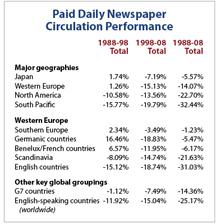
- Western circulations: In the past 20 years, circulation in Western countries has dropped more than 14%. Circulation is down the most in the South Pacific (-32%), followed by North America (-23%), Western Europe (-14%), and Japan (-6%). The Western Europe number would be down more had 5 million East Germans not been added to the count in 1991.
- Circulation peaks: North America and Western Europe both hit their circulation peaks in 1989. It is clear there was an “internet effect” after 1998 – and particularly acute in the past five years with the advent of broadband.
- Internet effect: The internet has surely impacted circulation, but trends we see today were happening before the internet. For example, circulation in North America was down 11% between 1988 and 1998, compared with a decrease of nearly 14% from 1998 to 2008. So, trends in print were pointing downward before the Digital Revolution.
- Last 5 years vs. previous 5 years: It is the numbers from the past decade that fascinate me the most. Between 1998 and 2003, circulation declined 6.5% in Western Europe; by comparison, it declined 9% between 2003 and 2008. An even starker trend can be seen in North America where circulation dropped nearly 2% in the first five years of the past decade compared with 12% in the second half of the decade. In the South Pacific, circulation declined 5% in 1998-2003 and more than 15% in 2003-2008. Circulation decreases accelerated 2-10 percentage points in the past five years in these regions.
- Stark contrasts in Europe: It should be noted that in Western Europe, where nothing is homogenous, there are stark differences in historic circulation performance that might surprise many. Whereas Southern Europe saw a 1% decline in circulation the past 20 years, the Germanic countries dropped 5%, the Benelux/French countries 6%, the Scandinavian countries nearly 22%, and the English-language countries 31%.
- English countries: The world's five predominantly English-speaking countries – Australia, Canada, Ireland, New Zealand, United Kingdom, and United States – have seen paid-for daily circulation decline 25% in the past two decades. The best performer of the lot was the United States, down 22%. This compares with the worst-performer, New Zealand, at 35%; Ireland at 33%; the United Kingdom at 33%; Australia at 32%; and Canada at 25%.
- China and India: Not surprisingly, the world's two largest countries also are the world's largest print newspaper countries: China and India. The only news was that it took until the first decade of the 21st century for circulation to catch up to population – a commentary on their histories and their rises today.
What we sometimes forget in the never-ending discussion about how to monetise “new audience” vehicles such as web sites and mobile operations is that print newspapers weren't always cash machines. In fact, they were infinitely more profitable as declining enterprises than they were as rising enterprises. It took generations of owners with different motives moving up the profitability food chain to reach the unreasonable heights of today's newspaper industry.
And so it will go as we track audiences in the decades ahead. Print will fall to its natural level, as will other audience vehicles – no doubt to be replaced by other delivery mechanisms. New vehicles take longer to commercially develop, we will come up with doomsday scenarios in the interim, and then equilibrium will get restored. It happened yesterday, it's happening today, and it will happen tomorrow.
I suppose I'll always track circulation data because it tells me a lot about where our industry has been and where it's going. It's my equivalent of keeping score by hand. The data helps me with the cultural nuances of newspapers worldwide and where different countries are in their development.
Yet as I crunch these numbers one more time, I can't help but be reminded: the audience story today is so much more than circulation.
Upcoming Events
-

Subscriber Acquisition Master Class
10-17 November 2026
-

Media Advertising Summit
New York, United States
07-10 December 2026
-

AI-Native News Product Master Class
18-25 February 2027
-

Media Subscriptions Summit
Oslo, Norway
08-12 March 2027
-

World Congress of News Media
New York, United States
25-30 April 2027
-

Branded Content & Partnerships Master Class
20-27 May 2027
-

Subscriber Retention Master Class
17-24 June 2027
-

Conferencia Latinoamericana
15-16 July 2027
-

South Asia News Media Festival
New Delhi, India
19-22 July 2027
-

Asia/Pacific News Media Summit
19-20 August 2027
-

CEO Roundtable at Kilkenny
Kilkenny, Ireland
24-26 August 2027
-

Media Innovation Week
Amsterdam, The Netherlands
27 September - 01 October 2027








