

Detroit newspapers’ reinvention more about weak days than strong days
The Earl Blog | 15 April 2009
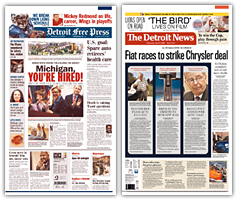 Two weeks into the Detroit Media Partnership’s transformational experiment to three-day home delivery, it’s clear we’re focusing on the wrong days of the week.
To see what I mean, go back four months when Detroit Media Partnership – the joint operating agreement between Gannett and MediaNews that that manages the business functions for the Detroit Free Press and The Detroit News – announced that it was reducing its seven-day print home delivery to its three most profitable and most read days of the week: Thursday, Friday, and Sunday.
It was an astounding admission that the cost structures governing daily newspapers were crumbling and that advertising had dropped so much that a major metropolitan market could only support home delivery of the newspapers three days per week. A new distribution model was needed.
What a loss. What a defeat.
In fact, a snapshot of the transition that began March 31 sees the potential for “victory” from the perspectives of:
- Cost reduction.
- Audience development.
- The re-introduction of small advertisers to big-city newspapers.
Other potential victories can be seen in the earliest evidence to emerge from shaking up of status quo operations.
And much of the innovation is not so much coming from the three “strong” days of home-delivered publishing that is mostly business-as-usual, but on the four “weak” days that observers and critics have largely ignored.
I visited this week with INMA member Janet Hasson, senior vice president audience development/strategy for the Detroit Media Partnership. She sees a series of affirmations and surprises after a year of discussions and planning.
Whereas the move to three days of home delivery is explicitly about reducing costs of distribution, transportation, and newsprint, Hasson notes the newsroom has been largely left intact. Said Hasson: “If you produce a great newspaper, readers will reach out.”
Background
The Michigan market is unique. Dependent on the automotive industry, the state’s economic slide started more than five years ago. As it transitions from a manufacturing base to a more diversified economy, the state's growth sectors today are government, education, and health care.
Whereas much of the United States can expect an economic upturn from today’s recession in the year, Detroit has underlying issues that make a newspaper’s recovery from a severely depressed advertising base tougher than other parts of the country.
And it’s these issues that make Michigan a test case for the Detroit Media Partnership.
Readers
On Monday, Tuesday, Wednesday, and Saturday – traditionally advertising-poor days of the week for U.S. newspapers – the Free Press and The News now publish slimmed-down “compact” single-copy editions. These “express editions” feature shorter stories, fewer jumps, and more colour that are also are better in e-edition format. Executives made tough choices to limit content in the express editions. Still in the American skinny-broadsheet style, the morning Free Press on these “weak days” is typically 32 pages in a single section while the same-sized News is in two sections with sports broken out.
Meanwhile, the newspapers have increased pagination to 80 and 116 pages, on average, on home-delivered Thursdays and Sundays, while the home-delivered Friday newspaper has increased to 44 pages.
What’s been fascinating to follow is how loyal subscribers have navigated this new terrain:
- Single-Copy: Combined single-copy sales on non-home-delivered days of the week have risen from a combined average of 129,000 pre-change to 148,000 post-change.
- E-Edition: Unique e-edition views on non-home-delivered days have risen from under 3,600 pre-change to more than 30,000 daily post-change. Demand for e-editions was so great that servers shut down temporarily on the first day.
- Subscriptions: The Sunday Free Press has maintained the majority of its 400,000 subscribers, while the Thursday and Friday newspapers have gained 40,000 subscribers because the new subscription package is forced at three days. The newspapers are ahead of projections in retaining subscribers.
What the Free Press and News have seen are dropped subscriptions from what they suspect are “people on the bubble.” For example, they have seen subscribers drop because of the change in home delivery distribution and prefer to consistently pick up the newspaper single-copy. Said Hasson: “I’ve been pleasantly surprised by how many people understand the reason we must change. Everything around them is changing. If we had done this a year ago, maybe it wouldn’t have been as successful.”
Advertisers
Both newspapers have been converted on these four days of the week to fixed-inventory models for advertising, advertising rates have been reduced to coincide with lower circulation, and they have adopted modular advertising formats. In other words, advertising costs per thousand (CPMs) will go up and down based on supply and demand – and huge fluctuations in pagination won’t be tolerated on non-home-delivered days.
Hasson said advertisers have mostly applauded the Detroit Media Partnership for their moves.
For example, the reduced advertising rates on Monday, Tuesday, Wednesday, and Saturday has opened the door for small- and medium-sized companies, and early results have seen new health care and legal advertising.
Marketing and Research
Detroit Media Partnership made major investments in marketing and research, but they did so in non-traditional ways.
For example, the partnership engaged with California-based global design consultancy IDEO to structure interviews with consumers throughout the re-engineering process – from products to communications plans. Everything was tested.
Conclusions
When the Detroit Media Partnership first announced this move four months ago, it sounded radical.
Four months later – after newspaper closures, print-to-online conversions, discontinuations of print publishing on certain days of the week, and more – the Detroit move seems almost timid by comparison.
They’re still printing a newspaper seven days a week. They realise that if they want to generate revenue, it will have to come from the print newspaper. They simply are prioritising resources where the best opportunities reside – and minimising resources where they don’t make money.
Is this radical or smart business?
The nuances of this great experiment are far more interesting than is being portrayed in the trade press and blogosphere today:
- The re-assembling of the print newspaper via express editions.
- The express editions’ fixed-inventory advertising model.
- The lower advertising structure in the express editions.
- The reader migration to print single-copy express editions and e-editions on weak days.
- The intensive testing methods in the product development phase.
What does success look like later in 2009? Hasson said retaining print subscribers and attracting new readers through express print editions, e-editions, and market buzz. And that the focus on audience will broaden the base of advertisers.
And, of course, the costs. Detroit Media Partnership is betting on that shifting resources from fuel, paper and distribution costs to investment in content and digital platforms will position the company for survival during this tough economic time and poised for growth post-recession.
As always, INMA will continue to follow this story in the months ahead.
Upcoming Events
-

Subscriber Acquisition Master Class
10-17 November 2026
-

Media Advertising Summit
New York, United States
07-10 December 2026
-

AI-Native News Product Master Class
18-25 February 2027
-

Media Subscriptions Summit
Oslo, Norway
08-12 March 2027
-

World Congress of News Media
New York, United States
25-30 April 2027
-

Branded Content & Partnerships Master Class
20-27 May 2027
-

Subscriber Retention Master Class
17-24 June 2027
-

Conferencia Latinoamericana
15-16 July 2027
-

South Asia News Media Festival
New Delhi, India
19-22 July 2027
-

Asia/Pacific News Media Summit
19-20 August 2027
-

CEO Roundtable at Kilkenny
Kilkenny, Ireland
24-26 August 2027
-

Media Innovation Week
Amsterdam, The Netherlands
27 September - 01 October 2027








