

Creator journalism is a medium, not a personality type
Conference Blog | 13 September 2026

The news industry has spent three years arguing about whether creators are competitors, collaborators, or a category error. Thursday’s opening module of INMA’s Young Audiences Summit suggested the argument itself is the problem.
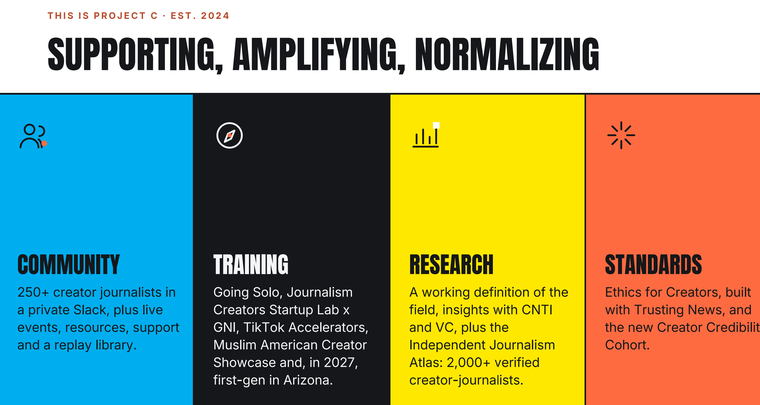
“Creator and influencer are marketing terms,” said Liz Kelly Nelson, founder of the U.S. creator-journalism community Project C. “The creator ecosystem is a medium in the same way print or broadcast are.”
The three-module virtual summit, curated by INMA Young Audiences Initiative Lead Kerstin Hasse and made free to members through the support of Knight Foundation, drew nearly 360 registered participants from more than 200 companies in 43 countries.
Hasse opened with the numbers that make the topic urgent. Citing the Reuters Institute Digital News Report 2026, she noted 27% of people globally now get news from creators, and 51% say they trust individual creators more than established news brands. In France, the YouTube-born HugoDécrypte reaches 28% of under-35s — more than Le Monde.
Publishers have noticed: 76% want their newsrooms to be more like creators and 79% plan to prioritise video. Yet 70% worry creators are stealing their audiences’ attention. The creators themselves are not getting rich: only three in 43 independent creator journalists say they can live from their work.
A five-point test — and a business model
Nelson, who spent 25 years at The Washington Post, USA Today, and Vox, offered a five-point test for a creator journalist:
- They produce journalistic work.
- They usually cover a niche rather than general news.
- They are a trusted messenger for a loyal audience.
- They work independently of a traditional news organisation.
- And they leverage the creator economy to build a sustainable career.
That fourth point prompted the day’s liveliest exchange. Hasse pointed to Johanna Rüdiger, who works full-time for Deutsche Welle while building a large Instagram following of her own. A creator journalist? Yes, Nelson said — for the work outside the Deutsche Welle umbrella. A star reporter monetised through a newsroom’s existing infrastructure “is just doing personality-driven journalism inside a newsroom. It’s valuable, but it’s not the same category.”
Creator journalism, she argued, “is a business model and a distribution model. It is not a beat, and it is not a synonym for news influencer.” News influencers — “anybody with an iPhone who can get in front of a green screen” — are “the opinion section of the Internet.”
Her advice to publishers came in three parts:
- Invest in in-house marquee talent — “Who is your Ezra Klein?” — and solve retention with bonuses and revenue shares so they do not walk out the door.
- Partner with creators editorially rather than defaulting to marketing deals: “If you are in a city that has an independent creator journalist already doing incredible coverage of the arts, rather than hiring an arts reporter, can you partner with them?”
- Find a niche, resourced as “an entrepreneurial unit tasked with finding success on this new platform.”
She cited MLK50 in Memphis, whose creator-in-residence partnership grew TikTok and Instagram engagement by 660%; the Houston Chronicle, which paired its food team with food creators and now runs a cross-functional creator programme; CalMatters’ Creator Circle; and The Washington Post’s creator network, built outside the newsroom.
The appetite is there. Hasse’s own study found 95% of creator journalists want to collaborate with traditional media, but only 20% feel taken seriously by them. Nine in 10 would love an editor, a producer, or a legal team. “They just can’t afford it,” Nelson said. “What institutional media can do is bring the institution to that relationship.”
Young audiences are not disengaged — they are dosing
Sofia Bliss-Carrascosa of Knight Foundation brought the consumer’s view — her own. Born after 9/11, she described a feed in which public-health experts and a current-events meme page told her about a recent U.S. foodborne illness outbreak before any legacy news notification did. “The first person that has told me that this thing happened is my meme page,” she said. Then she goes to legacy apps to fact-check it.
Her central point is that the institution is no longer a sufficient credential. Citing the Pew-Knight Initiative, she noted Americans aged 18 to 29 trust national news outlets about as much as social media. “You’re starting on a level playing ground.”
Creators, she said, make trust explicit where newsrooms leave it implicit — stating their credibility up front, building affinity in comments and DMs, and being transparent about their values and biases.
Bliss-Carrascosa pushed back hard on the news-avoidance narrative. Reuters found 18- to 24-year-olds are no more likely to be news avoiders than anyone else under 55. A generation for which “everything I’ve lived through has pretty much been called unprecedented” has learned to dose information in tolerable loads. “That is interpreted as disinterest or disengagement, when in reality it’s making sure you’re consuming an amount of information that is tolerable for you.”
Nor is it a young-people problem: 49% of all U.S. adults mostly get news because they happen to come across it.
A five-hour live channel built in a bedroom
Nicolás Copano, creative director of Turno Media, set out to launch an FM station in Chile, where every frequency is taken. Instead, inspired by CNN’s small breaking-news room in Atlanta and the look of video-game livestreams, he built a studio in his house during the pandemic.
Turno is now, by Copano’s account, Chile’s most-watched streaming channel: five hours live every weekday morning on YouTube, a team of 20, more than 105 million views in 2025, a 3,000-member WhatsApp community, and no Web site. “We don’t just have followers,” he said. “We have emotional shareholders.”
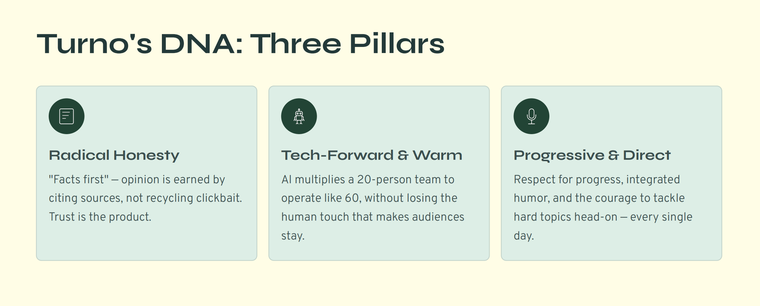
Revenue comes from YouTube ads, memberships at US$5 to US$20, sponsors, and events. AI handles tagging, metadata, and bulk clip production for a “sushi video strategy” that places small pieces on every platform. His advice was blunt: don’t over-produce. “The biggest learning is control the cost.”
In her closing takeaways, Hasse reframed the day: The question is no longer “is this person a creator?” but “are they doing journalism, and what kind?” The shifts are not confined to Gen Z — The Economist, which does not byline its writers, now puts its journalists on camera. And the real opponent is not creators but misinformation and “AI slop.”
The INMA Young Audiences Summit continues Tuesday, September 15, and Thursday, September 17. Recordings are available on demand to INMA members.
Upcoming Events
-

Subscriber Acquisition Master Class
10-17 November 2026
-

Media Advertising Summit
New York, United States
07-10 December 2026
-

AI-Native News Product Master Class
18-25 February 2027
-

Media Subscriptions Summit
Oslo, Norway
08-12 March 2027
-

World Congress of News Media
New York, United States
25-30 April 2027
-

Branded Content & Partnerships Master Class
20-27 May 2027
-

Subscriber Retention Master Class
17-24 June 2027
-

Conferencia Latinoamericana
15-16 July 2027
-

South Asia News Media Festival
New Delhi, India
19-22 July 2027
-

Asia/Pacific News Media Summit
19-20 August 2027
-

CEO Roundtable at Kilkenny
Kilkenny, Ireland
24-26 August 2027
-

Media Innovation Week
Amsterdam, The Netherlands
27 September - 01 October 2027








