

Starting late can be an advantage if you copy fast
The Distillation Blog | 25 September 2026

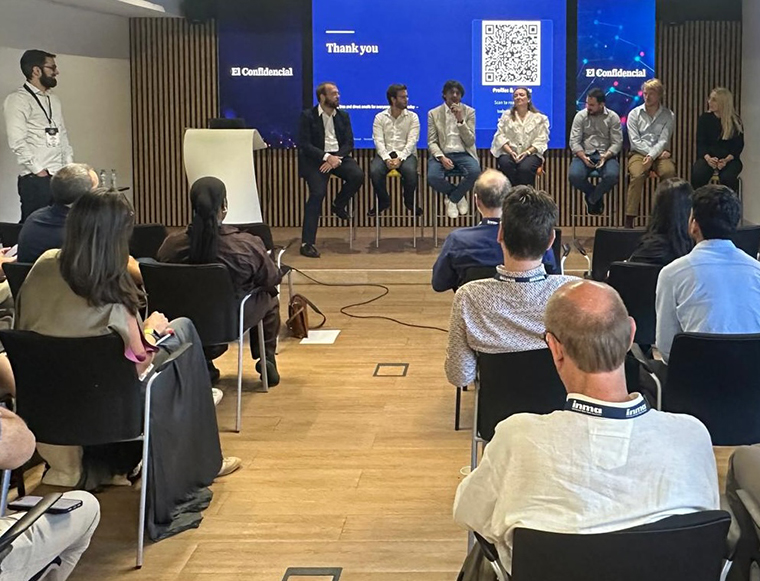
I am writing this in real time from Madrid, between sessions at INMA Media Innovation Week, where more than 260 delegates from 28 countries have spent three days inside Spanish media companies and are now halfway through the European News Media Conference. This conference has an ethos: 37 media company case studies, explaining what they did and what it returned. It is INMA’s most practical event of the year.
Madrid supplies the thesis. Before late 2019 there were effectively no national paywalls in Spain. Trust in news sits at 33%, roughly one Spaniard in 10 pays for online news, and direct visits to news sites run 10 points below the European average. Yet Madrid’s publishers built a million-subscription economy in six years. PRISA’s chair, Joseph Oughourlian, has said being so far behind meant the group barely had to deliberate over priorities. Spain copied what had been proven.
Four directions inside INMA, one storyline:
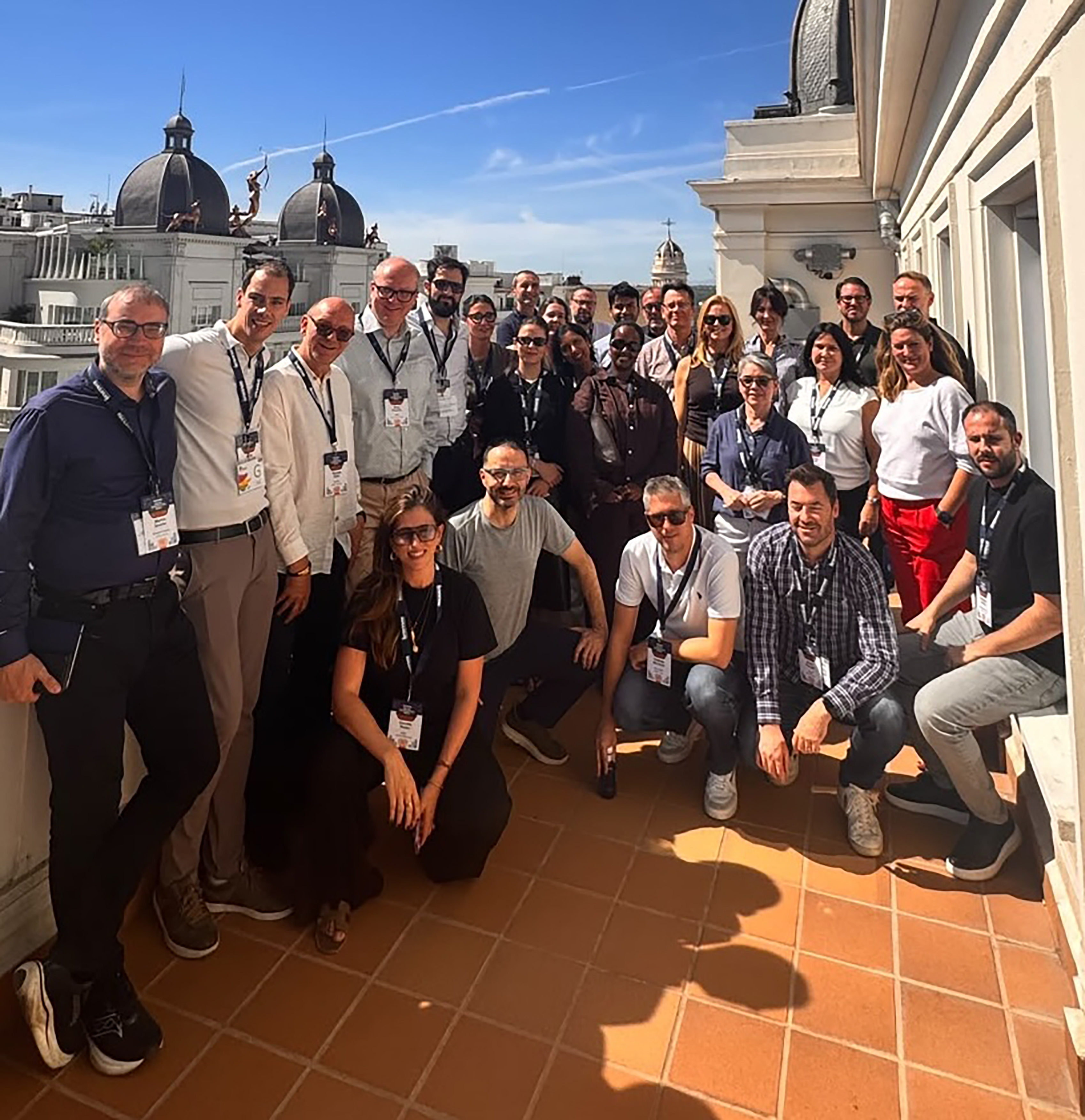
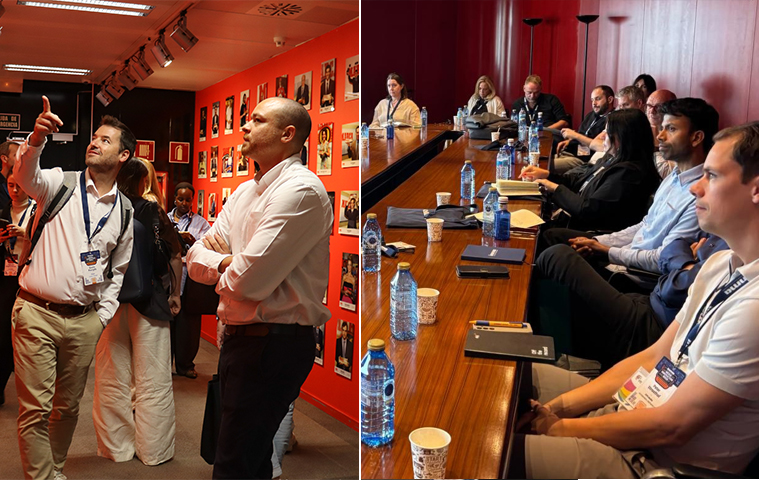
- INMA Spanish Media Study Tour: Greg Piechota and Gabe Dorosz took 25 delegates into eight Spanish media companies, from PRISA to Vocento.
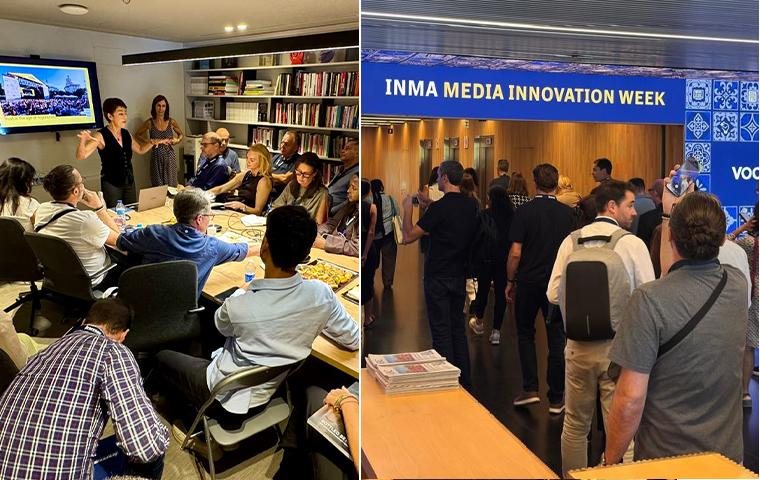
- INMA European News Media Conference: Pilar Gil on PRISA’s Americas plan, Monocle, NTM, DPG Media, the first Spanish data on AI Overviews, and Kerstin Hasse and Sonali Verma busting newsroom fears with cases from six continents.
- INMA Readers First Initiative: Greg’s Subscription Benchmarks meet-up in Madrid and his blogs on three myths of engagement and on a car factory.
- INMA blogs: Sonali on usefulness, Kerstin’s creator journalism series and Chile’s Turno.
The insight: The advantage of arriving late is that the answers already exist. It disappears the moment you stop copying and start deliberating.
What Madrid copied
The Madrid study tour was a tour of imitation — in a good way. El País launched its paywall in 2020 and has 490,000 subscribers, almost 30% outside Spain, on a plan that calls for 800,000 by 2029. Unidad Editorial has passed 350,000 across El Mundo and Expansión, growing 20% a year. Vocento is at 190,000 digital-only and targeting 320,000.
Each number has a borrowed idea behind it. El Mundo handed its paywall to an algorithm in early 2025 — no human decides what is locked, about half of article page views are paywalled, conversion more than doubled. El País drew 40,000 readers to a three-day festival for its 50th anniversary, and elDiario.es borrowed its summer festival, now 20,000 strong, from La Repubblica and Le Monde. What elDiario.es did not copy was its membership model, 123,000 members strong, which predates The Guardian’s.
One thing nobody copied. Marca claims a billion page views a month, more than El País, El Mundo, and AS combined, and has no paywall; neither does AS. In what AS’s Tomás de Cos calls the most competitive sports market in the world, locking content hands the audience to rivals, so AS sells scale: 3.5 billion social video views in July, social revenue doubled this year.
The insight: Spain’s subscription decade took six years because the mistakes had been made elsewhere. If your paywall, festival, or bundle is still an original experiment in 2026, you are paying tuition somebody else already paid.
What Madrid invented
Three things in Madrid are not copies, and none is technology.
The first is independence written into the balance sheet. elDiario.es is 70% owned by its team and caps any advertiser or grantor at 10% of revenue. El Confidencial, founder-owned since 2001, keeps €17 million in equity so it can publish for a year with no revenue at all — built after the government pulled about €1 million a year in advertising following its exclusives on the prime minister’s circle. It counts lawsuits as a KPI. Maldita.es, a fact-checking foundation, funds itself partly through a for-profit technology company it owns, with 30 clients in 15 markets. In a market where the government is the third-largest advertiser, that is not idealism. It is risk management.
The second is a business model for after the traffic. El Confidencial has lost close to half its traffic in a year to AI Overviews, AI Mode, and Discover. Its answer is arithmetic: One million readers who return every month are 7% of its audience and 70% of its business. “We are not in the traffic business,” said COO Alejandro Laso. “We are in the returning-reader business.”
The third is efficiency. Marca turned a meeting room into a social video studio for €1,000, most of it soundproofing, and its music brand Noise — three twenty-somethings — paid for its year with two branded campaigns. PRISA bought PostUnited, a youth football social brand, and grew it from 14 million to 50 million followers in four months. And La Voz de Galicia can say that nobody in Galicia lives more than 25 kilometres from one of its journalists.
The insight: The Spanish inventions are about who owns the company and what things cost, not what tools it uses. Those are decisions a board can copy without a technology budget.
The conference: seven minutes, one idea
NTM in Sweden made its journalism free for everyone under 25 — a deliberately cumbersome sign-up that verifies age and takes payment details, an automatic step to 50% off at 25 and full price at 30. After 18 months, the under-25 base is up 400%, cannibalisation is 2.5%, 35% of those who aged out are paying, and 90% of sign-ups were people the company had never met.
Jonas Lips of DPG Media makes a 50-second vertical in 20 minutes, and two people produce 12 to 14 a day for HLN and VTM Nieuws. A free student subscription fronted by Lips drew 50,000 sign-ups in a day.
Beobachter made personal finance irresistible to 25-year-olds with street-interview videos and a finite, seasonal newsletter promising to save readers 100 francs: a 67% unique open rate and 85% of readers still there at the end. Funke’s social-only Hamburg brand hires by video rather than cover letter and spent six months building community before selling a thing. elDiario.es answered a survey in which almost two in five Spaniards under 24 would accept a somewhat undemocratic regime with “Factos Franquistas”: 10 myth-busting verticals made in two weeks with two influencers, more than half the views from 18- to 34-year-olds.
Brand had its own run of cases. Blick treated trust as a hygiene factor for a tabloid and built its campaign on the same story felt from two sides — the Bitcoin high for the holder and for the one who missed it — lifting trust and entertainment scores at once. Aller Media interviewed 4,000 Nordic women and turned one report into a campaign against the “thin algorithm,” new partnerships, and 50-plus articles by other media. InnovateMedia sponsored a start-up contest with a strategy workshop instead of ad space, and won a client. Euractiv, rebuilt by Mediahuis, sells B2B subscriptions to named newsletters through six salespeople and no online checkout; its upsell trigger is the ratio of opens to deliveries.
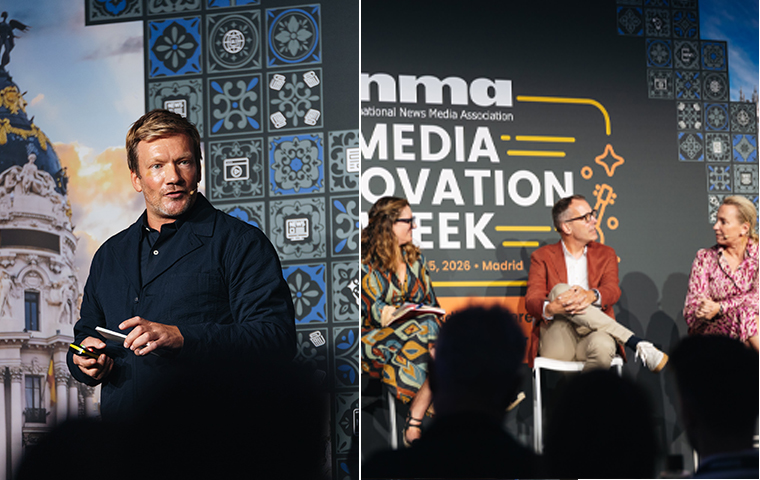
Monocle’s Anders Braso asked the room to learn from luxury rather than tech — “nobody needs Chanel” — and offered a test: Remove the logo and see whether people still recognise you. The INMA European Board’s panel produced the week’s most telling number. Asked where they would put their entire 2027 budget, 39% of the room said brand. Asked who is actually planning to invest in brand next year, one hand went up.
The insight: Every one of these ideas can start in a month and be measured in a quarter. That is the selection criterion for this stage.
The ghosts, and what busts them
Kerstin and Sonali took the stage on Thursday as ghostbusters, polling the room on its fears and answering each with a case from somewhere else:
- Fear of the newsroom rejecting AI: A Norwegian group got half of 600 journalists using it within a year by solving concrete problems and having journalists train journalists.
- Fear of not knowing where to start: iTromsø, with 20 staff, ran an agentic pipeline through the data for an Airbnb investigation while reporters did the interviews, and Mediacorp’s “Snack Bot,” trained on its 500 best social videos, now coaches reporters’ vertical-video pitches into near-daily million-view clips.
- Fear of irrelevance beside an answer engine: Nation Media Group uses AI “red and green signals” to steer reporters off commodity news; The Times cut story output by 25% and posted record audience growth; the Toronto Star reopened comments, moderated by AI and answered by journalists, and commenters subscribe more.
- Fear that audiences stay on the platforms: Mediahuis built Spill News outside its legacy brands so it could be “breakable,” and the Boston Globe’s B-Side newsletter was never meant to drive traffic — it monetises through advertising and US$30 ticketed dinners.
- Fear that they have stopped reading: The Economist took vertical video from TikTok into its app and, this summer, into a tier, Economist Plus.

Tamedia auto-generated hyperlocal articles from crawled sources and averaged five readers each. The Irish Times sold events as inventory with no metrics. NTM launched a TikTok-style local app too early. The remedy in every case was the same: Ask what the user needs first.
The insight: None of these companies is Spanish, and every one of these fixes was copied in Madrid by 260 people with notebooks. The fear is original. The cure never is.
Pilar Gil and the advantage nobody can copy

Pilar Gil, chief executive of PRISA Media and a member of the INMA Board of Directors, closed Wednesday with the plan she set on taking the job 16 months ago: four verticals, radio turned into a live business of roughly 2,000 events a year and 60 million downloads a month, and the Americas as the growth engine — from one subscriber in six today to 30% of an 800,000 base by 2029, with a senior hire from The New York Times and the anchor Jorge Ramos for El País U.S. Her closing line aligned PRISA with The New York Times on AI: Platforms will not extract its journalism “with impunity.”
The insight: Everything else in Madrid can be copied. The 600 million Spanish speakers cannot. Ask what your equivalent is — the language, the region, the archive — before you spend a euro on tactics.
The cliff arrives late, too
Spain is also late to the search cliff, and this week we saw its timetable. Clara Soteras’s refreshed study of Spain’s five biggest news sites found AI Overviews on roughly half of tested queries in July, up from 30% in November 2025. Vocento’s analysis of two million ABC keywords found that where AI answers appear, they produce zero clicks 91% of the time — but they surface on only about 6% of Spanish news queries, against roughly half in the UK. “All Google has to do,” said its chief digital officer, “is press the button.”
The headlines INMA followed for members this week describe what the button does. Sonali flagged Chartbeat data in Axios: 40% of desktop visitors to publisher sites no longer scroll at all. Business Insider’s new chief told staff the traffic model that built the company is over. McClatchy laid off more than 90 unionised journalists across 17 titles while expanding an AI “content scaling agent.” Google began paying publishers whose content shapes AI Overviews, in sums one executive called “peanuts.” And seven executives scored Google’s court-ordered ad tech remedies for Digiday at five out of 10 — “far from a clean win.”
The insight: The countries behind on the cliff get to watch the ones ahead. Spain has somebody else’s data and is spending the time on registration walls and returning readers. That is the late-starter’s advantage, applied a second time.
Repertoire, usefulness, and the person
Greg’s Subscription Benchmarks meet-up in Madrid worked with the 318 brands benchmarking with INMA on one question: where profitable growth comes from as audiences shrink. Across the 2019-2025 data, superior acquisition had a stronger link to subscriber growth than superior retention, but aggressive acquisition is penalised by higher churn. And the winning combination of tactics in INMA’s growth models produces 70% more revenue in year three than holding course.
Greg’s blog on three myths explains why the experiment should be copied rather than invented. You do not own your loyal audience: The median reader spends three minutes and 14 seconds on one of three monthly visits, 66% of news users draw on five or more sources, and 73% reached news last week through a side door. New habits take 59-66 days to form, so join a routine rather than propose one — start with e-mail. His second blog, from BMW’s Oxford plant — 1,200 robots, 200 people, 800 cars a day — ends with a guide who lived through two waves of automation: “When technology changes, you change the way you work with it, too.”
Sonali’s blog supplies the editorial test, from The Inquirer’s Arlene Burgos: “If this story succeeds, what will the audience know, feel, or be able to do that they could not before?” At Maeil in Seoul, three AI agents turn the newspaper into a briefing, an investing co-pilot, and a tutor, and AI builds the daily podcast from eight of 150 articles, checked by a journalist.
Kerstin’s Young Audiences blogs keep the person in the frame. Liz Kelly Nelson’s definition — the creator ecosystem is a medium, the way print and broadcast are — comes with a fact for a board slide: 98% of the United States’ top 50 creator journalists launched after the pandemic began. And Nicolás Copano’s Turno, Chile’s first streaming news channel, runs five live hours a weekday with 20 people and drew 105 million views last year. His rule: Never spend your budget.
Meanwhile, Kerstin brought the first INMA Young Audiences cohort to Madrid — the people doing the work.
The insight: If two-thirds of your readers use five sources, originality is not the moat. Execution is. The benchmarks, the blogs, and the case studies exist so you can copy the execution.
What it means for your company
Distil the week, and you get three sentences:
- Spain built a million-subscription economy in six years by copying what worked and skipping what did not.
- What Madrid invented — independence on the balance sheet, a returning-reader P&L, a €1,000 studio — are decisions about ownership and cost, not technology.
- The search cliff reaches every market on a delay, and the delay is the only free resource you will get.
Three decisions for this month: Name the three proven ideas from this week your company will copy before December, with an owner and a metric for each. Put a returning-reader figure — the 7% who are 70% — on the executive dashboard next to traffic. And work out what it would take to make your under-25s free.
Which leaves one question for your executive team: If a market with 33% trust and one payer in 10 can build a million subscriptions in six years by copying what works — what, exactly, is your company still trying to invent?
The Distillation is INMA’s weekly read on where the news business is going based on our content. Available as a blog, a newsletter, and a podcast.
Upcoming Events
-

Subscriber Acquisition Master Class
10-17 November 2026
-

Media Advertising Summit
New York, United States
07-10 December 2026
-

AI-Native News Product Master Class
18-25 February 2027
-

Media Subscriptions Summit
Oslo, Norway
08-12 March 2027
-

World Congress of News Media
New York, United States
25-30 April 2027
-

Branded Content & Partnerships Master Class
20-27 May 2027
-

Subscriber Retention Master Class
17-24 June 2027
-

Conferencia Latinoamericana
15-16 July 2027
-

South Asia News Media Festival
New Delhi, India
19-22 July 2027
-

Asia/Pacific News Media Summit
19-20 August 2027
-

CEO Roundtable at Kilkenny
Kilkenny, Ireland
24-26 August 2027
-

Media Innovation Week
Amsterdam, The Netherlands
27 September - 01 October 2027








