

A 37-day shutdown revealed the depth of Nation Media Uganda’s audience loyalty
Conference Blog | 06 October 2026

Audience loyalty is easy to measure when everything is working: Readers visit, viewers tune in, subscribers renew, and advertisers keep spending.
But what happens when a media organisation suddenly disappears from the platforms its audiences rely on?
For Nation Media Group (NMG) Uganda, that question became real when its operations were shut down for 37 days. Print, television, and radio operations were affected, forcing NMG to rethink how it stayed connected with audiences, employees, advertisers, and other stakeholders.
Hajara Batuuka, head of marketing at NMG, shared with attendees of last week’s INMA Africa Audience Development Summit what the disruption revealed about resilience, trust, and, ultimately, what it takes to bring audiences back after their routines have been broken.
Immediate priorities
When NMG’s usual operations were interrupted, the immediate priority was finding alternative ways to keep as much of the business running as possible.
Its distributed office network proved valuable: one location connected to its courier business remained available for physical work. An existing remote-work policy allowed employees to continue working from home, while teams later used offsite digital production to livestream news and other programmes. The e-paper also returned before physical newspaper distribution, giving subscribers another route back to NMG’s journalism.
Commercial continuity was equally important. Staff continued contacting customers and collecting outstanding payments, while the courier business remained fully operational. Internally, virtual staff meetings, weekly management check-ins and wellness sessions helped employees stay connected throughout the shutdown.
For Batuuka, the experience sharpened NMG’s understanding of what resilience actually requires.
“And the lesson we learned was obviously that resilience is a mix of having a big distribution network, existing digital capability, and of course, your team being able to adapt to new ways of working,” she said.
Audience response
But the shutdown did more than test NMG’s operations. It also gave the organisation something media companies rarely experience: a clear view of how audiences respond when a familiar news brand suddenly disappears.
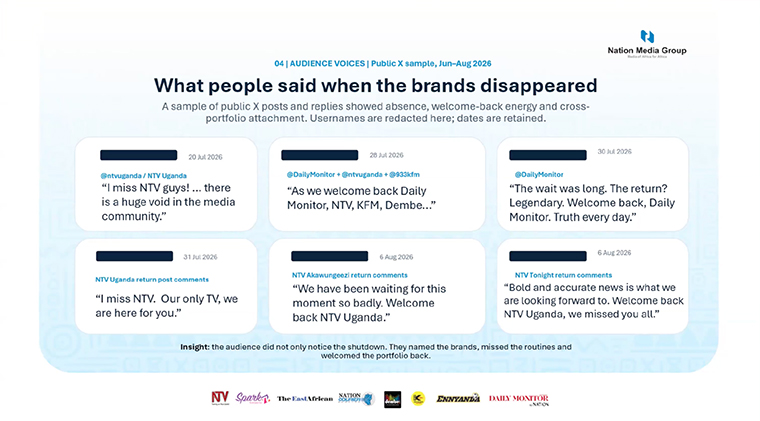
Messages began arriving from people saying they missed NTV and were waiting for its return.
“It's because we've built trust over time as Nation Media Group,” she said. “So each brand has been able to build trust in its own audience.”
NMG’s Daily Monitor, for example, carries the tagline “Truth Daily.” Consistently delivering on such brand promises helped establish the trust that became visible during the shutdown, Batuuka said.
When NMG returned, audiences returned with it.
The company also discovered that its absence was felt well beyond its consumer audience. Batuuka said NMG was missed by government stakeholders, businesses and corporate clients as well as ordinary readers and viewers.
That offers a useful way of thinking about loyalty. Metrics such as reach, subscriptions and engagement can show how frequently audiences use a product. A disruption can reveal something harder to quantify: whether that product has become part of people’s routines, and whether they notice when it is gone.
That made NMG’s return more than a simple reopening.
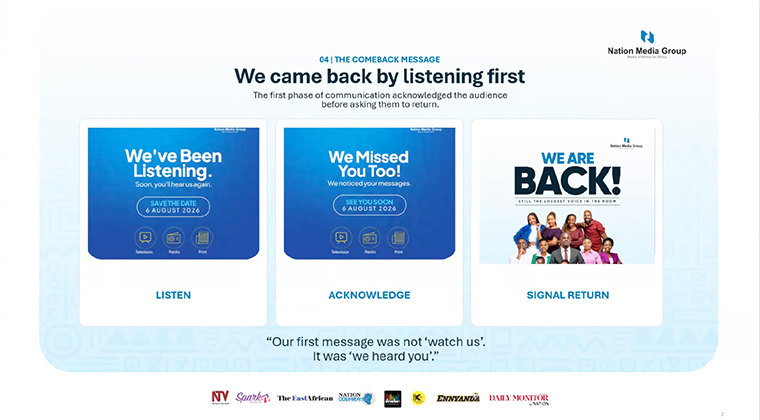
The company did not assume that restoring its platforms would automatically restore old habits. Instead, it treated the comeback as a deliberate audience-rebuilding exercise.
The first step was listening to what people had been saying during the shutdown, acknowledging that NMG had missed its audiences too, and communicating its return in phases.
As digital operations resumed, NMG told audiences where they could find livestreams and programming online, including on YouTube. When studio operations returned, it communicated that milestone again.
Corporate relationships required the same level of attention. Teams reached out directly to clients, reassured them about consistent delivery, and addressed losses experienced during the disruption.
One of the most visible parts of the comeback, however, happened offline. NMG staff went onto the streets and sold newspapers themselves.
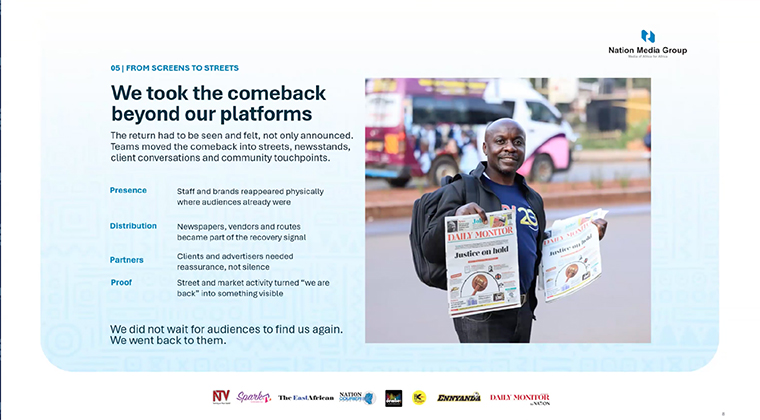
“So that was also proof that to the country that we were honestly back,” Batuuka said.
The organisation also adjusted its programming during its first week back and shared behind-the-scenes accounts of what employees had experienced during the shutdown. Rather than simply announcing its return, it brought audiences into the story of that return.
Rebuilding momentum also meant rebuilding habits.
After more than a month away, audiences had inevitably adapted. NMG therefore focused on reminding people of the programmes they had previously watched or listened to and encouraging them back into familiar routines.
The group promoted popular shows and enlisted its on-air talent to speak directly to followers through their own social media accounts, telling audiences they were back on television and radio and inviting them to return.
It also explored other ways to strengthen a sense of belonging, including branded merchandise linked to an anniversary and events that brought audiences closer to its brands.
For publishers, this highlights an often-overlooked dimension of loyalty. Audiences do not necessarily return simply because content is available again. Media consumption is habitual, and once a routine is interrupted, publishers may have to actively rebuild it.
As Batuuka put it, “consistency and routine does matter as we are building loyalty.”
Digital + physical presence
Another key lesson from NMG Uganda’s experience was that digital capability and physical presence were not competing strategies. Both mattered, and they often reinforced each other.
Digital tools were critical to maintaining operations and reconnecting with audiences. But Batuuka stressed that in Uganda, face-to-face relationships still carry considerable weight.
“Physical presence in Uganda still matters. It matters as much as that digital element is growing rapidly, but the physical presence connecting with our customers, the stakeholders on a one-on-one basis,” she said.
That combination shaped NMG’s recovery: livestreams alongside roadside newspaper sales, social posts alongside direct conversations with clients, and digital distribution alongside events and physical engagement.
Ultimately, the shutdown provided NMG Uganda with an unusually clear test of the relationship between a media brand and its audience.
News builds trust, but loyalty extends beyond news alone, Batuuka said. Health, entertainment, and other content help create a broader ecosystem in which audiences feel valued and listened to, encouraging them not only to consume content but to participate, engage, and spend with the brand.
The broader lesson is that audience loyalty is not created at the moment it is tested. It is built gradually through consistent journalism, trusted brands, reliable routines, and multiple points of connection.
Banner photo: Adobe stock image by Dilok.
Related Articles
-

Arena Holdings learns reaching millions isn’t the same as servi...
8 October 2026 -

Nine Publishing sees AI licensing as an audience strategy
5 October 2026 -

3 newsroom strategies to counter Facebook demonetisation
3 September 2026 -

Prothom Alo’s World Cup content flywheel engages millions
31 August 2026 -

At Mediacorp’s CNA, loyalty means giving audiences a reason to ...
20 August 2026 -

Milenio builds loyalty infrastructure with gamification, data, ...
23 July 2026 -

Investment games surge at news companies, highlight audience pa...
16 July 2026 -

News Corp Australia’s Dear Rachelle podcast reignited hope whil...
13 July 2026
Upcoming Events
-

Subscriber Acquisition Master Class
10-17 November 2026
-

Media Advertising Summit
New York, United States
07-10 December 2026
-

AI-Native News Product Master Class
18-25 February 2027
-

Media Subscriptions Summit
Oslo, Norway
08-12 March 2027
-

World Congress of News Media
New York, United States
25-30 April 2027
-

Branded Content & Partnerships Master Class
20-27 May 2027
-

Subscriber Retention Master Class
17-24 June 2027
-

Conferencia Latinoamericana
15-16 July 2027
-

South Asia News Media Festival
New Delhi, India
19-22 July 2027
-

Asia/Pacific News Media Summit
19-20 August 2027
-

CEO Roundtable at Kilkenny
Kilkenny, Ireland
24-26 August 2027
-

Media Innovation Week
Amsterdam, The Netherlands
27 September - 01 October 2027








