

Investment games surge at news companies, highlight audience participation
Digital Subscriptions Blog | 16 July 2026

Across Europe and North America, financial publishers are turning to investing competitions to strengthen reader relationships, support financial literacy, build communities, and encourage readers to return every day.
Yet the most valuable lesson may have little to do with investing at all. The real story is how publishers are rethinking audience engagement.

Rather than relying on content alone, they are creating experiences that encourage participation, habit, and long-term relationships.
Whether you are a financial publisher, a national newspaper, or a local news organisation, the underlying challenge remains similar: How do you transform audience interaction into a long-term relationship?
This article explores how publishers are using one initial experience — in this case, a stock market game — as the starting point for a broader engagement strategy.
While a game may attract attention, it is the surrounding ecosystem of content, tools, events, communities, and follow-up experiences that ultimately determines whether readers return. Having worked with publishers across Europe and North America, Norkon analysed participation and engagement patterns from more than 100,000 portfolios to identify audience behaviours and engagement trends.
What recent investing competitions reveal about publisher engagement
Looking across recent publisher initiatives, one pattern becomes clear: Investing competitions are no longer isolated experiments. They are increasingly being used as part of broader audience engagement strategies.
The recent Financial Times launch is one example of this wider movement. Over the past six months alone, similar initiatives have also been introduced by publishers in Canada, Belgium, the Netherlands, Denmark, Estonia, Latvia, and Lithuania.
For decades, publishers competed primarily through content. Today, many are complementing journalism with experiences encouraging readers to participate rather than simply consume. That shift can take many forms, from events and communities to newsletters, podcasts, educational initiatives, and interactive experiences.
Although the format is similar, the objectives differ. The Financial Times introduced a subscriber-exclusive experience, Verslo Žinios focused on market discovery, Äripäev integrated its competition into a broader investor ecosystem, and Roularta supported participants through educational content and editorial portfolios for new investors.
While objectives vary, each initiative is built around the same principle: active audience participation.
Together, these examples illustrate that the real innovation is not the game itself but the growing recognition that meaningful audience engagement increasingly comes from combining journalism with participatory experiences.
The growing popularity of such interactive experiences reinforces a broader trend across publishing: Readers increasingly expect experiences built around content, not just content itself.
The bigger lesson: the game is not the strategy, but a stepping stone
The strongest lesson emerging from these initiatives is that the game itself is not the destination but the gateway to a broader audience journey. While a competition can generate attention, registrations, and repeat visits, the most successful publishers are those that connect the experience to a wider journey.
Äripäev, part of the Bonnier Group, provides one of the clearest examples. Its competition is embedded within a broader investor ecosystem that includes editorial coverage, community initiatives, Nasdaq events, and the annual Investor Festival, creating multiple touchpoints before, during, and after the game itself.
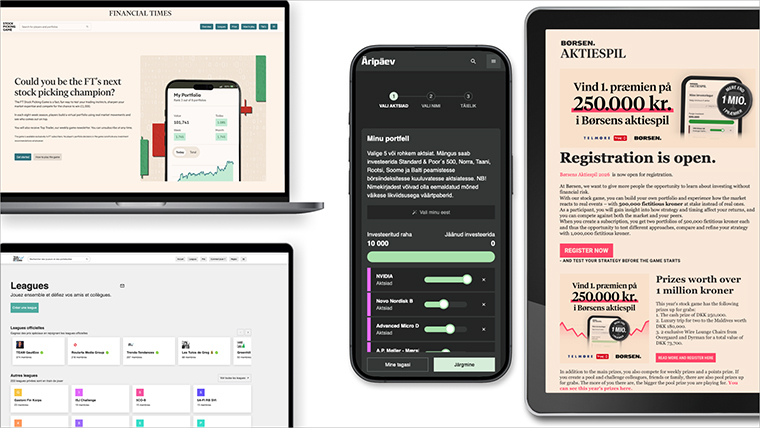
This reinforces a broader lesson: The strongest audience relationships are rarely built around a single product, but around a connected ecosystem of experiences that helps readers discover, understand, follow, and act on the topics that matter to them.
The more closely an initiative is connected to a publisher’s broader ecosystem, the greater the likelihood of long-term engagement.
What 100,000+ portfolios reveal about investor behaviour
The portfolios created by each participant reveal a different set of insights.
Across the competitions analysed over the past 10 months, technology stocks dominated trading activity. NVIDIA consistently ranked as the most-traded stock regardless of geography. Other recurring names included Microsoft, Alphabet, AMD, Micron Technology, and ASML.
At the same time, local champions continued to play an important role. Scandinavian investors frequently selected Novo Nordisk. Dutch and Belgian participants favoured Adyen and ASML. Canadian players showed strong interest in domestic energy and resource companies, while Swiss audiences consistently gravitated toward household names such as Nestlé and Holcim.
The result is a mix of global enthusiasm for technology and local market familiarity.
For publishers, this data provides a unique lens into audience interests that traditional analytics alone cannot offer. While article consumption shows what readers read, portfolio decisions reveal what readers care enough to act on, whether influenced by market momentum or careful analysis.
It also highlights how participation can create new pathways into journalism. Readers who select a company are more likely to follow related earnings announcements, market movements, and editorial coverage. The competition becomes more than a game; it becomes a gateway into financial content.
The bigger picture
The most interesting takeaway is not that publishers are launching stock market games per se, but what those initiatives reveal about audience behaviour.
Whether the goal is subscriber engagement, financial literacy, community building, or audience insight, interactive initiatives such as investing competitions give readers an opportunity to participate rather than simply observe.
Yet the most successful interactive experiences are those creating deeper engagement and new pathways into journalism by connecting readers to a wider ecosystem of content, newsletters, podcasts, events, and communities.
While investing competitions provide the example explored here, the principle extends beyond financial journalism. It reflects a broader shift in publisher strategy: creating experiences that invite audiences to participate, return, and build lasting habits over time.
Banner image: fotofabrika
Related Articles
-

WSJ executive councils show how publishers build communities th...
19 October 2026 -

AI’s effect on super user math
15 September 2026 -

At Mediacorp’s CNA, loyalty means giving audiences a reason to ...
20 August 2026 -

Tribun Network turns print “dots” into AI-powered insight
20 August 2026 -

Indian Express builds a video-first future around trusted journ...
20 July 2026 -

Economist launches subscription tier targeting younger audience...
20 July 2026 -

Grupo RBS builds social-first video operation to expand audienc...
20 July 2026 -

Inside Denník N’s successful subscription strategy
15 July 2026
Upcoming Events
-

Subscriber Acquisition Master Class
10-17 November 2026
-

Media Advertising Summit
New York, United States
07-10 December 2026
-

AI-Native News Product Master Class
18-25 February 2027
-

Media Subscriptions Summit
Oslo, Norway
08-12 March 2027
-

World Congress of News Media
New York, United States
25-30 April 2027
-

Branded Content & Partnerships Master Class
20-27 May 2027
-

Subscriber Retention Master Class
17-24 June 2027
-

Conferencia Latinoamericana
15-16 July 2027
-

South Asia News Media Festival
New Delhi, India
19-22 July 2027
-

Asia/Pacific News Media Summit
19-20 August 2027
-

CEO Roundtable at Kilkenny
Kilkenny, Ireland
24-26 August 2027
-

Media Innovation Week
Amsterdam, The Netherlands
27 September - 01 October 2027








