

AI’s effect on super user math
Product & Tech Initiative Blog | 15 September 2026

My colleagues Gabe and Greg (heads of the INMA Advertising Initiative and Readers First Initiative, respectively) recently made a compelling case for super users — the small group of highly engaged people who generate a disproportionate share of traffic, subscriptions, and revenue. For online paid subscribers in news this 1% drives 27% of pageviews (according to INMA Subscription Benchmark Services).
Their argument is attractive because it reflects how many successful consumer businesses work. A relatively small number of customers often account for a large share of value. Find those people, understand not only who they are but why they value you, and use that insight to serve them — and more people like them — better.
That 1% clearly matters to today’s business. Gabe would go further on advertising: Publishers should serve their most engaged, identifiable users more deliberately, rather than treating advertising as something that disappears when someone subscribes. Super users visit often, develop habits, respond to new products, and are more likely to pay. They are also easier to learn from because their behaviour produces strong signals.
For a publisher facing immediate revenue pressure, concentrating product development, personalisation, and retention efforts on this group can feel both rational and measurable.
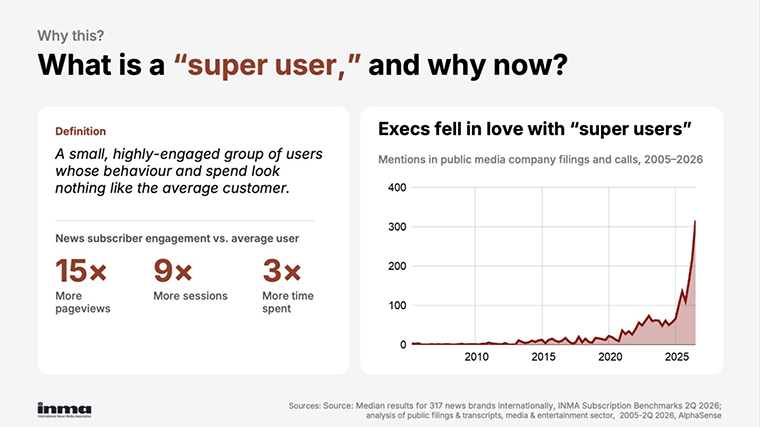
Greg pointed out that “there is no average user in media.” So what happens if we confuse this small group of people who are most valuable today with the full market we need tomorrow?
Younger audiences increasingly encounter news away from publisher Web sites and apps. They move between social video, search, messaging, podcasts, and, now, AI interfaces. They may value journalism without developing the habit of visiting a homepage or downloading a news app. Asking them to cross a bridge into an owned-and-operated product only works if what they find on the other side fits the way they want to consume information.
The age profile of many digital subscription bases makes this more urgent. If the strongest willingness to pay remains concentrated among older, highly engaged readers, the strategy can perform well for years while the future audience quietly forms different habits elsewhere. AI could accelerate that change by answering questions, summarising information, and completing tasks without requiring the user to visit the original source.
This does not mean abandoning loyal customers or giving away journalism indiscriminately. Nor does it mean every platform relationship is good. Distribution outside owned products creates hard questions about monetisation, attribution, audience data, and control. Publishers need a clear view of the value exchanged whenever journalism travels.
It also means being careful with the label “super user.” Is the 1% defined by passion for a particular news brand or by income, education, and the ability to pay? The same concentration of spending appears in many industries. If we mistake economic advantage for unusually strong product affinity, we may build for a narrower audience than we realise.
The answer is not the 1% or the 99%. It is an intentional portfolio. Serve the super users who fund the business now. Keep improving the direct products that create loyalty, identity, and first-party data. At the same time, experiment seriously with formats, partnerships, and commercial models that reach people where their habits are forming.
That requires two sets of measures. One should track the health of the current business: frequency, retention, revenue, and lifetime value. The other should test whether the publisher is building future relevance: reach among younger audiences, meaningful engagement away from owned products, attribution, and the ability to convert distributed value into sustainable income.
We should use current data to run today’s business but not assume it describes tomorrow’s market. The strategic question is: How do we protect the revenue generated by today’s super users while building a valuable relationship with the audiences who may never behave like them?
If you’d like to subscribe to my bi-weekly newsletter, INMA members can do so here.
Banner photo: Adobe stock image by Andrea Raffin.
Related Articles
-

Marketers should outsource tasks, not thinking
25 October 2026 -

WSJ executive councils show how publishers build communities th...
19 October 2026 -

Bundling is a pricing decision, rebundling is an organisational...
18 October 2026 -

At Mediacorp’s CNA, loyalty means giving audiences a reason to ...
20 August 2026 -

Tribun Network turns print “dots” into AI-powered insight
20 August 2026 -

Nation Media Group focuses editorial strategy on stories that m...
4 August 2026 -

Briefly News empowers journalists with AI tool suite Nova
4 August 2026 -

Indian Express builds a video-first future around trusted journ...
20 July 2026
Upcoming Events
-

Subscriber Acquisition Master Class
10-17 November 2026
-

Media Advertising Summit
New York, United States
07-10 December 2026
-

AI-Native News Product Master Class
18-25 February 2027
-

Media Subscriptions Summit
Oslo, Norway
08-12 March 2027
-

World Congress of News Media
New York, United States
25-30 April 2027
-

Branded Content & Partnerships Master Class
20-27 May 2027
-

Subscriber Retention Master Class
17-24 June 2027
-

Conferencia Latinoamericana
15-16 July 2027
-

South Asia News Media Festival
New Delhi, India
19-22 July 2027
-

Asia/Pacific News Media Summit
19-20 August 2027
-

CEO Roundtable at Kilkenny
Kilkenny, Ireland
24-26 August 2027
-

Media Innovation Week
Amsterdam, The Netherlands
27 September - 01 October 2027








