

Briefly News empowers journalists with AI tool suite Nova
Conference Blog | 04 August 2026

As the project manager for Briefly News, Rianette Cluley found herself facing a challenge familiar to publishers around the globe: rising workloads, shrinking resources, and the need to maintain quality while producing more content across more platforms. But their solution — an evolving suite of AI tools collectively referred to as Nova — has reshaped workflows, improved writing quality, and delivered measurable returns on both time and money. Cluley shared insights into how Nova was created at INMA's Africa Newsroom & Tech Summit.
Digital press under stress
Briefly News is part of Legit, which operates large digital newsrooms across Nigeria, Kenya, Ghana, and South Africa. Writers produce up to six stories per day, and each of its properties has between 25 and 40 writers. However, “Each project also only has one or two copy editors,” Cluley explained. “So there’s a massive amount of articles our copy editors have to check daily, and it just wasn’t realistic or sustainable to expect them to go through all that content every day.”
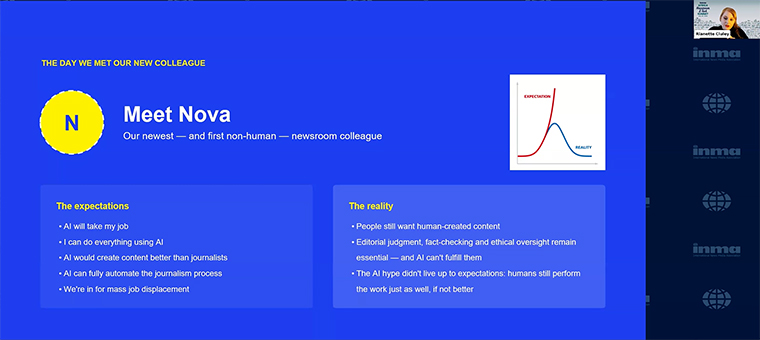
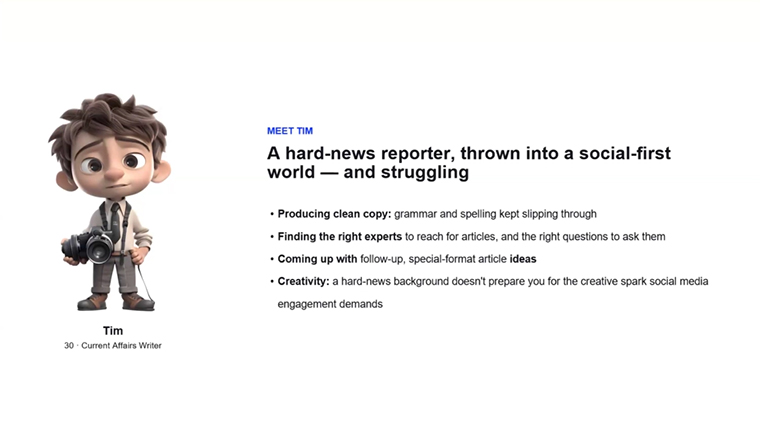
The increased pressure was especially noticeable for writers transitioning from traditional print backgrounds into a digital world. As an example, Cluley presented the example of “Tim” — a fictionalised composite of a real Briefly News reporter. Tim struggled with clean copy, identifying experts, generating interview questions, and, importantly, packaging hard news for social media: “He really, really grappled with distributing traditional hard news in a creative way on social media,” she said.
The newsroom needed a way to support writers like Tim, reduce the load on editors, and improve consistency without sacrificing the human creativity readers still demanded. It was important to keep that human element because, as Cluley pointed out, “Our readers still wanted human creative content… they can tell when it is AI-created.”
Building Nova
Legit began experimenting with simple AI usage in 2023, but really gained traction in 2025 after Cluley and some colleagues participated in the Thomson Reuters Foundation’s AI in the Newsroom Mentorship Programme. During a four‑day workshop, the team built a custom GPT designed to handle repetitive tasks like grammar checks, verifying the five Ws and H, suggesting headlines, and generating meta descriptions.
The goal was simple: get “nearly perfect copy to the copy editor” so editors could spend more time on fact‑checking and verification. And initially, it delivered. Writers saw cleaner drafts, editors doubled the number of stories they could review, and the newsroom gained breathing room.
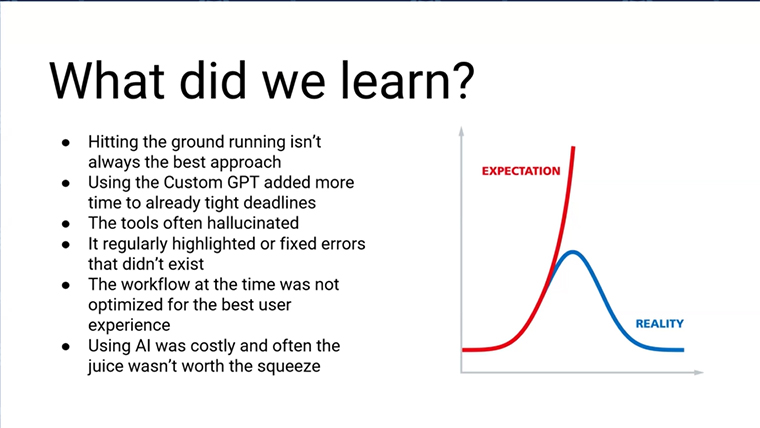
But the tool also revealed the limits of early AI adoption. Writers had to juggle multiple browser tabs, something that slowed them down — especially in regions with unreliable Internet. It also hallucinated, finding errors that didn’t exist. “Writers ended up spending more time looking for the error that wasn’t there than actually fixing real errors,” Cluley recalled.
But the biggest issue was scale. Legit attempted to deploy it across four projects using a single paid ChatGPT account. This turned out to be a mistake, as it led to frequent logouts, glitches, and growing frustration. “We had to think about how to make it better and more user-friendly,” Cluley said.
Rebuilding the tool
Rather than abandon AI, Legit regrouped and asked writers what worked, what didn’t, and what their ideal tool would look like. They also researched alternatives, tested new platforms with small control groups, and adopted a top‑to‑bottom rollout strategy: managers tested first so they could flag glitches and fix them before handing it over to a group of writers.
“This helped us not just achieve actionable feedback, but we also had a group of writers who could back us when using the new tool,” Cluley said, noting that because everyone had this negative experience with the original AI, it was important to have a group that could get the writers on board with using the new tool.
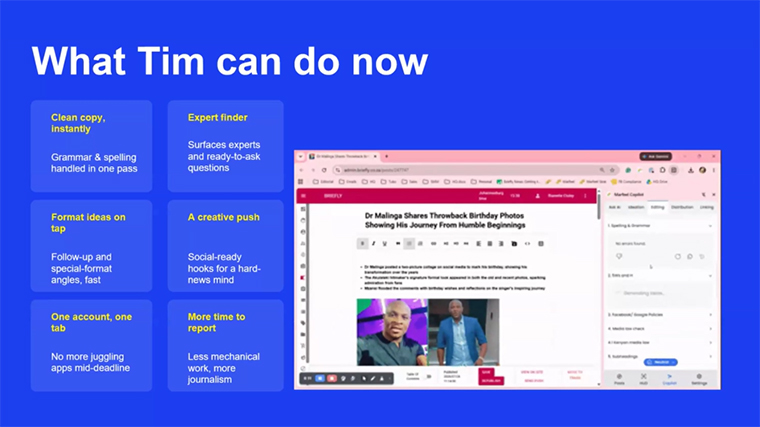
The reset led to a tool called Moffield Copilot, a Chrome‑based extension that sits directly beside the CMS. Every writer has their own account and there’s no more switching between tabs. It also eliminated the problem of hallucinations caused by overloaded custom GPT instructions.
With Moffield Copilot, writers could run grammar checks, structure reviews, headline suggestions, and meta descriptions with a single click. But the tool went further, adding:
- Social media distribution prompts.
- Follow‑up story ideas.
- Internal and external linking checks.
- Media law checks to flag unverified allegations.
- Policy compliance checks against internal style guides.
- Translation support.
Quality, speed, and engagement
The results were seen almost instantly. When Tim began using Nova, his weekly performance jumped more than 150%, driven by stronger headlines, cleaner copy, and better social media packaging.
“His creative boost is literally on his fingertips,” Cluley said. “No more moving between tabs; just more time to do what journalists do best.
The streamlined workflow afforded writers time to experiment with angles, pursue follow‑ups, and refine storytelling. Editors gained time to verify facts. And the newsroom gained consistency without sacrificing human voice.
What about ROI?
Cluley emphasised that AI’s value was measurable. She built an ROI calculator using Claude to measure what each writer brought in during a specific timeframe and compare it to what they cost the company during that time. She found some writers delivered positive ROI, but others were negative.
“One of the main challenges I thinkwe faced in 2026 was how to turn those negative return on investment writers into positive return on investment writers,” She said.
The answer was Pressroom, a draft‑building tool trained on Legit’s top‑performing articles. By generating first drafts in the newsroom’s voice and style, Pressroom reduced time spent rewriting press releases, conference summaries, and social media posts. Writers could shift their energy toward research, fact‑checking, expert sourcing, and creative storytelling — the work that drives revenue.
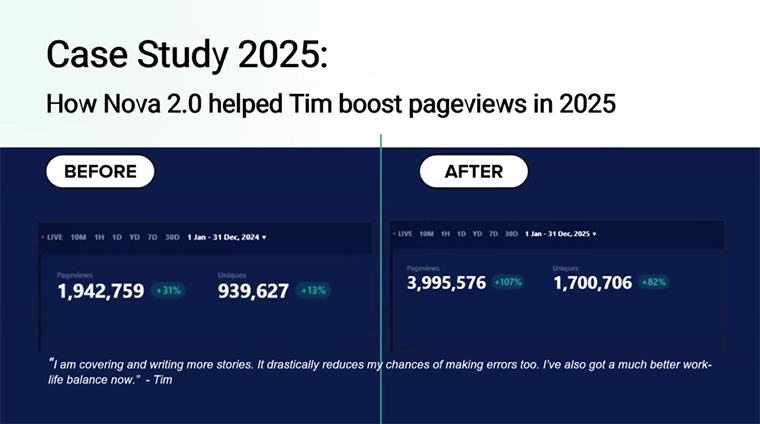
This combination of Moffield Copilot and Pressroom helped writers produce more stories, faster, with fewer errors. As Tim put it, “I’m covering and writing more stories… and it drastically reduces the chances of making errors.” He added that the tools gave him “a much better work‑life balance,” even allowing him to “have dinner with my family.”
For a newsroom producing hundreds of stories per week, those gains translate directly into higher output, better quality, and improved financial performance.
Lessons for other newsrooms
Cluley closed with practical advice for publishers considering AI adoption:
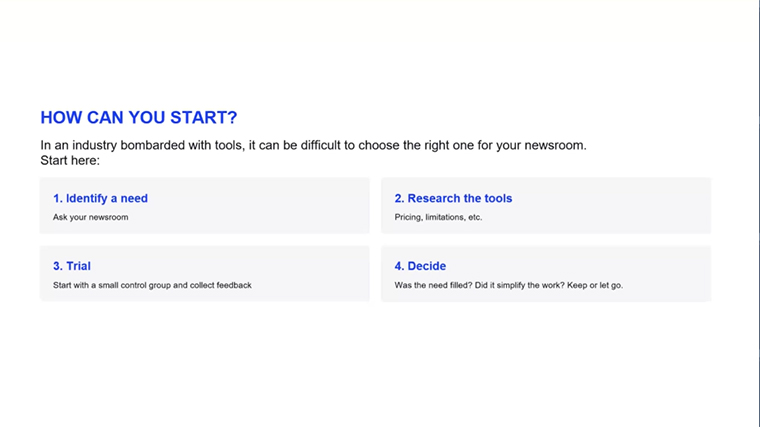
- Identify a real need. Don’t start with the technology; start with the problem. This includes asking the newsroom what they need. “The writers are the people doing the legwork,” she said. Their input is essential.
- Research tools thoroughly. Compare costs, features, and long‑term sustainability.
- Start with a trial. Whether you build or buy, always soft launch it with a control group before a company-wide rollout. “I would highly suggest the top using it first, bottom last. And then gather their feedback and optimise it as and when needed.”
- Evaluate whether “the juice is worth the squeeze.” If the tool doesn’t save time or improve quality, rethink it.
Finally, Cluley urged INMA members to embrace collaboration and learn from other newsrooms: “Reach out to your peers in the industry, read those case studies, attend those workshops, and truly challenge your understanding or your opinions of AI adoption in your newsroom,” she said. “You’d be surprised how much you can learn from others.”
Related Articles
-

Marketers should outsource tasks, not thinking
25 October 2026 -

AI’s effect on super user math
15 September 2026 -

Radical collaboration could provide the solution news publisher...
2 September 2026 -

The front door is gone — and Asia-Pacific publishers are rebuil...
26 August 2026 -

At Mediacorp’s CNA, loyalty means giving audiences a reason to ...
20 August 2026 -

Tribun Network turns print “dots” into AI-powered insight
20 August 2026 -

Newsroom AI disclosure necessary, but context matters
12 August 2026 -

Nation Media Group focuses editorial strategy on stories that m...
4 August 2026
Upcoming Events
-

Subscriber Acquisition Master Class
10-17 November 2026
-

Media Advertising Summit
New York, United States
07-10 December 2026
-

AI-Native News Product Master Class
18-25 February 2027
-

Media Subscriptions Summit
Oslo, Norway
08-12 March 2027
-

World Congress of News Media
New York, United States
25-30 April 2027
-

Branded Content & Partnerships Master Class
20-27 May 2027
-

Subscriber Retention Master Class
17-24 June 2027
-

Conferencia Latinoamericana
15-16 July 2027
-

South Asia News Media Festival
New Delhi, India
19-22 July 2027
-

Asia/Pacific News Media Summit
19-20 August 2027
-

CEO Roundtable at Kilkenny
Kilkenny, Ireland
24-26 August 2027
-

Media Innovation Week
Amsterdam, The Netherlands
27 September - 01 October 2027








