

Nation Media Group focuses editorial strategy on stories that matter
Conference Blog | 04 August 2026

Kenya's Nation Media Group has cut its daily story output by almost half and says the result has been higher traffic, stronger conversions, and less burnout in the newsroom. Speaking at INMA's Africa Newsroom & Tech Summit, Harry Misiko, the company's managing editor for content strategy, argued that the real crisis facing African newsrooms is not a shortage of stories but an oversupply of them, and that editors must learn to say no far more often than they say yes.
The problem isn't finding stories, it's choosing them
Misiko, who has spent 15 years at Nation Media Group, told delegates that the “current problem in Africa is not about deployment, about chasing our story” but “not finding our story, but finding the story that matters.”
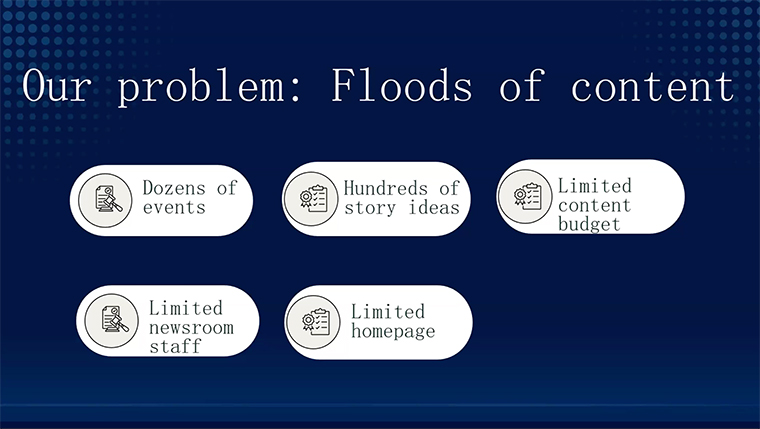
He described newsrooms flooded daily with dozens of events and hundreds of story ideas from reporters, correspondents, contributors and columnists, set against limited budgets, limited staff, and a homepage that “can only handle so much” because human attention is finite. That mismatch, he said, forces editors into difficult daily choices: “The headache for any newsroom manager, content manager, editor like myself is actually making those editorial choices.”
He warned that covering everything carries hidden costs: exhausted reporters, burned-out editors, duplicated coverage, shallow reporting, cluttered homepages, declining engagement, and ultimately fewer conversions and less revenue.
“Chasing more does not necessarily mean more subscriptions, does not mean more audiences, does not mean more readership,” he said.
A new question at the morning editorial conference
At Nation Media Group's daily editorial conference, which Misiko chairs, the guiding question has shifted from “can we cover and publish this story?” to “should we even cover this story?”
To answer that, the newsroom applies a four-part framework adapted from Dmitry Shishkin's user needs model, developed at the BBC. A story idea is first tested for editorial value, public interest, accountability, national importance, then checked against four audience needs: informing people (including selective breaking news), helping people understand through perspective and education, making people feel something (inspiration or diversion), and enabling people by helping or connecting them.
Stories that pass those tests are then weighed for business value, subscriber potential, conversion and retention potential, and brand authority, and finally for resource feasibility: time, money, staff and logistics. Misiko said the newsroom typically wants at least two or three of these boxes ticked before committing to resource-intensive stories.
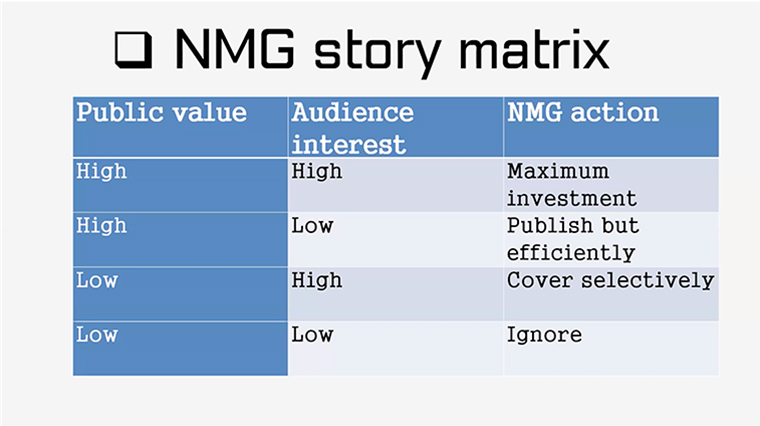
Nation Media Group also uses a “story matrix” crossing public value against audience interest: high public value and high audience interest gets maximum investment; high public value with low audience interest gets efficient, moderate coverage; low public value with high audience interest gets selective coverage; and stories low on both are ignored.
Misiko pointed to Kenya's approaching general election as a live test of the framework. Rather than “chase every politician” and cover “every campaign rally” and “every press statement,” he said Nation Media will prioritise deeper analysis, exclusive interviews, data journalism, fact-checks, explainers, accountability journalism and candidate trackers — betting that this delivers more value than daily rally coverage, “because everyone is going to speak anyways.”
AI as an assistant, not a replacement
Responding to a question from the moderator on AI and emerging technology, Misiko said Nation Media Group was among the first newsrooms in Kenya — and the region — to launch an AI policy. He said the newsroom uses AI mainly for brainstorming and idea triage, including a tool that flags “green” story angles (less covered, more original) versus “red” angles (repetitive and overdone), as well as for headline testing, social media iteration, and adapting a single story into multiple versions for different platforms and audiences, such as a youthful audience or the Kenyan diaspora.
He was emphatic that AI should not replace editorial judgment.
“I treat AI always as an intern or an assistant,” Misko said. “So whatever they give me, it's up to me again to evaluate and check, is this thing even suggesting the right things or it's off. Hallucinations are here, and we are very awake to see.”
He illustrated the risk with an example from the newsroom: an AI tool editing a story about a political coalition's “core principles” changed a repeated reference to “core principle” into “head teacher,” apparently because it associated the phrase with a school principal rather than a coalition principle.
“That will be equally messy,” he said.
Verification remains a work in progress
On accuracy and verification, Misiko was candid that Nation Media Group is still building AI models trained on the newsroom's own house style, English conventions and archive of published journalism, so that early drafts can be cleaned up before a human editor checks facts, names and substantive details. He compared the process to running a draft through Grammarly: it catches basic issues but “doesn't mean it edited for you. You still have to do the job yourself.”
He described AI adoption as “a continuing journey” that never fully ends, noting that as staff are trained on one model, newer models arrive and require fresh adjustment: “we always feel like you are running behind because things are moving very fast.”
Cultural resistance and lessons learned
Misiko acknowledged the shift has not been smooth. Nation Media Group has had to unwind its identity as one of Kenya's biggest breaking-news outlets, now deliberately ceding first-alert coverage to bloggers and social platforms in favor of “the story behind the story.”
He offered a set of core lessons:
- Not every story deserves equal treatment.
- Depth beats volume.
- Data and AI can only improve judgment, not replace it.
- Every assignment carries an opportunity cost.
- Editors must create focus, not just content.
- Sometimes an editor's most important decision is choosing not to cover a story at all.
Misiko described ongoing friction and cultural resistance stemming from reporters' fear of missing out, commercial and political pressure to cover events the newsroom has chosen to skip, internal resistance from staff not aligned with the new approach, and legacy workflows that push against the new editorial priorities.
“It takes double the time to end an entrenched culture,” he said.
He offered practical starting points for other newsrooms:
- Build a simple story-scoring system.
- Define clear priorities.
- Shift planning meetings from “what happened” to “what matters most.”
- Use AI and analytics more responsibly.
- Learn to say no more often.
Related Articles
-

VG turned AI video into discovery engine for premium content
14 September 2026 -

What news CEOs are investing in — and what they are killing
8 September 2026 -

USA Today asks: Is a human really needed in every loop?
25 August 2026 -

WSJ Japan finds AI translation is “not a one-and-done deal”
24 August 2026 -

Amid a flood of content, Nation develops ways to stop doing com...
12 August 2026 -

Legit’s Briefly News introduced an AI tool that wins the newsro...
11 August 2026 -

BusinessDay moves from business content to business intelligenc...
6 August 2026 -

NDTV looks beyond AI novelty to build products that deliver rea...
21 July 2026
Upcoming Events
-

Subscriber Acquisition Master Class
10-17 November 2026
-

Media Advertising Summit
New York, United States
07-10 December 2026
-

AI-Native News Product Master Class
18-25 February 2027
-

Media Subscriptions Summit
Oslo, Norway
08-12 March 2027
-

World Congress of News Media
New York, United States
25-30 April 2027
-

Branded Content & Partnerships Master Class
20-27 May 2027
-

Subscriber Retention Master Class
17-24 June 2027
-

Conferencia Latinoamericana
15-16 July 2027
-

South Asia News Media Festival
New Delhi, India
19-22 July 2027
-

Asia/Pacific News Media Summit
19-20 August 2027
-

CEO Roundtable at Kilkenny
Kilkenny, Ireland
24-26 August 2027
-

Media Innovation Week
Amsterdam, The Netherlands
27 September - 01 October 2027








