

NDTV looks beyond AI novelty to build products that deliver real value
Conference Blog | 21 July 2026

As AI makes it increasingly easy to build new applications, NDTV is asking a more difficult question: Which ones are actually worth building?
That was one of the central themes as 20 news media executives visited NDTV during the INMA South Asia News Media Festival study tour in Noida, India.
NDTV is an Indian news media network spanning television, digital, and social platforms. Its seven channel brands include flagship English and Hindi news channels, business and global channels, and three regional channels. The company also operates digital verticals across areas including food, health, auto, entertainment, and sports.
Gaurav Barjatya, head of marketing at NDTV, told study tour participants the network reaches more than half a billion people globally across its platforms, generating more than 1 billion views per month.
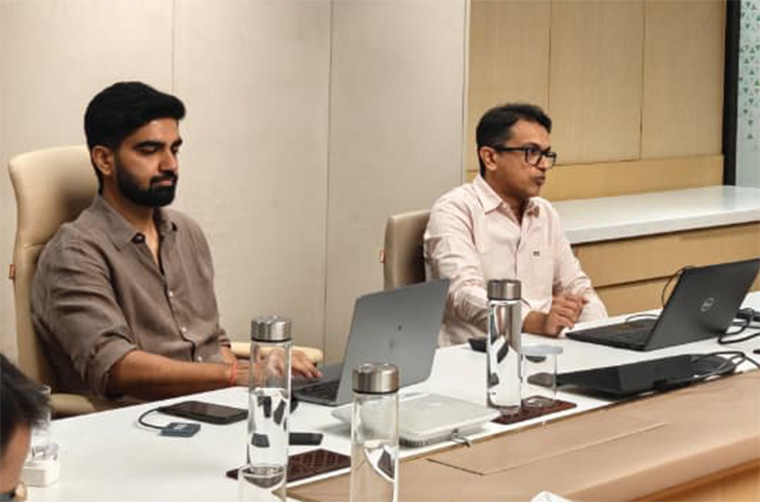
Rohan Tyagi, chief product officer at NDTV, took delegates through the company’s expanding portfolio of AI experiments, from internal newsroom tools and analytics to personalisation, an AI answer engine, and a new audio news experience.
“The entry barrier for teams and for organisations and for individuals is really decreasing,” Tyagi said.
That shift, he explained, puts greater importance on determining the actual value of what is being created.
“You build an AI application, and within a few weeks or months, no one is using that application anymore,” he said. “A lot of applications are being built because it’s possible to build them, and there is a novelty factor initially.”
Finding value in thin and thick AI
NDTV has developed a framework that distinguishes between what Tyagi called “thin” and “thick” AI layers.
Thin applications can be deployed quickly with relatively little engineering. One example is NDTV’s internal infographic generator, which can use different AI models depending on which performs best. Rather than simply giving individual employees access to an image-generation tool, NDTV has built shared templates, prompts, and usage controls so knowledge can be reused across teams.
Another thin application connects multiple analytics sources and allows employees to ask questions through Slack. Used primarily by SEO teams and being expanded to editorial teams, the agent is designed to handle some of the routine analytics requests that would otherwise go to an analytics team.
Tyagi compared its capabilities to those of a junior analyst but stressed that it was not intended to replace a person. Instead, it can handle certain queries from growth, SEO, and editorial teams.
“So again, very thin layer but very high value,” Tyagi said. “So not too much engineering effort but not a gimmick as well.”
For NDTV, the lesson is that even a technically simple AI layer can provide substantial value if it addresses a genuine workflow problem, Tyagi said: “So again, very thin layer but very high value. So not too much engineering effort but not a gimmick as well.”
Reimagining the app around discovery
A deeper AI investment is supporting NDTV’s efforts to make its app more visual, personalised, and discovery-driven.
The app combines a card-based visual feed with recommendations. AI helps generate summaries and select portions of videos for the cards, while headlines remain manually produced. NDTV initially required manual review of all AI-generated summaries and is now reducing that requirement where it has seen greater accuracy, although sensitive categories still receive 100% manual review.
The recommendation system uses large language model embeddings to understand relationships between stories and make recommendations with fewer signals from users.
NDTV has seen higher scroll depth with the visual, recommended feed than with its classic feed. But the experiment has also highlighted an important challenge: Some of its most loyal users prefer the traditional experience.
“These are two different approaches and it’s not very right and wrong, but it’s a tough problem to balance both,” Tyagi said.
Building AI around NDTV’s journalism
NDTV has also made a larger investment in Ask NDTV, an answer engine grounded in the company’s own content.
The system draws from millions of records in NDTV’s archive and is intended to do more than retrieve articles. The goal is to answer more complex questions by drawing across NDTV’s journalism, rather than relying on general Internet knowledge, Tyagi said.
“This is supposed to answer questions, which do not get answers when you are reading just article after article or seeing video after video,” Tyagi said.
The company is also experimenting with AI-generated, short-form audio news using modelled voices of its anchors. The feature creates audio scripts rather than simply reading article summaries — a distinction NDTV found important because content written to be read does not necessarily work when heard.
Yet experimentation does not mean removing editorial boundaries. NDTV has an AI editorial policy, and Tyagi said the company discourages AI use in text while looking for areas where the technology can be used without disadvantages for users, platforms, or editorial ethics.
That combination — experimentation alongside a clear focus on usefulness and editorial considerations — offered perhaps the broader lesson from the NDTV visit: The opportunity is not simply to build more with AI but to determine where AI creates enough value to justify building at all.
Related Articles
-

Marketers should outsource tasks, not thinking
25 October 2026 -

AI’s effect on super user math
15 September 2026 -

At Mediacorp’s CNA, loyalty means giving audiences a reason to ...
20 August 2026 -

Tribun Network turns print “dots” into AI-powered insight
20 August 2026 -

Nation Media Group focuses editorial strategy on stories that m...
4 August 2026 -

Briefly News empowers journalists with AI tool suite Nova
4 August 2026 -

Grupo RBS builds social-first video operation to expand audienc...
20 July 2026 -

AI adoption in newsrooms should move from experiment to strateg...
12 July 2026
Upcoming Events
-

Subscriber Acquisition Master Class
10-17 November 2026
-

Media Advertising Summit
New York, United States
07-10 December 2026
-

AI-Native News Product Master Class
18-25 February 2027
-

Media Subscriptions Summit
Oslo, Norway
08-12 March 2027
-

World Congress of News Media
New York, United States
25-30 April 2027
-

Branded Content & Partnerships Master Class
20-27 May 2027
-

Subscriber Retention Master Class
17-24 June 2027
-

Conferencia Latinoamericana
15-16 July 2027
-

South Asia News Media Festival
New Delhi, India
19-22 July 2027
-

Asia/Pacific News Media Summit
19-20 August 2027
-

CEO Roundtable at Kilkenny
Kilkenny, Ireland
24-26 August 2027
-

Media Innovation Week
Amsterdam, The Netherlands
27 September - 01 October 2027








