

AI adoption in newsrooms should move from experiment to strategy
Conference Blog | 12 July 2026

Artificial Intelligence is no longer just an experimental tool for news organisations. According to digital media consultant Alvaro Liuzzi, the industry is entering a new stage in which AI adoption must be driven by editorial strategy, business objectives, and organisational culture rather than enthusiasm for new technology alone.
Speaking during the recent INMA Webinar Mapping AI Integration in Media: From Experimentation to Strategy, Liuzzi argued that some media companies have already moved beyond isolated AI experiments and are beginning to achieve sustainable transformation.
The challenge now, he said, is designing organisational change that goes far beyond technology itself.
From asking “what?’ to asking “why?”
The AI conversation has evolved dramatically over the past three years, according to Liuzzi, who has spent more than two decades leading digital transformation projects for organisations including Argentina’s Clarín.
He described the period between 2023 and 2025 as the era of the “what,” when news organisations focused on discovering AI’s possibilities through experimentation, efficiency gains, and testing.
According to Liuzzi, the remainder of 2026 and the years ahead will become the era of the “why.”
Borrowing from journalism’s classic five Ws — what, who, where, when, and why — he argued media companies must now define the purpose behind AI adoption instead of simply implementing new tools.
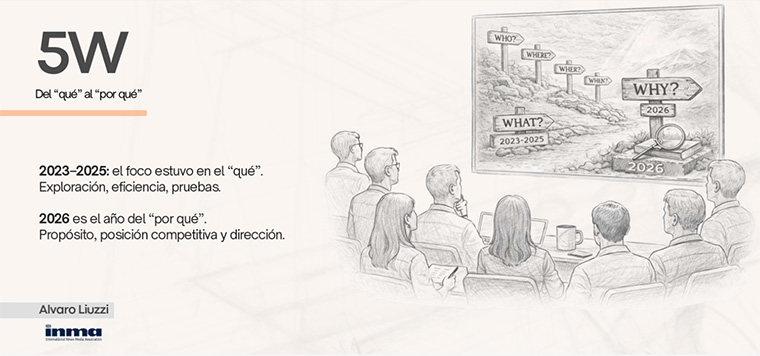
“The transformation begins not with technology but with strategic organisational decisions,” Liuzzi said, emphasising that concepts such as purpose, competitive positioning, and long-term direction must guide AI integration.
Experimentation is widespread, integration is rare
Three years after the arrival of ChatGPT, Liuzzi believes the media industry has reached a turning point.
Citing 2025 data from Arc XP and Digiday, he noted that experimentation with AI has become common, but true organisational integration remains extremely limited.
According to the data:
-
64% of media companies use AI for routine tasks.
-
24% have integrated AI into broader organisational processes.
-
Only 1% have achieved cross-functional integration across their operations.
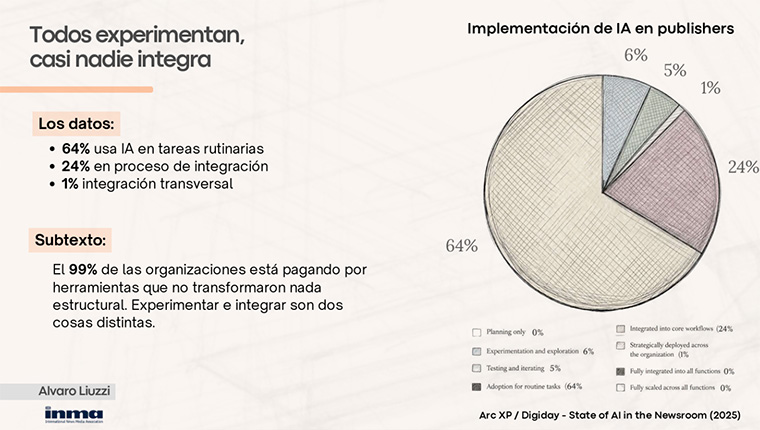
For Liuzzi, the distinction is critical: “Experimenting and integrating are not the same thing,” he said, arguing many organisations have invested in AI tools without producing any structural transformation.
Another study from WAN-IFRA reveals a similar pattern: While 33% of media organisations report an advanced level of AI adoption inside the newsroom, only 18.5% have advanced AI strategies for audience engagement, and just 6% have reached an advanced level of AI-driven monetisation.
Those figures suggest sustainability, revenue generation, audience relationships, and business models still lack comprehensive AI strategies.
Trust still depends on human journalists
Liuzzi also highlighted growing concerns about credibility. Quoting research from the Reuters Institute, he said audiences remain cautious about fully AI-generated journalism:
- Only 12% of respondents said they accept content produced entirely by AI.
- Acceptance rises to 21% when AI-generated content includes human intervention, while 43% are comfortable with journalism created by humans using AI as an assistant.
- The strongest preference remains for fully journalist-produced content, with 62% favouring work created by reporters.
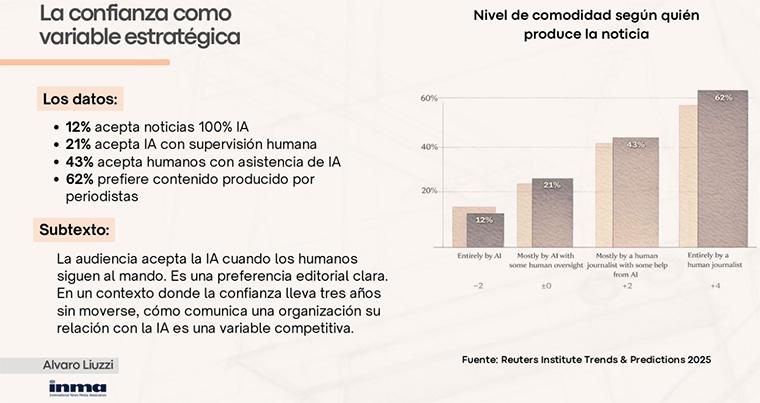
“In a context where trust has remained stagnant for three years, how an organisation communicates its relationship with AI becomes a competitive advantage,” Liuzzi said.
His conclusion was straightforward: Audiences are willing to embrace AI only when humans remain firmly in control.
New newsroom roles are emerging
Liuzzi’s own research also shows how AI is reshaping newsroom structures.
Over the past several years, he has documented at least 80 new professional roles linked to AI implementation, spanning infrastructure, product development, training, governance, strategic leadership, and editorial production.
Interestingly, he argued the most influential professionals are not necessarily engineers or programmers. Instead, the key figures are those capable of bridging editorial teams and technology departments.
Most of these new AI-related positions have emerged in media organisations in the United States and the United Kingdom, according to Liuzzi.
Three successful AI case studies
Liuzzi shared three examples from Argentine media organisations where he participated directly in AI integration projects.
-
The first involved Todo Jujuy, which implemented structural AI integration with governance systems and oversight of automated workflows in 2023. The outlet increased its audience by 83% while tripling its user base.
-
A second project at media outlet 0221 in 2024 focused on a comprehensive review of newsroom workflows, prompt engineering workshops, and customised AI models. Around 90% of staff reported positive experiences with the new systems.
-
The third example came from Clarín in 2025, where AI became part of the newspaper’s editorial strategy. Fifty journalists and editors worked in coverage-based teams and developed 16 functional AI prototypes created by journalists themselves.
The biggest obstacles
According to Liuzzi, the first major challenge was cultural resistance. Many journalists were reluctant to modify established workflows or adopt unfamiliar technologies.
Clear internal communication, opportunities to experiment safely, and involving journalists in designing their own AI tools significantly reduced resistance.
The second challenge involved preventing AI initiatives from becoming isolated experiments. Instead, organisations needed to embed AI into daily editorial routines while creating metrics that demonstrated long-term impact.
A third obstacle was the lack of strategic leadership. In many companies, executives had decision-making authority but limited understanding of AI’s capabilities.
The organisations that advanced the furthest were those that first defined what they wanted to achieve before selecting technological solutions.
Liuzzi also stressed the importance of recognising AI’s limitations: “It is not an autonomous tool capable of doing journalism on its own.”
Strategic risks beyond the newsroom
AI adoption also raises broader strategic concerns. Liuzzi recalled that many media organisations made a costly mistake over a decade ago by outsourcing audience relationships to social media platforms.
Today, he fears the industry could repeat that error by allowing AI platforms to become the primary interface between publishers and audiences.
Instead, he encouraged media companies to strengthen direct relationships through newsletters, podcasts, memberships, and subscription models.
He also warned against the “survivorship bias” that dominates discussions about AI. Organisations tend to focus on successful implementations while overlooking failed projects that offer equally valuable lessons for decision-makers.

Another concern is what he called the “generational paradox.” As AI automates certain newsroom functions, some organisations have reduced internship hiring while simultaneously losing experienced journalists through retirement.
According to Liuzzi, this fact risks hollowing out both ends of the newsroom — the newcomers and the veterans — who together preserve editorial culture.
He also warned about “cognitive sedentary behaviour” or excessive dependence on AI tools that weaken human autonomy, creativity, innovation, and adaptability.
What has actually worked
Based on his experience, Liuzzi identified six practices that consistently deliver positive results:
- Continuous training and experimentation create safe spaces where journalists can learn AI’s capabilities and limitations.
- Participatory tool design allows reporters to develop AI solutions tailored to their own workflows.
- A process-first culture ensures organisations define editorial objectives before selecting technologies.
- Clear ethical policies establish transparency, human oversight, and fairness from the outset.
- Creating “uncomfortable pauses” gives newsrooms time to rethink workflows instead of pursuing constant content production.
- Finally, human-centered AI keeps journalism focused on ethics, creativity, and editorial judgment rather than automation alone.
Measuring AI maturity
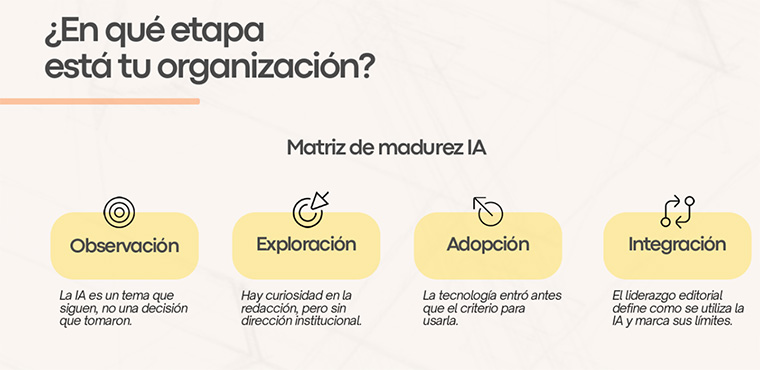
Liuzzi concluded by presenting an AI maturity framework that helps media organisations assess their progress.
- The first stage is observation, where companies simply monitor AI developments.
- The second is exploration, marked by newsroom curiosity but little institutional direction.
- Third comes adoption, where AI tools are used without consistent editorial criteria.
- The highest level is integration, where editorial leadership defines both how AI should be used and where its limits lie.
He closed with three questions that every media company should ask itself:
Is AI use the result of a collective organisational decision or merely scattered individual practices?
Is every AI application guided by editorial judgment or only by the pursuit of efficiency?
And finally, what kind of news organisation do you want to become in two years — and what decisions are you making today to get there?
Related Articles
-

Marketers should outsource tasks, not thinking
25 October 2026 -

WSJ executive councils show how publishers build communities th...
19 October 2026 -

AI’s effect on super user math
15 September 2026 -

At Mediacorp’s CNA, loyalty means giving audiences a reason to ...
20 August 2026 -

Tribun Network turns print “dots” into AI-powered insight
20 August 2026 -

Nation Media Group focuses editorial strategy on stories that m...
4 August 2026 -

Briefly News empowers journalists with AI tool suite Nova
4 August 2026 -

Grupo RBS builds social-first video operation to expand audienc...
20 July 2026
Upcoming Events
-

Subscriber Acquisition Master Class
10-17 November 2026
-

Media Advertising Summit
New York, United States
07-10 December 2026
-

AI-Native News Product Master Class
18-25 February 2027
-

Media Subscriptions Summit
Oslo, Norway
08-12 March 2027
-

World Congress of News Media
New York, United States
25-30 April 2027
-

Branded Content & Partnerships Master Class
20-27 May 2027
-

Subscriber Retention Master Class
17-24 June 2027
-

Conferencia Latinoamericana
15-16 July 2027
-

South Asia News Media Festival
New Delhi, India
19-22 July 2027
-

Asia/Pacific News Media Summit
19-20 August 2027
-

CEO Roundtable at Kilkenny
Kilkenny, Ireland
24-26 August 2027
-

Media Innovation Week
Amsterdam, The Netherlands
27 September - 01 October 2027








