

Grupo RBS builds social-first video operation to expand audiences, drive new revenue
Conference Blog | 20 July 2026

At the INMA Latin American Conference, Debora Pradella shared how Grupo RBS reimagined its newsroom and commercial strategy to meet the social‑first news consumption demand.
Pradella, digital product executive manager for the Brazilian media group, explained how the company built a native short‑form video operation that has transformed its reach, relevance, and revenue across the video-focused platforms of Instagram Reels, TikTok, and YouTube Shorts.
As the largest media organisation in southern Brazil, Grupo RBS has more than 68 years of operations and a monthly reach of 11 million people. The company produces journalism, sports, and entertainment content for three regional newspapers, radio stations, digital platforms, and a regional TV station. It also owns the biggest music festival in southern Brazil.
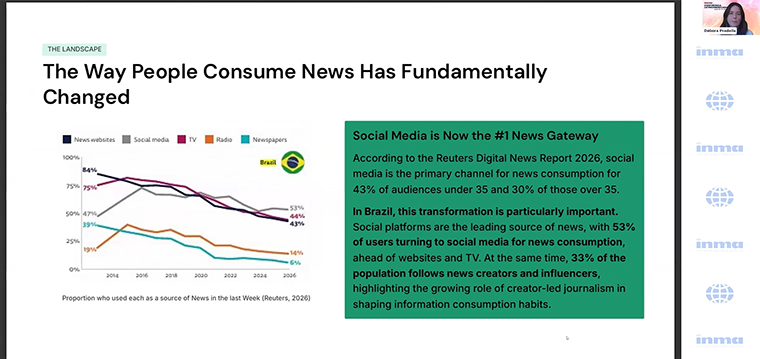
Although the company’s integrated newsroom produces content across all platforms, audience behaviour had shifted so much in recent years that traditional workflows no longer fit, Pradella said: “The way people consume news has changed a lot in the last years.”
Citing the 2026 Reuters Institute Digital News Report, Pradella noted social media has become the primary gateway for news consumption. According to the report, 43% of audiences under 35 and 30% of those over 35 prefer to consume news on social platforms.
In Brazil, the shift is even more pronounced: 53% of users prefer to consume news directly on social media rather than on publishers’ Web sites or apps. And, as with other regions, 33% of the Brazilian population follows news creators and news influencers.
It’s not just about platforms, however; it’s also about formats. With short‑form video becoming the dominant mode of news consumption on social networks, audiences are looking for “fast visual and mobile-first storytelling.”
Grupo RBS was producing content primarily for its owned platforms and treating social media as a distribution channel, and was seeing declining engagement, weakened audience relationships, and missed revenue opportunities.
“We had a gap between how the audience were consuming the content and information in this new ecosystem and how we were producing our journalism,” Pradella said.
That raised a question: How could its journalists remain relevant and sustainable in social-first news consumption environments?
“And then we made a strategic decision to go all in on short-form video natively.”
Going native
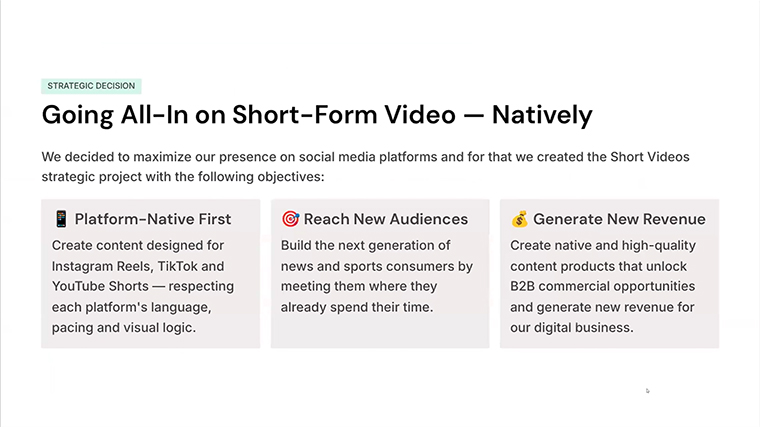
The company launched a project with three goals:
- Create native content for Reels, TikTok, and Shorts.
- Reach new audiences.
- Develop new editorial products that unlock commercial opportunities.
The initiative rests on three pillars: a dedicated creator team, an integrated multidisciplinary operation, and revenue generation as a core mandate.
The first pillar involved building a team of young journalists who are also fluent creators. These journalists consume short‑form content themselves and understand platform language, pacing, and visual logic.
“Every video is conceived for Reels, TikTok, and YouTube Shorts, respecting the language, the visual logic. There’s no repurposing or adapting,” Pradella said.
Starting with just three creators, the team has now expanded to six. In the past year, they published 13,000 short‑form videos across platforms, becoming trusted voices for the audience.
The second pillar was creating a multidisciplinary operation that unifies editorial, product, and commercial teams around shared goals. RBS adopted agile methods to align workflows and performance metrics. The creator team serves as the “creative engine,” combining reporting skills with native platform storytelling.
An editorial coordinator ensures narrative coherence and journalistic standards. Product analysts connect content with portfolio strategy and audience development. The commercial team identifies monetisation opportunities and integrates them into the content pipeline.
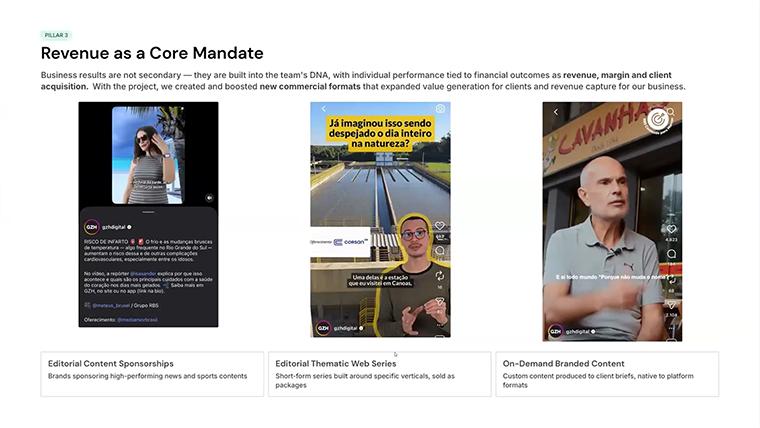
The third and final pillar is revenue. Pradella emphasised that business results are central to the project: “Business results are not secondary for us — the business results are in the DNA of this team.”
Individual performance is tied to financial outcomes such as revenue margin and client acquisition.
Exploring commercial formats
RBS developed three commercial formats for short‑form video:
- Editorial content sponsorship, in which brands sponsor high‑performing news or sports videos.
- Editorial thematic Web series, which are short‑form video packages built around specific subjects and sold to clients.
- On‑demand branded content, produced according to a client brief and fully owned by the brand.
In this model, the newsroom retains editorial control in the first two formats, while the client controls the content in the third.
The results have been significant.
In terms of consumption and reach, RBS saw massive growth in views, engagement, and platform presence.
Last year, the company generated more than 500 million views across social platforms from short‑form video alone. In the first half of this year, it reached nearly 300 million views. The growth was driven by “authentic, high quality editorial content and relevance and the fluence in the social formats, not through just content replication or click-bait contents,” Pradella said.
The project also diversified RBS’s audience. Before the initiative, its digital portfolio skewed heavily male and over 35. Now, its sports TikTok profile reaches younger audiences aged 25 to 34, and its news Instagram and TikTok accounts attract more female users.
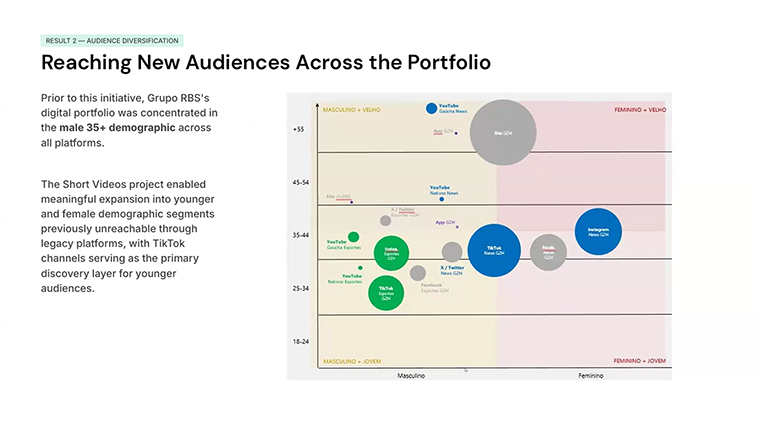
“This audience didn’t have relation and engagement with our products… before this project,” Pradella said. She called the shift “very strategic for the future of our digital portfolio.”
Short‑form video has now become a core revenue product. Last year, RBS generated more than R$3 million — about US$600,000 — from social video, representing nearly fourfold growth in three years. More than 200 brands partnered with RBS: “[They have] really adopted the format as a strategic storytelling solution for their marketing strategy.”
The operation runs with a 70% operating margin, supported by a lean team structure.
Continued expansion
The company continues to expand its offerings and recently launched new social media profiles and video network accounts, moving from a single brand profile to a “strategic ecosystem of targeting accounts.”
These include a news radio profile featuring behind‑the‑scenes content, a main digital news profile offering real‑time updates and analysis, and a sports profile focused on soccer. Each profile serves distinct audience segments and creates new commercial inventory.
Grupo RBS is also transforming its newsroom to be increasingly video‑first. A six‑month training programme launched in May is teaching 180 journalists across all platforms to create, edit, and distribute short‑form video. RBS is expanding collaborative publishing between brand accounts and individual reporters to amplify reach and build communities around journalists themselves.
Additionally, it is experimenting with creator partnerships to reach new audiences, including a collaboration with a TikTok creator who shared World Cup content to boost Grupo RBS sports channels, and another with a humour creator who reacts to RBS radio content. The company shares revenue from monetised content.
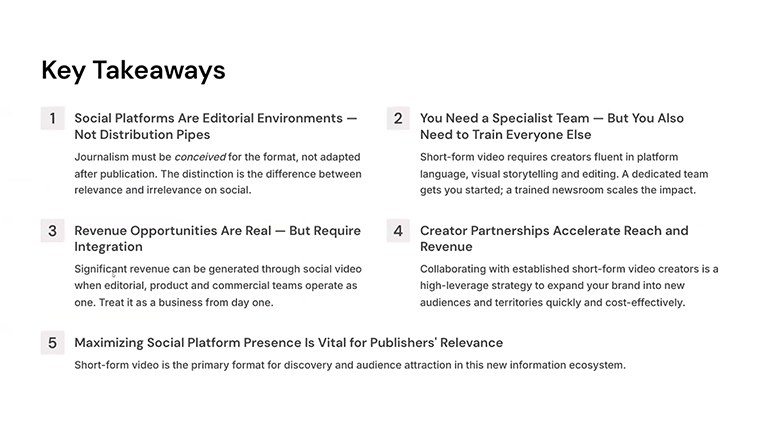
Pradella closed with five key takeaways:
1. Social platforms are editorial environments, not distribution pipes: “Journalists must be conceived for the format natively and not just adapted after the publication.”
2. Publishers need specialist teams but must also train the entire newsroom.
3. Revenue opportunities are real but require integration across departments.
4. Creator partnerships can accelerate reach and revenue.
5. Maximising social platform presence is essential for publishers’ survival: “We must produce short-form video. This is essential for our survival as publishers in this new digital environment.”
Related Articles
-

At Mediacorp’s CNA, loyalty means giving audiences a reason to ...
20 August 2026 -

Tribun Network turns print “dots” into AI-powered insight
20 August 2026 -

Nation Media Group focuses editorial strategy on stories that m...
4 August 2026 -

Indian Express builds a video-first future around trusted journ...
20 July 2026 -

Economist launches subscription tier targeting younger audience...
20 July 2026 -

Inside Denník N’s successful subscription strategy
15 July 2026 -

AI adoption in newsrooms should move from experiment to strateg...
12 July 2026 -

Why are audiences going to AI answer engines for news?
30 June 2026
Upcoming Events
-

Subscriber Acquisition Master Class
10-17 November 2026
-

Media Advertising Summit
New York, United States
07-10 December 2026
-

AI-Native News Product Master Class
18-25 February 2027
-

Media Subscriptions Summit
Oslo, Norway
08-12 March 2027
-

World Congress of News Media
New York, United States
25-30 April 2027
-

Branded Content & Partnerships Master Class
20-27 May 2027
-

Subscriber Retention Master Class
17-24 June 2027
-

Conferencia Latinoamericana
15-16 July 2027
-

South Asia News Media Festival
New Delhi, India
19-22 July 2027
-

Asia/Pacific News Media Summit
19-20 August 2027
-

CEO Roundtable at Kilkenny
Kilkenny, Ireland
24-26 August 2027
-

Media Innovation Week
Amsterdam, The Netherlands
27 September - 01 October 2027








