

Inside Denník N’s successful subscription strategy
Readers First Initiative Blog | 15 July 2026

In a time when many publishers are struggling with subscription-based business models, Slovakia’s Denník N is excelling. This week’s Webinar, presented as part of the INMA Subscription Masters series, saw INMA’s Greg Piechota sitting down with Tomáš Bella, one of Denník N’s co-founders and CEO of the EUobserver, to delve into the company’s subscription strategy, pricing philosophy, and the vital decisions that have shaped its readers‑first business model.
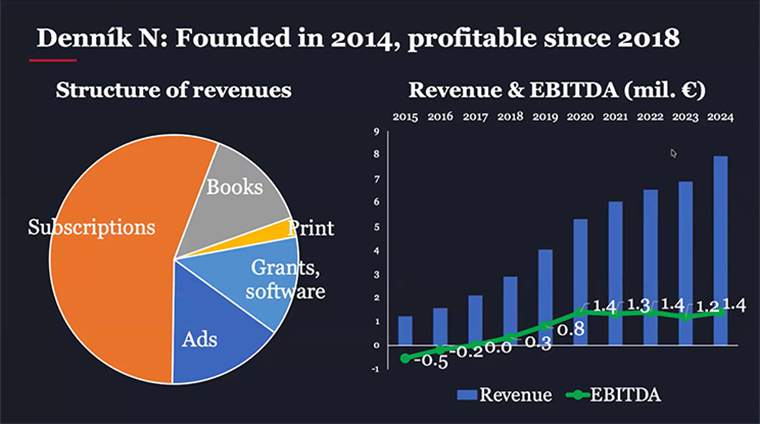
Piechota noted that Denník N was founded in 2014 when a group of journalists left a newspaper after it was taken over by an oligarch. “They started with like 40 people,” Piechota said. “Today they have the largest newsroom in the country, with more than 110 journalists.”
And, notably, the company has been profitable since 2018.
No grand strategy
Bella began by explaining Denník N’s ownership structure and approach to expansion. “We are 80% owned by our own staff,” he said, adding, “There is no grand strategy for acquisitions for the next five years, but we are very opportunistic.” He described how Denník N recently acquired EUobserver, an English‑language publication in Belgium, after initially being approached for technical and subscription support. “After six weeks of discussions, they suggested, ‘Okay, how about you actually take over the whole company?’ And we did that.”
Bella said the most significant lesson he has learned about subscriptions is the importance of pricing.
“Everyone is 95% worrying about the number of subscribers and 5% about what price we are charging them — and it should be 50‑50,” he said. Publishers often make the mistake of pricing for an “average reader,” even though only a small portion of readers will ever subscribe.
“Once you understand the average reader is not my target group for the subscription, then you realise you probably have to charge much, much more than you originally thought,” he said.
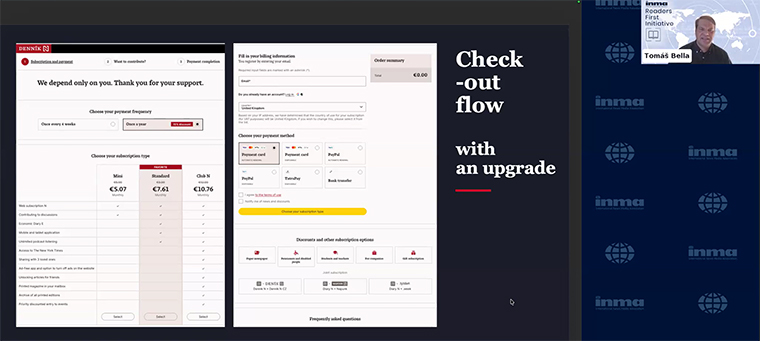
Bella described how Denník N has repeatedly tested pricing models, including offering two subscription tiers at launch — €5 and €9 — with no difference in benefits. “Still a lot of people chose the higher price,” he said, emphasising that multiple packages increase revenue even when the product is identical.
Bella explained Denník N’s decision to bill subscribers every four weeks instead of monthly.
“It’s like 3% difference in the revenue,” he said, adding that tests showed no negative impact on conversion rates, noting that in subscribers’ minds, “it’s the same. Also, it’s technically easier.”
A simple process
Walking INMA members through the company’s current checkout structure, he explained it has three subscription tiers — mini, standard, and Club N — and multiple landing pages tailored to different acquisition channels. Denník N hires external analysts specifically for pricing modelling because subscriber behaviour can be predicted “in a shockingly precise way.”
A key part of Denník N’s conversion strategy is minimising friction: “We always believed in asking for an absolutely minimum amount of information,” Bella said. In fact, the checkout requires only an e-mail address, with no password or demographic fields. He said this approach is possible because “70% of the money is from subscriptions,” so making conversion fast and easy is top priority.
Bella also noted that Denník N continues to offer one‑time payments — something that’s highly unusual today.
“We were trying to get rid of [one‑time payments] for 12 years and we couldn’t,” he said. Tests consistently showed that removing the option reduced performance. He attributed this to regional consumer habits: “So many people are scared of recurring payments.”
The company’s one-time payments mean more churn because many customers buy for four weeks, then churn, then return a week later to buy again, Bella said: “Some people exist like this for 10 years; they keep buying one-time subscriptions 10 times per year, but that’s kind of how they like it.”
Denník N publicly offers discounted prices for students, teachers, pensioners, and disabled readers. Bella said these discounts do not harm the brand and are rarely abused. “The fraud is non‑existent,” he said, explaining that readers view the discounts as fair and aligned with the publication’s values.
The “unlocking articles for friends” feature is the most popular benefit in the premium tier, Bella said. It allows subscribers to share paywalled articles with others, who must enter an e-mail address to access the content.
“This one actually works extremely well for us,” he said. In some cases, when the newspaper has written stories about political parties, the parties themselves have circulated unlocked links internally — generating thousands of new leads for Denník N.
“Now we have 2,000 email addresses… and we can try to sell those people something.”
Redefining quality
Part of the company’s success lies in rethinking how Denník N defines article quality: “The quality is what people want to pay for,” he said. Each morning, journalists receive a list of the previous day’s best‑converting articles. Each week, they receive individualised reports showing which of their stories converted and which did not.
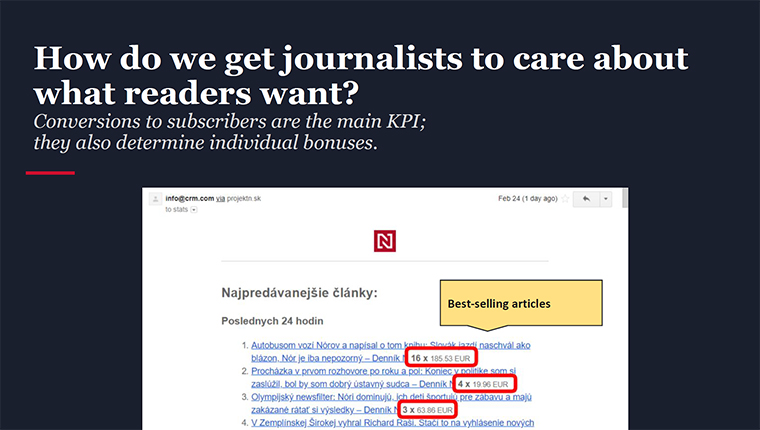
Bella emphasised that the metric is used for feedback, not punishment.
“After 12 years, we still haven’t fired a single person,” he said. “So it’s not a horrible place to work.”
Instead, the data informs hiring, coverage decisions, and even bonuses. Topics that convert well but are under‑reported lead to new hires. Topics that perform poorly may be reconsidered or covered differently. He cited coverage of the war in Ukraine as an example, noting that a daily military analysis column continues to convert strongly even as reader interest in other war‑related content declines.
Bella acknowledged that all metrics have intended consequences but can also have unintended consequences. However, providing no data is worse. Without feedback, “they’re not really being forced to think about what readers actually want,” he said. The goal is to make the metric actionable, particularly by identifying formats that consistently perform well.
He also described Denník N’s annual chart mapping article volume against conversions to identify gaps in coverage.
“The easiest thing to do is just say, okay, this one works very well, but it’s under‑reported. Let’s hire another person to do that,” he said.
Simplicity on the homepage
Piechota asked Bella about Denník N’s unusual homepage design, which has just two columns. On the left are long, paywalled articles, and on the right-hand side is a live blog. There aren’t any videos or large art elements, but Bella said that, although unusual, it was intentional.
“It started as a necessity and then became a strategy,” he explained. “We started with a very simple feed.”
Then, as the site grew, more elements were added. Bella said he tried introducing a more complex design many times over the years, but testing consistently showed that users preferred the simple, familiar design.
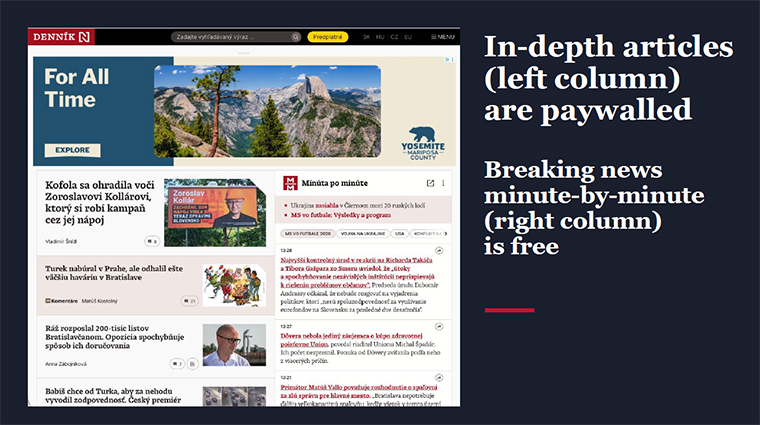
“In the end, if you are honest and if you are rigorous about how you do the Web site, if you are measuring actually what is happening… then it’s very hard to beat such a simple design.”
Banner photo: Adobe stock by terovesalainen
Related Articles
-

Bundling is a pricing decision, rebundling is an organisational...
18 October 2026 -

At Mediacorp’s CNA, loyalty means giving audiences a reason to ...
20 August 2026 -

Tribun Network turns print “dots” into AI-powered insight
20 August 2026 -

FT teams up humans with AI to create stronger sense of communit...
3 August 2026 -

Indian Express builds a video-first future around trusted journ...
20 July 2026 -

Grupo RBS builds social-first video operation to expand audienc...
20 July 2026 -

Why are audiences going to AI answer engines for news?
30 June 2026 -

Rheinische Post programme turns print loyalty into digital conf...
11 June 2026
Upcoming Events
-

Subscriber Acquisition Master Class
10-17 November 2026
-

Media Advertising Summit
New York, United States
07-10 December 2026
-

AI-Native News Product Master Class
18-25 February 2027
-

Media Subscriptions Summit
Oslo, Norway
08-12 March 2027
-

World Congress of News Media
New York, United States
25-30 April 2027
-

Branded Content & Partnerships Master Class
20-27 May 2027
-

Subscriber Retention Master Class
17-24 June 2027
-

Conferencia Latinoamericana
15-16 July 2027
-

South Asia News Media Festival
New Delhi, India
19-22 July 2027
-

Asia/Pacific News Media Summit
19-20 August 2027
-

CEO Roundtable at Kilkenny
Kilkenny, Ireland
24-26 August 2027
-

Media Innovation Week
Amsterdam, The Netherlands
27 September - 01 October 2027








