

Why are audiences going to AI answer engines for news?
Newsroom Innovation Initiative Blog | 30 June 2026

My newsroom friends, are you paying attention to what your audience actually wants?
Probably not, according to the latest Digital News Report released by the Reuters Institute for the Study of Journalism at Oxford, which surveyed about 100,000 news consumers all over the world.
And guess who is eating your lunch as a result? It should come as no surprise to any of you that the answer is ... AI answer engines.
Why are news consumers asking AI answer engines about news?
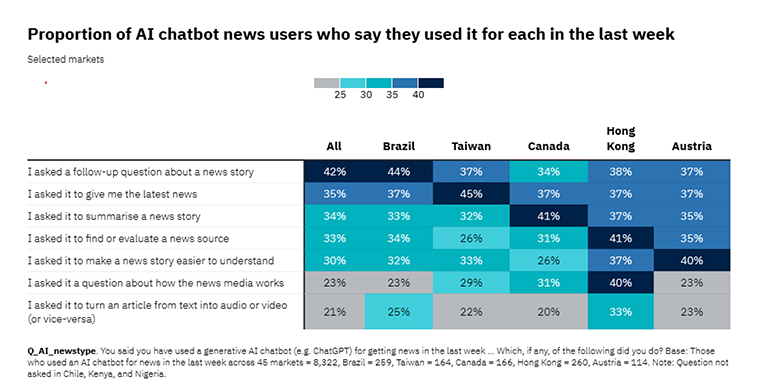
“Across 45 markets, asking chatbots a follow-up question is the clear front-runner, reported by 42% of users,” wrote researcher Amy Ross Arguedas.
About 34% of those surveyed use chatbots for summarisation, while 30% say they use them to make it easier to understand the news, she said.
In other words: We are spending time and effort writing articles that actually do not help our audiences get the information or the analysis they are looking for. They feel like they need to go to an AI answer engine to find what they need.
At the risk of stating the obvious, this is the exact opposite of what we should be trying to do.
We have talked endlessly for the past two decades about building a daily habit. Yet we are driving our audiences into the arms of AI companies because we make them feel stupid when they come to our content. They turn to their AI confidantes, which do not judge them for being ignorant, and quietly ask them to explain what they are reading.
Why is it that we cannot simply do a better job of meeting our audiences where they are, intellectually? Do we really have to keep writing as if we know everything and we assume our audiences do as well? Why don’t we give them what is relevant to their lives?
Also worth noting: Only 4% of those surveyed said they “always” or “often” click through to sources provided by AI answer engines. Those who do click through say the main reason is they want to verify the news or find out more about the source. This is in contrast with search and social media users, who generally click through to seek greater detail, the report said.
“Taken together, the findings suggest that people are not just using chatbots to receive news but also to navigate, interpret, assess, and simplify it,” Arguedas wrote.
“While some use (AI) to access the latest news, many are using it to interrogate, summarise, and evaluate information, pointing to a more expansive role that combines access with interpretation.
“The demand for simpler, more digestible news reinforces the value of clearer writing and summarised formats for time-poor audiences, while the appetite for follow-up questions points to opportunities to better anticipate audience needs through formats such as explainers or newsletters.
“For publishers already struggling with weakening links to audiences, this suggests a need to focus not only on visibility but on what makes their journalism distinct, including their role as trusted sources in a noisy information environment and deeper reporting that goes beyond what AI can easily replicate.”
If you’d like to subscribe to my bi-weekly newsletter, INMA members can do so here.
Banner art: Adobe stock image By Thapana_Studio.
Related Articles
-

Marketers should outsource tasks, not thinking
25 October 2026 -

WSJ executive councils show how publishers build communities th...
19 October 2026 -

AI’s effect on super user math
15 September 2026 -

At Mediacorp’s CNA, loyalty means giving audiences a reason to ...
20 August 2026 -

Tribun Network turns print “dots” into AI-powered insight
20 August 2026 -

Nation Media Group focuses editorial strategy on stories that m...
4 August 2026 -

Briefly News empowers journalists with AI tool suite Nova
4 August 2026 -

Indian Express builds a video-first future around trusted journ...
20 July 2026
Upcoming Events
-

Subscriber Acquisition Master Class
10-17 November 2026
-

Media Advertising Summit
New York, United States
07-10 December 2026
-

AI-Native News Product Master Class
18-25 February 2027
-

Media Subscriptions Summit
Oslo, Norway
08-12 March 2027
-

World Congress of News Media
New York, United States
25-30 April 2027
-

Branded Content & Partnerships Master Class
20-27 May 2027
-

Subscriber Retention Master Class
17-24 June 2027
-

Conferencia Latinoamericana
15-16 July 2027
-

South Asia News Media Festival
New Delhi, India
19-22 July 2027
-

Asia/Pacific News Media Summit
19-20 August 2027
-

CEO Roundtable at Kilkenny
Kilkenny, Ireland
24-26 August 2027
-

Media Innovation Week
Amsterdam, The Netherlands
27 September - 01 October 2027








