

FT teams up humans with AI to create stronger sense of community
Newsroom Innovation Initiative Blog | 03 August 2026
As editorial product director at the Financial Times, Hannah Sarney sits outside the editor’s office but spends her days working with product, tech, data, commercial, and marketing teams. Serving as a bridge between journalism and the systems that support it, one of her primary responsibilities is shaping the FT’s editorial subscriber engagement strategy.
During a recent Webinar presented by the INMA Newsroom Innovation Initiative, Sarney explained her reach extends to newsletters, audience diversity, data insights, and, increasingly, community journalism.
“The question that we’re always asking ourselves is how do you build community around quality journalism?” she said. The answer, she said, is not so much a fact, but a feeling: “And that is the feeling of being heard.”
People want to be seen as real people with authentic questions, ideas, and experiences instead of just being measured as a click or a pageview. With that in mind, the FT is moving from the idea of “audience” to one of “community.”
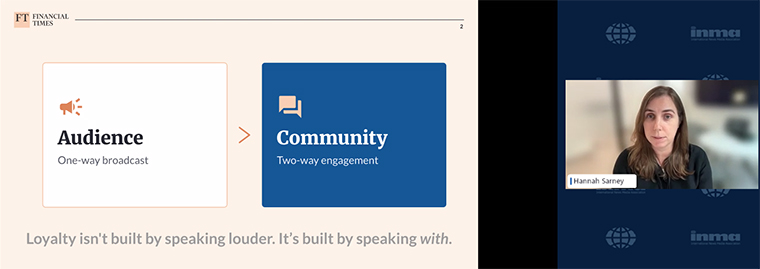
This isn’t just about making people feel good — although that is often a pleasant side effect; it’s more about strengthening journalism, deepening subscriber relationships, and building a more sustainable business model.
“Traditionally, news was a broadcast: we talk and they listen,” Sarney said. But today, publishers have both the opportunity and the responsibility to create belonging, moving from one‑way communication to two‑way engagement. Loyalty isn’t built by speaking louder: “It’s done by speaking with and listening to,” she added.
And at the FT, that shift is supported by something many publishers envy: a highly knowledgeable subscriber base.
The power of trust
FT commenters aren’t anonymous Internet users. They’re CEOs, central bankers, fund managers, professors, lawyers — people who often know as much, or sometimes more, about the topics being covered as the journalists themselves.
They don’t just consume FT journalism; they improve it. They spot typos, offer context, and share experiences that deepen reporting.
One subscriber captured the feeling perfectly: “I like the fact that you care enough about me as a reader to allow me on the stage with the author.”
Sarney said she still gets goosebumps when she reads that line aloud.
The data backs up the emotional impact.
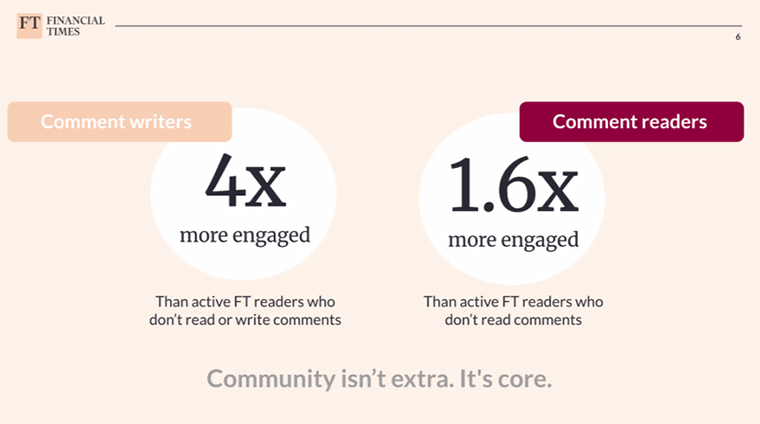
Subscribers who write comments are four times more engaged than those who don’t. Those who simply read comments — without writing anything — are still 1.6 times more engaged. Monthly subscribers who comment are 24% more likely to be retained, and converted trialists who comment are 76% more likely to stay subscribed.
Community isn’t extra, Sarney emphasised: It’s core.
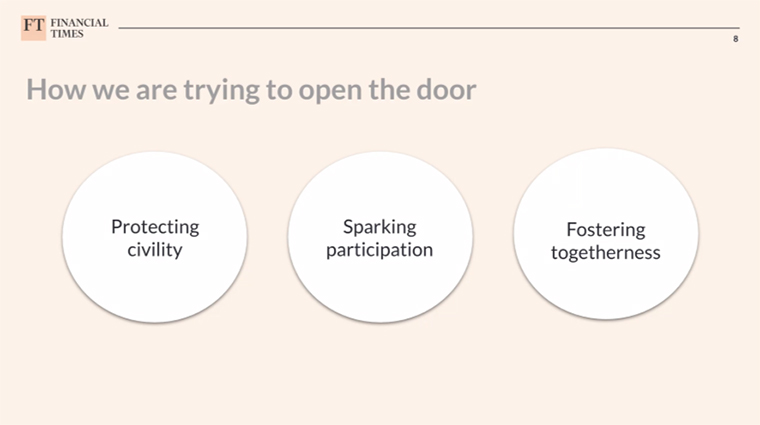
Of course, building community isn’t easy. Like every newsroom, the FT faces pressures, competing priorities, and limited time. And while more than half of FT subscribers read comments, only about 4% write them. Sarney doesn’t see that as apathy. She sees it as a sign that the door doesn’t feel open yet.
“We haven’t even fully beckoned people in,” she said. So the FT is focusing on three areas: protecting civility, sparking participation, and fostering togetherness.
Joining humans and AI for better moderation
Protecting civility begins with moderation. The FT’s moderation team sits within editorial and is led by Lucy Warwick‑Ching, head of community. They also use AI moderation through a tool called Utopia, which learns from human moderator decisions.
The goal, Sarney explained, is to lift the baseline of commenting quality while keeping humans firmly in control. It’s a partnership that reflects the company’s broader approach of leaning into AI as a support tool but maintains humans as the decision‑makers.
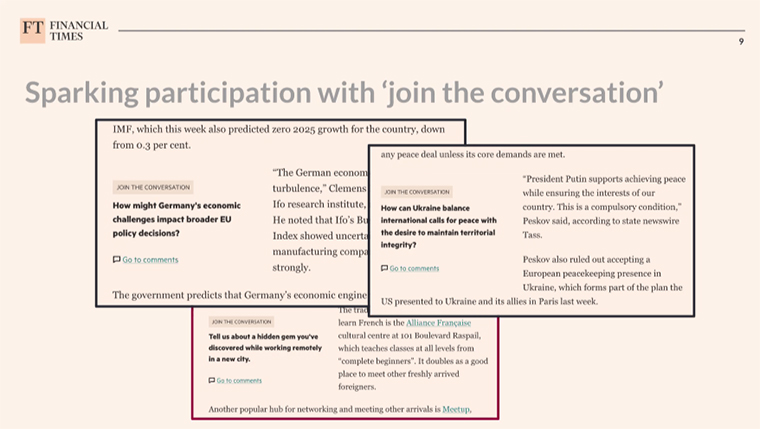
The FT has been experimenting more with sparking participation, testing a feature called “Join the Conversation.” It takes the same approach as starting an in-person conversation: asking an open‑ended question about the topic “with the intent of inviting more people into the conversation.”
Although it sounds simple — just write a question and publish it — scaling it across complex topics has been challenging. Reporters and editors need time to understand the story, craft thoughtful prompts, and check them through editorial layers.
So the FT turned to its AI team and began experimenting with prompts. When given a detailed prompt, the AI could generate useful questions in seconds. The community team then reviewed, edited, and published them.
The result has been more thoughtful conversations and more readers scrolling down to the comments — including people who had never participated before.
Sparking participation is only part of the equation though. The FT also wanted to build habits — ways for readers to engage regularly and directly with journalists. That led to one of the FT’s most successful community initiatives: Ask an Expert.
The FT already had a live Q&A function, but it was clunky, hard to find, and difficult to follow. “You had to really want to take part,” Sarney said.
The FT reimagined the experience and created a live chat where subscribers can ask questions directly to FT columnists, reporters, and experts. It looks and feels like a familiar chat interface, designed with product, tech, and design partners to encourage broad participation.
“We wanted to make it fun and easy and intuitive,” Sarney said, and that has been achieved.
The experience is rewarding and enjoyable for both subscribers and journalists. Readers can submit questions ahead of time, set calendar reminders, and easily catch up afterward. The sessions live on as evergreen content, and the FT tracks page views, time spent, repeat visits, and diversity of journalist participation.
The results are impressive; thousands of subscribers have created comment profiles for the first time specifically to participate in Ask an Expert. “These are people that have never set up their comment or profile, which means they’ve never been down in that space,” Sarney pointed out. “They’re setting them up to engage in this arena because it’s making more sense and feels right to them.”
Subscribers love the personal nature of the interaction and how easy it is to participate. And they’re actively seeking out past and upcoming sessions through MyFT, the platform’s personalisation tool. The FT is now exploring ways to make Ask an Expert even more interactive, including allowing subscribers to “upvote” their favourite questions asked by other subscribers.
At the heart of it all is trust: “Community builds trust,” Sarney said. “And we know that trust is what future‑proofs our journalism. It builds loyalty and it builds habit.”
Banner photo: Adobe stock by InfiniteFlow.
Related Articles
-

Marketers should outsource tasks, not thinking
25 October 2026 -

Bundling is a pricing decision, rebundling is an organisational...
18 October 2026 -

AI’s effect on super user math
15 September 2026 -

At Mediacorp’s CNA, loyalty means giving audiences a reason to ...
20 August 2026 -

Tribun Network turns print “dots” into AI-powered insight
20 August 2026 -

Nation Media Group focuses editorial strategy on stories that m...
4 August 2026 -

Briefly News empowers journalists with AI tool suite Nova
4 August 2026 -

Indian Express builds a video-first future around trusted journ...
20 July 2026
Upcoming Events
-

Subscriber Acquisition Master Class
10-17 November 2026
-

Media Advertising Summit
New York, United States
07-10 December 2026
-

AI-Native News Product Master Class
18-25 February 2027
-

Media Subscriptions Summit
Oslo, Norway
08-12 March 2027
-

World Congress of News Media
New York, United States
25-30 April 2027
-

Branded Content & Partnerships Master Class
20-27 May 2027
-

Subscriber Retention Master Class
17-24 June 2027
-

Conferencia Latinoamericana
15-16 July 2027
-

South Asia News Media Festival
New Delhi, India
19-22 July 2027
-

Asia/Pacific News Media Summit
19-20 August 2027
-

CEO Roundtable at Kilkenny
Kilkenny, Ireland
24-26 August 2027
-

Media Innovation Week
Amsterdam, The Netherlands
27 September - 01 October 2027








