

VG turned AI video into discovery engine for premium content
Ideas Blog | 14 September 2026

At VG, Norway’s biggest news site, only 12%-13% of front-page exposure goes to paid content. At the same time, we saw a familiar pattern: Strong stories disappeared from the front page within hours, even with a clear reader value days, weeks, and months later.
That mattered especially in consumer and personal finance journalism — two of our strongest subscription drivers. We were producing premium stories with long shelf lives, but too many still depended on a single, fast-moving surface for discovery.
That is not just an editorial challenge. It is a product challenge.
So we asked: Could AI help us create more entry points to premium journalism without compromising editorial quality?
AI works with journalists
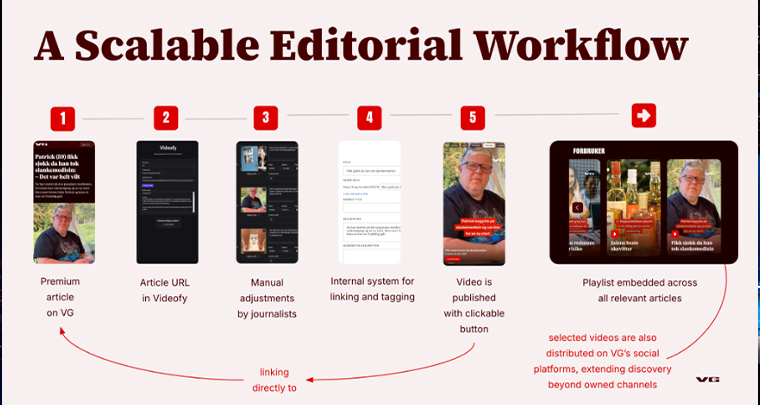
We built a custom VG+ workflow around Videofy, an AI-powered text-to-video tool, developed within Schibsted, originally at VG. Schibsted has since open-sourced a base version of Videofy on GitHub, making the technology available to developers and media organisations beyond our own newsroom.
The tool generates a first video version in seconds. That allows journalists to spend less time on repetitive production and more time on editing, context, and editorial judgment.
Our guiding principle was simple: AI handles repetitive production. Journalists remain responsible for editorial decisions.
Every video is reviewed, edited, and approved by our newsroom before publication.
Distribution beyond the front page
We did not treat video as a stand-alone format; we built a distribution system around it.
Videos are published in Stories, our vertical, swipeable format, organised into topic-based playlists and embedded across relevant articles. Each video includes a clear path to the full story.
The short video is not the product; it is a bridge into the journalism.
That changed how premium content is discovered. Instead of relying on a single, fast-moving front page, stories can now surface through playlists, article embeds, vertical feeds, and social platforms.
Readers can get a quick video overview in 30 seconds and go deeper with one tap. For subscribers, VG+ becomes easier to explore. For non-subscribers, the path into paid journalism becomes more natural, efficient, and aligned with the visual, mobile-first habits we see in younger audiences.
Compelling results
This quickly proved to be more than a packaging experiment.
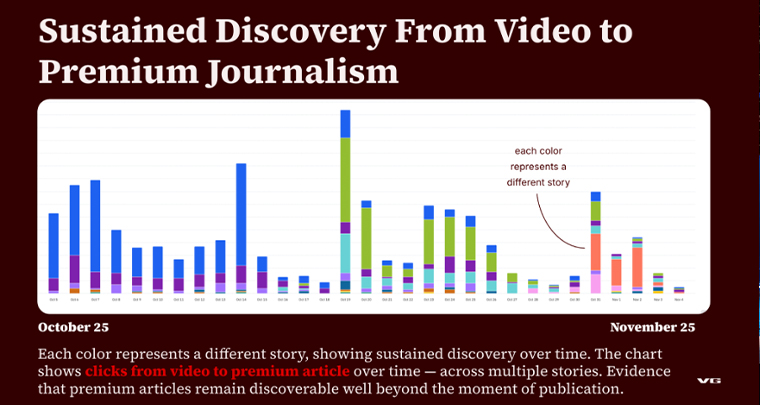
In many stories, more than 20% of viewers clicked from the video to the full article. In our consumer category alone, videos generated 1 million+ views in 2025. One premium story comparing electric and fossil cars in icy conditions converted 25.7% of viewers. A viral sleep-hack story reached 477,990 views on TikTok and 232,000 on Instagram, with a 23.5% click-through to the article.
Just as importantly, engagement persisted over time. Stories continued to generate traffic weeks and months after leaving the front page, extending the life of our journalism.
The sleep-hack case also influenced how we design articles. Reader data revealed a clear drop-off point. By making seven small editorial adjustments to pacing and structure, we increased completion by 10% — without changing the journalism itself.
Another premium story — a visual-first guide to Christmas pork ribs — saw a 74% completion rate and an average read time of 2:18.
Video has evolved from a promotional tool into a driver of product and editorial learning.
Build systems, not experiments
For us, video is no longer just a promotional layer. It has become part of how we design premium journalism.
Working more visually has led us to rethink the article experience itself — improving pacing, strengthening visual guidance, and in some cases adding interactive elements supported by AI.
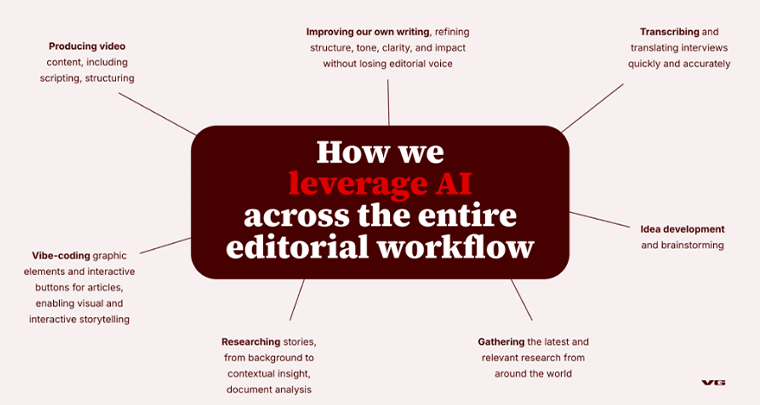
Beyond video, we now use AI across the workflow: idea generation, transcription, translation, research support, and improving structure and clarity. The principle remains the same: AI should solve a real editorial or user problem, not exist for its own sake.
The key lesson is to build systems, not isolated experiments.
AI creates the greatest value when it is aligned with a clear reader need and a well-defined business objective. For us, this meant reducing dependency on the front page, making VG+ more visual and easier to navigate, and extending the lifespan and value of our premium journalism. AI has enabled us to do this more efficiently while also unlocking the ability to scale our video production.
The goal is not more content. The goal is unique journalism. AI is valuable when it helps us create that journalism faster, package it better, and connect it more effectively with the audiences willing to pay for it.
Related Articles
-

Marketers should outsource tasks, not thinking
25 October 2026 -

AI’s effect on super user math
15 September 2026 -

At Mediacorp’s CNA, loyalty means giving audiences a reason to ...
20 August 2026 -

Tribun Network turns print “dots” into AI-powered insight
20 August 2026 -

Nation Media Group focuses editorial strategy on stories that m...
4 August 2026 -

Briefly News empowers journalists with AI tool suite Nova
4 August 2026 -

Indian Express builds a video-first future around trusted journ...
20 July 2026 -

Grupo RBS builds social-first video operation to expand audienc...
20 July 2026
Upcoming Events
-

Subscriber Acquisition Master Class
10-17 November 2026
-

Media Advertising Summit
New York, United States
07-10 December 2026
-

AI-Native News Product Master Class
18-25 February 2027
-

Media Subscriptions Summit
Oslo, Norway
08-12 March 2027
-

World Congress of News Media
New York, United States
25-30 April 2027
-

Branded Content & Partnerships Master Class
20-27 May 2027
-

Subscriber Retention Master Class
17-24 June 2027
-

Conferencia Latinoamericana
15-16 July 2027
-

South Asia News Media Festival
New Delhi, India
19-22 July 2027
-

Asia/Pacific News Media Summit
19-20 August 2027
-

CEO Roundtable at Kilkenny
Kilkenny, Ireland
24-26 August 2027
-

Media Innovation Week
Amsterdam, The Netherlands
27 September - 01 October 2027








