

Amid a flood of content, Nation develops ways to stop doing commodity news
Newsroom Innovation Initiative Blog | 12 August 2026

Here is a struggle that might sound familiar: Kenya’s Nation Media Group doesn’t have trouble finding stories. Indeed, it is awash with a flood of content. Its challenge is finding stories that are valuable.
Editors assign dozens of stories a day at Nation, the largest independent media house in east and central Africa, with operations in print, broadcast, and digital media and audiences in Kenya, Uganda, Tanzania, and Rwanda.
“The question is, realistically, how many stories can you publish? And by publish, I don’t just mean putting them out there on the platform but publishing well,” said Harry Misiko, Nation’s managing editor of content strategy, at the recent INMA Africa Newsroom & Tech Summit.
This problem is manifested in several ways, he said.
“You have hundreds of story ideas coming through — pitches from editors, from writers, from reporters, from correspondents, from contributors, from columnists — and then you have this limited budget to work with, and this is across the continent.”
The newsroom can only handle so many stories, and the homepage can only accommodate so many stories, he said.
“So, the headache for any newsroom manager like myself is actually making those editorial choices. And the question is, if you didn’t make any choice, what will be the cost of covering everything?”
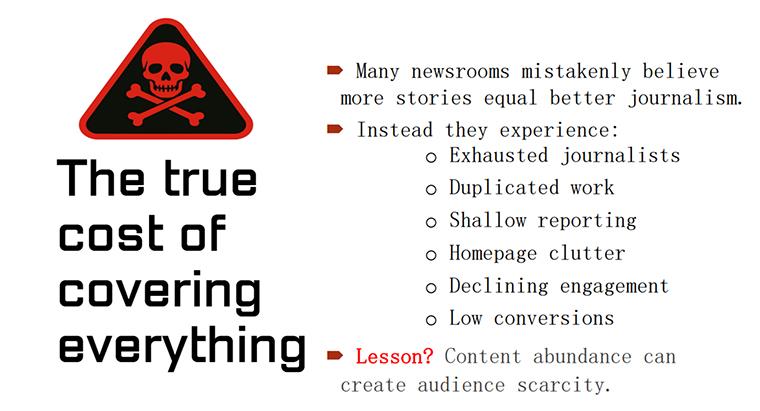
You will end up with “a newsroom full of reporters who are very exhausted and editors who are very burned out,” he said. “There is a lot of duplication across your coverage. It will obviously be very, very, very shallow. The homepage will be cluttered because you’re pushing almost everything there. There is a declining engagement.”
Nation’s approach to solving the problem is: “Instead of asking, ‘Can we cover this story?’ we ask, ‘Should we cover and publish this?’”
To answer the question, Misiko uses a simple framework that examines:
Editorial value: Public interest, accountability, national importance.
Audience value: Which user need does it meet?
Business value: Does it have subscriber value, conversion potential, or retention potential, or does it help build brand?
Resource cost: Time, money, staff, logistics.
A story needs to tick two or three of the boxes before Nation decides to pursue it.
For example, there is an election coming up in Kenya, and Nation does not have the resources to chase or quote every politician.
“Our priority will be around deeper and deeper analysis, exclusive interviews, a bit of data journalism, fact checks, explainers, accountability, journalism, and candidate trackers. All these will help us get more value than chasing every politician, every press release, every press conference and every press statement,” Misiko said.
“It’s actually going to help us get more value and much, much less noise.”
Nation also uses a story matrix to make decisions on content strategy.
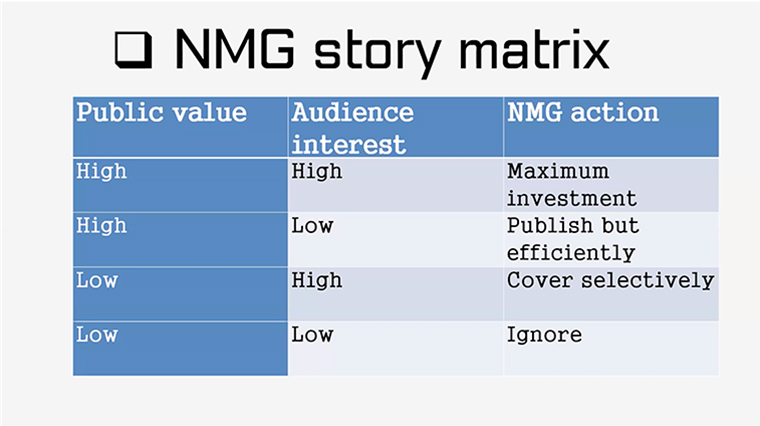
Nation puts 40% of its budget on high-impact stories, 30% on enterprise journalism, 20% on daily news, and 10% on story format experiments.
Easy, right? Actually, no.
“Every other stop is the start of another thing,” Misiko said. “We have had so many issues to deal with. The breaking news culture. Before we switched to this, we were the biggest news breakers around Kenya. Nowadays, we are very selective. Maybe we let others break the story but go look for the premium, the story behind the story, and do that one.
“You see a reporter running to you and telling you, ‘Are we not missing out on this big story?’ And you're like, ‘That is the cheap sauce. Can we go chase this other side of the story? And we’ll publish later, but it will be meaningful.’”
Also: “It actually takes double the time to end an entrenched culture, and culture change is not the easiest of things to do in a newsroom, especially for legacy museums like myself, like the one I worked at.”
The newsroom uses an AI tool that helps them distinguish between “red angles” and “green angles,” reflecting stories that have been “covered to death” and others that have not and are strong opportunities.
Nation also faces commercial and political pressure to cover news, with people demanding, “‘I had a press conference. Why was it not covered? We had this event as a business. We didn’t see your people. How can we get it covered?’ We are not listening much. We have to align in terms of what we are pursuing, and we have very cautious but fair responses to those requests.”
If your newsroom is grappling with this issue, Misiko offers the following advice:
Not every story deserves equal effort.
Depth will always beat volume.
Always choose quality over quantity. Traffic and conversions are both higher.
Remember every assignment has an opportunity cost.
Editors create focus, not just content.
Say no more often.
Change the conversation at your story planning meetings from “what happened” to “what matters most.”
If you’d like to subscribe to my bi-weekly newsletter, INMA members can do so here.
Banner image: Adobe stock image by Lightfield Studios.
Related Articles
-

VG turned AI video into discovery engine for premium content
14 September 2026 -

What news CEOs are investing in — and what they are killing
8 September 2026 -

USA Today asks: Is a human really needed in every loop?
25 August 2026 -

WSJ Japan finds AI translation is “not a one-and-done deal”
24 August 2026 -

Legit’s Briefly News introduced an AI tool that wins the newsro...
11 August 2026 -

BusinessDay moves from business content to business intelligenc...
6 August 2026 -

Nation Media Group focuses editorial strategy on stories that m...
4 August 2026 -

NDTV looks beyond AI novelty to build products that deliver rea...
21 July 2026
Upcoming Events
-

Subscriber Acquisition Master Class
10-17 November 2026
-

Media Advertising Summit
New York, United States
07-10 December 2026
-

AI-Native News Product Master Class
18-25 February 2027
-

Media Subscriptions Summit
Oslo, Norway
08-12 March 2027
-

World Congress of News Media
New York, United States
25-30 April 2027
-

Branded Content & Partnerships Master Class
20-27 May 2027
-

Subscriber Retention Master Class
17-24 June 2027
-

Conferencia Latinoamericana
15-16 July 2027
-

South Asia News Media Festival
New Delhi, India
19-22 July 2027
-

Asia/Pacific News Media Summit
19-20 August 2027
-

CEO Roundtable at Kilkenny
Kilkenny, Ireland
24-26 August 2027
-

Media Innovation Week
Amsterdam, The Netherlands
27 September - 01 October 2027








