

Legit’s Briefly News introduced an AI tool that wins the newsroom over
Newsroom Innovation Initiative Blog | 11 August 2026

In 2025, a team from Legit’s Briefly News unit created a custom GPT called Editorial Eye to help editors by ensuring a story met basic standards and was well-structured.
This was essential because each of Legit’s projects has 25-40 writers who produce up to six articles a day — and only one or two copy editors, Riannette Cluley, Briefly director and former editor-in-chief, told attendees at the recent INMA Africa Newsroom & Tech Summit.
“So, there’s a mass amount of articles or copy editors have to check daily, and it just wasn’t realistic or sustainable to expect them to go through all that content every day,” Cluley said.
The tool “would get nearly perfect copy to the copy editor, and what this actually did is it allowed our copy editors double the amount of articles they could check daily, and they could spend more time on fact-checking, verifying, etc.”
Alas, the tool did not work flawlessly: “Running all five Editorial Eye steps could take you anywhere between two minutes and 10 minutes, which doesn’t seem like a lot, but for someone writing 10 or six articles a day, it adds an hour to an already tight deadline,” she said.
The team also hard launched the product to all four projects using only one paid ChatGPT account, “which led to incredibly annoying glitches, hallucinations.” For example, Editorial Eye highlighted areas that didn’t exist in copy, and, because of this, writers ended up spending more time looking for the error that wasn’t there than actually fixing real errors.
“What we learned was that we needed to go through a testing phase with a control group beforehand to ensure annoying glitches were fixed,” Cluley said.
Using the custom GPT also meant writers had to have a number of browser tabs open, and moving back and forth between the CMS and the custom GPT slowed down work on an already tight deadline.
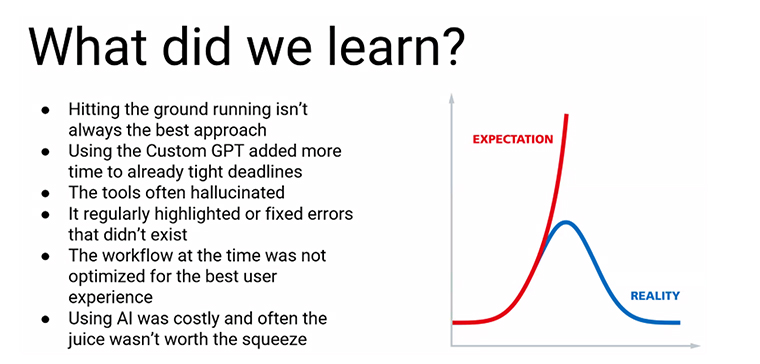
“We had to start thinking about how we could make it better and more user friendly. And using these AI tools is also incredibly costly, and very often what you pay for the juice is just not worth the squeeze. So our newsrooms, being quite small and having quite tight budgets, we just simply couldn’t afford the enterprise package fees associated with many of these LLMs and other tools,” she said.
The team had to start the whole process over again. They started collecting feedback from their writers on what they liked about Editorial Eye and which glitches they most often ran into.
“They also shared their ideas for optimisation, and we also asked them what their ideal tool would look like or how would it function day-to-day.”
The team then found a tool that met their users’ needs, soft launched it to a small control group, and collected feedback from them daily.
“This was incredibly helpful, and we took a top-to-bottom approach,” Cluley said. “Heads of departments worked with it before the writers worked with it, and they would tell us it’s glitching on this or it’s not getting that right. So, we could fix it almost immediately.”
Once they were satisfied, the tool was made available to the rest of the writers. They also had a core group of writers who supported using the new tool after everyone else already had a negative experience.
“It was important that we had people that kind of sold the new tool to the writers, and that’s exactly what that small control group did.”
For any other newsroom embarking on this journey, Cluley has the following advice:
“Just identify a need. Don’t forget to ask your newsroom ... . They’ll know best what AI could really help with.”
“Once you’ve completed your needs analysis, start researching the tools that best fit your needs.”
“Then build or buy your tool and soft launch it to a small control group. I would highly suggest the top using it first, bottom last, and then gather their feedback and optimise it as and when needed.”
“Based on your control group’s feedback, decide whether the juice is worth the squeeze. Are you spending too much for too little payoff, or has it benefitted your user massively?”
“If you’re still in doubt, I’ll leave you with this: Collaboration is essential. Reach out to your peers in the industry, read those case studies, attend those workshops, and truly challenge your understanding or your opinions of AI adoption in your newsroom. You’d be surprised how much you can learn from others.”
If you’d like to subscribe to my bi-weekly newsletter, INMA members can do so here.
Banner photo: Adobe stock image By InfiniteFlow.
Related Articles
-

Marketers should outsource tasks, not thinking
25 October 2026 -

What’s next for newsletters in the age of AI?
21 October 2026 -

How to market news subscriptions in the era of AI content
20 October 2026 -

Bundling is a pricing decision, rebundling is an organisational...
18 October 2026 -

AI’s effect on super user math
15 September 2026 -

Tribun Network turns print “dots” into AI-powered insight
20 August 2026 -

Africa’s news companies are finding their strategy in what they...
9 August 2026 -

BusinessDay moves from business content to business intelligenc...
6 August 2026
Upcoming Events
-

Subscriber Acquisition Master Class
10-17 November 2026
-

Media Advertising Summit
New York, United States
07-10 December 2026
-

AI-Native News Product Master Class
18-25 February 2027
-

Media Subscriptions Summit
Oslo, Norway
08-12 March 2027
-

World Congress of News Media
New York, United States
25-30 April 2027
-

Branded Content & Partnerships Master Class
20-27 May 2027
-

Subscriber Retention Master Class
17-24 June 2027
-

Conferencia Latinoamericana
15-16 July 2027
-

South Asia News Media Festival
New Delhi, India
19-22 July 2027
-

Asia/Pacific News Media Summit
19-20 August 2027
-

CEO Roundtable at Kilkenny
Kilkenny, Ireland
24-26 August 2027
-

Media Innovation Week
Amsterdam, The Netherlands
27 September - 01 October 2027








