

How to market news subscriptions in the era of AI content
Readers First Initiative Blog | 20 October 2026

Faced with unlimited content supply from creators and AI, the top news publishers differentiate their journalism and help consumers see the difference.
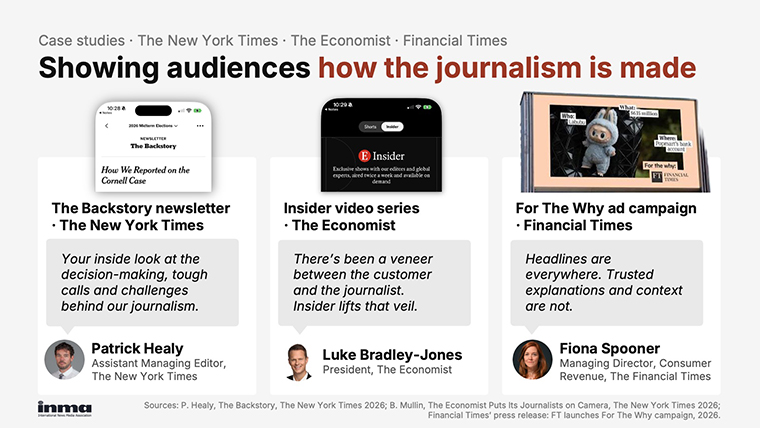
Last week, The New York Times launched The Backstory, a weekly newsletter and audio edition from Patrick Healy, its assistant managing editor for standards and trust, promising “an inside look at the decision-making, tough calls, and challenges" behind its journalism.
The first edition showed how reporters chose what to publish first from 1,000 pages of confidential Cornell University records on an alleged gang rape and an argument with a media critic who thinks the newspaper is too soft on U.S. President Donald Trump.
The Financial Times started this year a new global campaign “For The Why,” which featured its expert journalists and followed a simple structure — the who, what, and where draw the reader in, then the why is revealed as the thing worth subscribing for.
“Headlines are everywhere, trusted explanations and context are not,” explained Fiona Spooner, managing director/consumer revenue.
In the summer, the Economist, unveiled Economist Play, a new audio- and video-first subscription product hosted by its correspondents. It’s a huge change — for the first 183 years, the newspaper carried no bylines.
President Luke Bradley-Jones said the aim was to stress the “artisanal, human-crafted” aspects of journalism made without AI.
The Irish Independent has reserved 15 out of 25 slots on its home page for “signature journalism.” The group-wide programme at its publisher Mediahuis defined this as original work, human-made, and matching its brands’ purpose.
“Signature journalism” is measured by subscriber attention time, in Editor Cormac Bourke’s words, “the metric of quality rather than quantity of engagement.”
Signals about how news is made
Traditionally, news publishers marketed subscriptions through sampling and trials because well-made and presented content from a known brand used to be a reliable signal.
This approach no longer holds as a Web site’s content or look, on their own, indicate nothing. By June, NewsGuard had identified 3,749 AI news farms internationally. They churn out dozens of articles a day and often spread false claims.
In the meantime, per Reuters Institute, trust in the news has fallen globally to a record low of 37%, while audiences increasingly turn to independent creators over traditional institutional media, even if they trust them less.
Academics have found people care about clues about how news was made:
Last year researchers in Germany described a news site to 1,261 people. Half were told their stories were written by journalists, half that AI wrote them. The AI group trusted the site less.
In the U.S. and U.K., an “AI-generated” label made people rate even true, human-written headlines as less accurate because they assumed no human was involved.
In Chile, the two things that most restored trust were a visible human in charge and an honest note about what the AI did.
Seeing the value of journalism
Journalism is not news, nor content. Let me offer a metaphor: News is raw eggs. Journalism is cooking them into an omelette.
Witnessing, verification, investigation, and sense-making — the four core tasks of journalism, as described by George Brock, former professor at City St. George’s, University of London — are the work that turns raw information into something useful, reliable, and accountable.
The problem is what consumers search for and what subscribers pay for is now something they cannot see, nor verify.
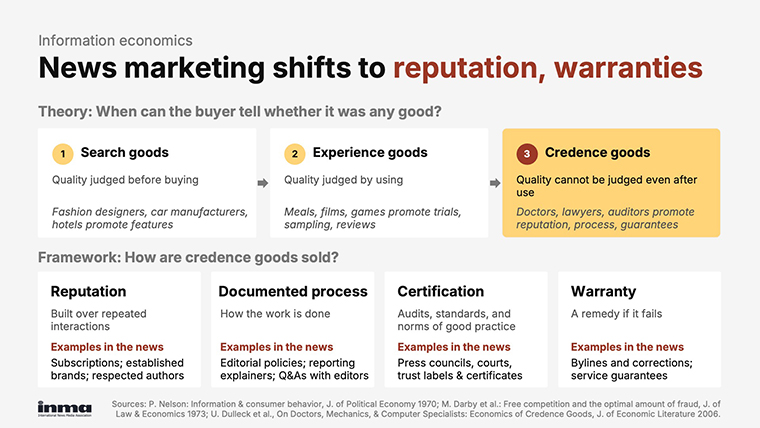
A classic theory in information economics categorises how consumers evaluate the quality of products and services, and offers a guide how to market them:
Search goods: Consumers can easily evaluate features and prices without buying the products first — clothes or cars, for example.
Experience goods: Quality cannot be easily judged before using or tasting the product — restaurant meals, video games, or movies, for example.
Credence goods: Consumers lack the expert knowledge or skills to assess if the service was done correctly even after using the product — clinical diagnosis, legal advice, financial audits, for example.
The new ingredients of news marketing
Because credence goods rely on blind trust, doctors, lawyers, or financiers build their reputation over repeated interactions, document their processes, surrender to audits and certification of “good practices,” and offer warranties.
Journalism has it all:
Subscriptions promise long-term investment in reporting.
Editorial policies are regularly reviewed and updated.
Established brands act as guarantors of quality.
Courts and press councils police adherence to professional standards.
And bylines and corrections offer both accountability and warranty.
Now is the time to communicate all these attributes to consumers. The New York Times is selling its process, the FT, its certified experts. The Economist gave its reputation a face, and the Irish Independent, most of its home page.
The trial or free sampling will no longer be enough.
Greg’s Readers First newsletter is a public face of a revenue and media subscriptions initiative by INMA, outlined here. INMA members can subscribe here.
Banner photo: Adobe Stock by DBFilms.
Related Articles
-

Marketers should outsource tasks, not thinking
25 October 2026 -

Bundling is a pricing decision, rebundling is an organisational...
18 October 2026 -

AI’s effect on super user math
15 September 2026 -

At Mediacorp’s CNA, loyalty means giving audiences a reason to ...
20 August 2026 -

Tribun Network turns print “dots” into AI-powered insight
20 August 2026 -

Nation Media Group focuses editorial strategy on stories that m...
4 August 2026 -

Briefly News empowers journalists with AI tool suite Nova
4 August 2026 -

Indian Express builds a video-first future around trusted journ...
20 July 2026
Upcoming Events
-

Subscriber Acquisition Master Class
10-17 November 2026
-

Media Advertising Summit
New York, United States
07-10 December 2026
-

AI-Native News Product Master Class
18-25 February 2027
-

Media Subscriptions Summit
Oslo, Norway
08-12 March 2027
-

World Congress of News Media
New York, United States
25-30 April 2027
-

Branded Content & Partnerships Master Class
20-27 May 2027
-

Subscriber Retention Master Class
17-24 June 2027
-

Conferencia Latinoamericana
15-16 July 2027
-

South Asia News Media Festival
New Delhi, India
19-22 July 2027
-

Asia/Pacific News Media Summit
19-20 August 2027
-

CEO Roundtable at Kilkenny
Kilkenny, Ireland
24-26 August 2027
-

Media Innovation Week
Amsterdam, The Netherlands
27 September - 01 October 2027








