

What’s next for newsletters in the age of AI?
Readers First Initiative Blog | 21 October 2026

As AI takes over inboxes, are newsletters in peril?
That was the question Greg Piechota posed during this week’s INMA Subscription Masters Webinar. INMA’s researcher-in-residence and lead of the Readers First Initiative sat down with Dan Oshinsky, founder of Inbox Collective and one of the most respected authorities on newsletter strategies, to explore the opportunities and threats newsletters face today.
Piechota began by focusing on new research from Northeastern University measuring online attention. Using a new metric — time spent in an active browser tab — the research made a surprising discovery.
“They found that Americans spend almost as much time on e-mail as on social media,” he said, noting this is different from what publishers typically see in Comscore or Similarweb data.
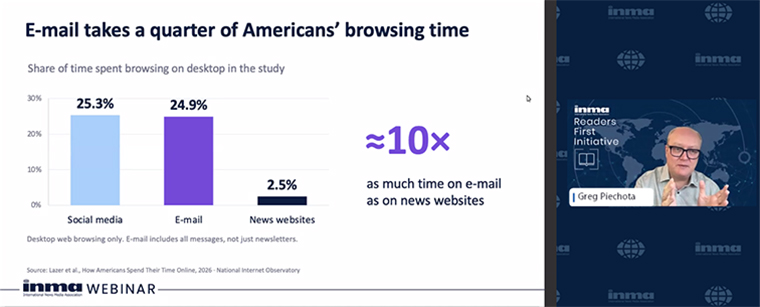
This new information represents a significant opportunity, he said.
While publishers often invest heavily in social media teams — sometimes with more than 100 staffers — e-mail remains comparatively underdeveloped despite its reach and engagement potential.
Benchmarking data from hundreds of publishers shows that the median outlet reaches only 12%-13% of households in its service area with newsletters, while the top quartile reaches 30%.
“You can actually triple your penetration if you want to get to the performance of the upper quartile,” he said.
Piechota also pointed out that publishers typically have far more newsletter subscribers than digital subscribers, making e-mail a powerful acquisition channel. Many outlets have large pools of “known users” — people who have registered or provided a phone number — who could be converted into newsletter recipients with minimal friction.
But looming over all of this, he warned, is “the elephant in the room … the AI inbox.”
As inboxes increasingly filter, sort, and summarise messages using AI, publishers must rethink how to ensure their newsletters remain visible, valued, and opened.
AI has entered the inbox
Oshinsky joined the conversation and immediately acknowledged the rapid evolution of AI inside inboxes. Gmail, Yahoo, and Microsoft are already integrating AI tools like Gemini to sort messages, surface priority content, and suppress e-mails users rarely engage with.
“AI is starting to come into the inbox in really interesting ways,” he said, noting inboxes increasingly decide what users see — and what gets buried.
While a small segment of power users may rely almost entirely on AI agents to read, summarise, and respond to e-mail, that’s not the norm. Oshinsky pointed to a recent viral post from Every’s founder, Dan Shipper, who declared “newsletters are dead” because his AI agents handle everything.
“Dan is in the top 1% of 1% of AI power users,” Oshinsky said, reminding that while some people might not need to check e-mails often, for most, the inbox is fully integrated into our lives.
“It’s very difficult for me to imagine a world in which that built-in habit of using e-mail to communicate, to share ideas, to share a note with somebody, a letter with somebody, to read content that you like — it’s very difficult for me to imagine that habit being broken,” Oshinsky said.
Even as AI becomes more aggressive in its filtering, most users will still want to read certain e-mails themselves. That is especially true of e-mails from distinctive voices or trusted brands.
Instead of disappearing, Oshinsky believes inboxes will begin to resemble podcast feeds: curated, personalised, and ranked by engagement. Newsletters will need to earn their place at the top.
“Just getting into the inbox isn’t going to be good enough anymore,” he said. If readers don’t open or click, AI will push those emails down — or out.
Creating a newsletter worth opening
Certain qualities define successful newsletters today, and those qualities will matter even more as AI becomes a gatekeeper.
Oshinsky outlined four key elements of a good newsletter.
- Depth of expertise and analysis. The strongest newsletters go deep. They offer insight, context, and clarity — not just a list of links. He added that readers increasingly expect substance.
- Personality. Independent creators have raised the bar by writing with personality and perspective. Oshinsky pointed to Stratechery and Lenny’s Newsletter as examples of writers whose voices build loyalty. “You have this person that you really trust … you have a relationship with him,” he said. Publishers can emulate this by letting reporters or editors bring more of themselves into the product — even if that is done in small ways, such as Q&As or weekly recommendations.
- A clear job to be done. Great newsletters tell readers exactly what they will get: a daily briefing, one actionable idea, a curated digest. “Having a really clear job is super important,” Oshinsky said. Readers should be clear on exactly what they’re getting when they sign up.
- Community connection. Newsletters can be a gateway into deeper engagement — events, Slack groups, membership programmes, etc. “Your newsletter serves to feed the community,” he explained, helping readers feel part of something meaningful. “Once they’ve joined and are participating, it keeps them engaged.”
The rise of personalisation
As inboxes become more personalised, newsletters must follow suit. Oshinsky introduced his “user ladder” framework, which maps the journey from anonymous reader to paying “super loyal” supporters. Most publishers stop at step two — collecting an e-mail address — but he suggested that deeper data is essential.
“I think there’s a couple missing steps there. One is learning a little bit more about your audience,” he said.
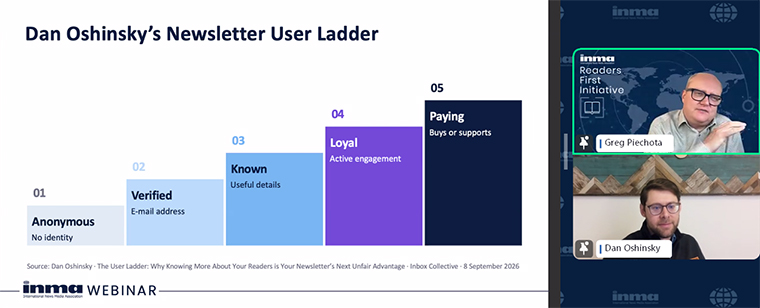
Publishers should learn about the audience’s interests, location, parental status, and on-site reading habits.
“If you’re a B2B publisher, it might be stuff around where you work, where you live, how senior your title is, so that way we know a little bit more about what we should put in front of you,” he explained. “If you are an executive in a certain line of business, you’re going to want a different type of content than someone who is entry-level.”
Such data allows for personalised digests, targeted event invitations, and more relevant content recommendations.
“The more we can learn about readers… the more likely we can use the personalisation tools as they come,” he said.
He also offered practical ways to collect this data without hurting sign-up rates, such as post‑signup surveys, event registrations, giveaways, and existing forms: “You already have an e-mail address. They’re in. Then we can ask.”
AI and content creation
Oshinsky urged publishers to use AI cautiously for newsletters: “I personally don’t use AI a lot for creation,” he said, warning AI‑generated content often feels generic — the opposite of what inboxes reward.
Instead, he sees the value of AI for such tasks as process automation, ideation, analysis, and content surfacing.
“I think it still really matters when you see a unique story, a unique marketing ask, a unique newsletter,” he said. “I think unique voices still matter.”
Related Articles
-

Marketers should outsource tasks, not thinking
25 October 2026 -

Bundling is a pricing decision, rebundling is an organisational...
18 October 2026 -

AI’s effect on super user math
15 September 2026 -

At Mediacorp’s CNA, loyalty means giving audiences a reason to ...
20 August 2026 -

Tribun Network turns print “dots” into AI-powered insight
20 August 2026 -

Nation Media Group focuses editorial strategy on stories that m...
4 August 2026 -

Briefly News empowers journalists with AI tool suite Nova
4 August 2026 -

Economist launches subscription tier targeting younger audience...
20 July 2026
Upcoming Events
-

Subscriber Acquisition Master Class
10-17 November 2026
-

Media Advertising Summit
New York, United States
07-10 December 2026
-

AI-Native News Product Master Class
18-25 February 2027
-

Media Subscriptions Summit
Oslo, Norway
08-12 March 2027
-

World Congress of News Media
New York, United States
25-30 April 2027
-

Branded Content & Partnerships Master Class
20-27 May 2027
-

Subscriber Retention Master Class
17-24 June 2027
-

Conferencia Latinoamericana
15-16 July 2027
-

South Asia News Media Festival
New Delhi, India
19-22 July 2027
-

Asia/Pacific News Media Summit
19-20 August 2027
-

CEO Roundtable at Kilkenny
Kilkenny, Ireland
24-26 August 2027
-

Media Innovation Week
Amsterdam, The Netherlands
27 September - 01 October 2027








