

Africa’s news companies are finding their strategy in what they refuse
Conference Blog | 09 August 2026

Kenya’s Nation Media Group has cut its daily story count by almost half and seen traffic rise, conversions improve, and burnout fall. The UK’s Times has cut its output by 25% and grown engagement.
One of those newsrooms is covering a general election in a market where the advertising economics never worked in the first place. The other has a London head office and a global subscription base.
That kind of convergence ran through the INMA Africa Newsroom & Tech Summit. Six news companies from Nigeria, Kenya, Uganda, and South Africa described businesses with almost nothing structurally in common — a business intelligence company, a membership-funded investigative outlet, a five-decade-old national newspaper, Uganda’s largest media house, a digital-native publisher with no print heritage — and kept arriving at the same four conclusions.
Publishing less, on purpose
Opening the summit, Sonali Verma, lead of INMA’s Newsroom Innovation Initiative, named the shift: Publishers are witnessing what she called the death of commodity content. Alongside the Times, she cited Hearst UK, which now asks reporters to justify each article’s purpose before writing it.
“More content is no longer the path to sustainability,” she said.
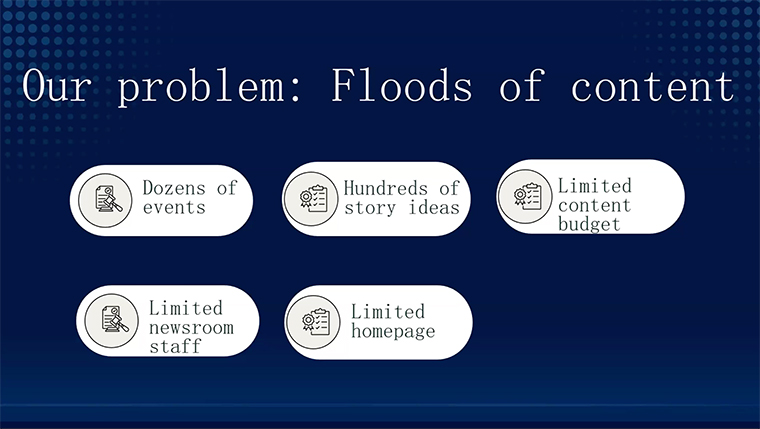
Harry Misiko, managing editor for content strategy at Nation Media Group, had the sharpest version. The crisis facing African newsrooms, he argued, is not a shortage of stories but an oversupply of them.
The question at his morning editorial conference is no longer whether the newsroom can cover something, but whether it should — tested against editorial value, audience need, business value, and resource feasibility before anything expensive is commissioned.
“Chasing more does not necessarily mean more subscriptions, does not mean more audiences, does not mean more readership,” Misiko said.
The same instinct showed up as a revenue decision rather than an editorial one. Dr. Innocent Unah, deputy editor-in-chief of BusinessDay Media Limited, described launching in Lagos in 2001 as Nigerian companies were raising capital and advertising money was abundant — and declining to chase it, accepting slower growth as the price of independence.
“We didn’t allow any monetary considerations to influence the direction of our storytelling. We allowed only data,” he said.
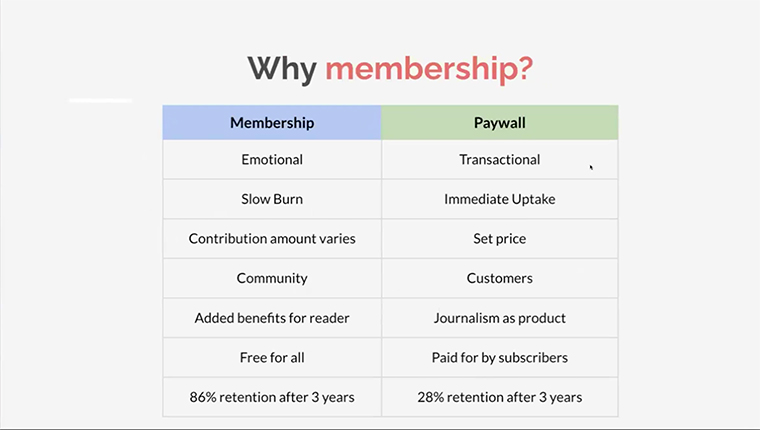
And Julia Harris, head of reader revenue at Daily Maverick, described refusing the paywall itself, on the principle that access to the truth should not depend on ability to pay. Membership now accounts for nearly half of revenue.
Three refusals — of volume, of easy money, of the industry-standard revenue mechanism — each of which made the newsroom’s job harder before it made it viable.
Building what nobody built for them
Refusal has a cost, and the speakers were unusually candid about it.
Harris was the clearest case. Without a paywall, Daily Maverick lost the enforcement mechanism every subscription system is built around. When a payment fails, nothing happens — the site works, the newsletters arrive, and many readers never notice they have stopped paying.
At one point roughly one in seven Maverick Insiders had a failed payment, about 14% of revenue, all involuntary churn recovered in-house through custom dunning sequences and retry timing.
“If you don’t withhold your product, you have to absorb the operational cost of recovery yourself,” Harris said.
Because off-the-shelf tools assume a paywall funnel, the team built its own messaging layer and a first-party engagement layer tracking reading behaviour and propensity to support. “If the thing that drives your revenue is proprietary to your model, you will end up building it,” she said.
Penlope Nankunda, content manager for digital at Vision Group, reached the same place from a different direction.
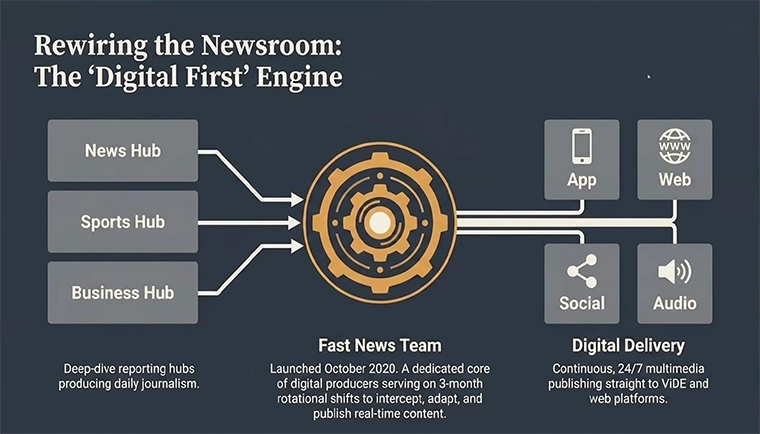
Uganda’s pandemic lockdown removed the company’s ability to circulate its newspaper in March 2020; by June it had launched an app that now hosts print, television, and radio products and has passed 10 million downloads. After losing search visibility in a provider migration, then weathering election-period Internet shutdowns and cyberattacks, Vision Group merged four Web sites into a custom CMS and built its own paywall.
Rianette Cluley, media project manager at Briefly News, learned it by getting it wrong first. A custom GPT initially worked — cleaner drafts, editors reviewing twice as many stories — then buckled, hallucinating errors that did not exist.
“Writers ended up spending more time looking for the error that wasn’t there than actually fixing real errors,” she said. The rebuild put the tool beside the CMS rather than in another tab, which matters where connections are unreliable.
The through-line is that most media technology assumes a paywall, a reliable connection, a large copy desk, or a functioning advertising market. Where those assumptions fail, building is not ambition. It is the only option left.
The rules come before the capability
Every speaker who discussed AI described constraining it first and gaining from it second.
Oyetunji Abioye, editor of Punch Newspapers, had the most tightly governed newsroom of the day. Punch reporters are required to run copy through AI proofreading before filing, with sanctions for those who don’t, and prohibited from using AI to write news stories at all.
Line editors carry the same dual obligation. Editors can upload a front page and ask AI to assess headline strength, but “editors, not AI, choose the final headline,” Abioye said.
The company wrote an AI Ethics and Responsible Use Policy after concluding that technology without rules creates risks.

Misiko treats AI as an intern whose output he still evaluates. Unah embeds it across the workflow, then layers human editorial judgment on top. Verma described a layered agent system at Norway’s iTromsø that analysed a decade of tourism data while reporters did the interviewing: “Agents can propose tools and queries, but it is the humans who make decisions.”
Abioye’s conclusion travels furthest: “The winning newsroom will not necessarily be the one using the most AI. It will be the one using AI most responsibly.”
The hard part is never the technology
The most consistent finding of the day was also the least technical. Every transformation described from the podium stalled on people.
Misiko has had to unwind Nation Media Group’s identity as a breaking-news brand, ceding first alerts to bloggers and social platforms while reporters fear missing out and commercial and political pressure pushes back.
“It takes double the time to end an entrenched culture,” he said.
Nankunda said Vision Group’s reorganisation into content hubs “wasn’t accepted immediately” and remains an open change management project.
Cluley rolled her rebuilt tool out from managers downward specifically so there would be a group of colleagues who could vouch for it because the first attempt had soured the newsroom.
Abioye met initial resistance, fear of replacement, and uneven skills, and answered with continuous training and open conversation.
Nankunda’s framing covers all of it: “Sustainability is not a destination. It’s continuous adaptation.”
What survives the machines
Verma closed on the argument that trust and human connection are becoming the core of newsroom strategy — journalists’ faces and voices out front, community treated as a premium product because that is the opposite of what chatbots provide.
The African case studies had already proved it in the field. Daily Maverick members supply story tips and professional expertise for investigations, and the company has hired comment moderators and its in-house counsel from within its own community. Unah’s entire 25-year argument is that credibility is the product: “Build trust among your readers first, then they will pay for the information you’re providing.”
Which leaves Cluley’s test as the one to take back to the desk — work out whether the juice is worth the squeeze. On this evidence, the newsrooms getting the most out of technology are the ones most willing to decide that it isn’t.
Related Articles
-

Marketers should outsource tasks, not thinking
25 October 2026 -

WSJ executive councils show how publishers build communities th...
19 October 2026 -

Bundling is a pricing decision, rebundling is an organisational...
18 October 2026 -

AI’s effect on super user math
15 September 2026 -

The front door is gone — and Asia-Pacific publishers are rebuil...
26 August 2026 -

At Mediacorp’s CNA, loyalty means giving audiences a reason to ...
20 August 2026 -

Tribun Network turns print “dots” into AI-powered insight
20 August 2026 -

Nation Media Group focuses editorial strategy on stories that m...
4 August 2026
Upcoming Events
-

Subscriber Acquisition Master Class
10-17 November 2026
-

Media Advertising Summit
New York, United States
07-10 December 2026
-

AI-Native News Product Master Class
18-25 February 2027
-

Media Subscriptions Summit
Oslo, Norway
08-12 March 2027
-

World Congress of News Media
New York, United States
25-30 April 2027
-

Branded Content & Partnerships Master Class
20-27 May 2027
-

Subscriber Retention Master Class
17-24 June 2027
-

Conferencia Latinoamericana
15-16 July 2027
-

South Asia News Media Festival
New Delhi, India
19-22 July 2027
-

Asia/Pacific News Media Summit
19-20 August 2027
-

CEO Roundtable at Kilkenny
Kilkenny, Ireland
24-26 August 2027
-

Media Innovation Week
Amsterdam, The Netherlands
27 September - 01 October 2027








