

Vision Group shares digital transformation to 5 platforms, 1 workflow
Conference Blog | 05 August 2026

Vision Group’s digital transformation was never a single “magic bullet” but a continuous, messy process of adaptation that began with a crisis and has kept evolving, according to Penlope Nankunda, content manager at New Vision Uganda.
A crisis that forced reinvention
Nankunda, who leads Vision Group’s digital team from its Kampala newsroom, framed her presentation during last week’s INMA Africa Newsroom & Tech Summit as a case study spanning 2020 to the present.
She divided the company’s history into “Vision Group pre-COVID” and “Vision digital pre- and post-COVID.”
Before the pandemic, Vision Group was a traditional newsroom built around print, radio, and TV, with an online presence that mainly supported those platforms.
When Uganda’s COVID-19 lockdown hit in March 2020, the company lost its ability to circulate its biggest product, the print newspaper, while broadcast could largely continue. An earlier attempt at an e-paper “had not really panned out.”
Facing that gap, Nankunda said the team asked: “How do we repackage? Who are we? How do we remain Vision Group, New Vision, and serve our audiences where they are?” noting audiences had moved online, onto TikTok, and toward digital news updates.
From free e-paper to a super app
Between April and June 2020, Vision Group secured a provider to push its e-paper and began giving the newspaper away free online starting April 1, 2020, a move Nankunda said retained audiences who knew the company for its physical paper, without requiring contact that could spread COVID.
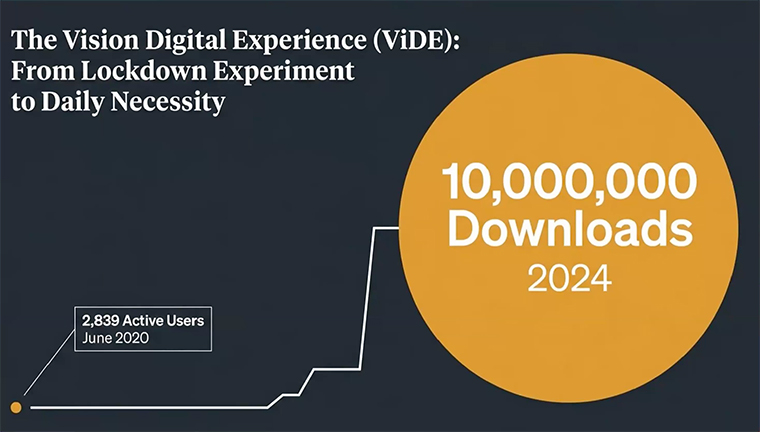
By June 2020, they launched an app, called ViDE (Vision Digital Experience), that has grown in phases since. The app now hosts the company’s print, TV, and radio products, and Vision Group has also invited other Ugandan media players to host their products on the app for free.
Nankunda said the app grew from 2,000 users in 2020 to over 10 million downloads and roughly 5 million active users to date, calling it “a baby we are proud of.”
Building utility beyond news
The app’s feature set expanded well beyond news distribution.
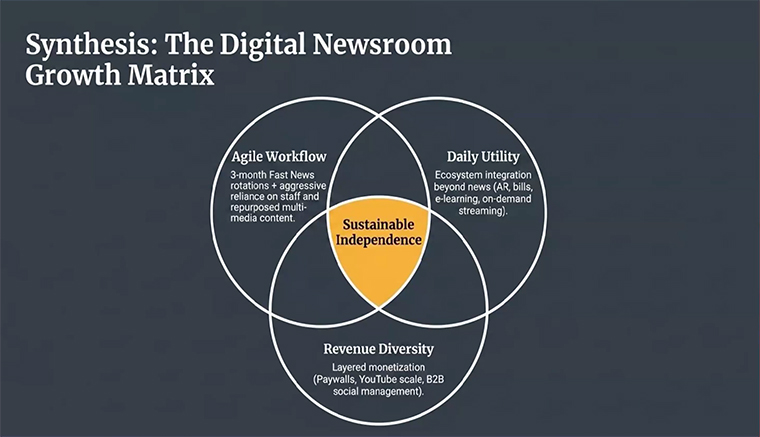
Vision Group added Augmented Reality so print readers could scan an image in the newspaper and watch related video content. It launched an e-learning platform using material repurposed from educational content the company was already producing across TV, radio, and print for children unable to attend school during lockdown.
To keep the app relevant enough so users wouldn’t delete it, Vision Group built in everyday utilities: Users in the diaspora, for example, can pay bills for parents in Uganda or buy airtime through the same app where they read news, and the platform has grown to offer event ticketing in partnership with event organisers.
Broadcast content also gained a longer shelf life through video-on-demand and radio-on-demand features, including music mixes made available during lockdown for at-home listening.
Restructuring the newsroom into hubs
Nankunda described a parallel reorganisation of the newsroom itself.
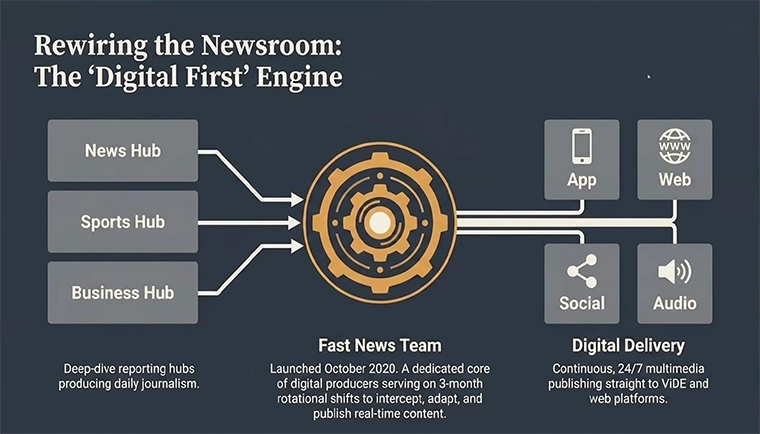
Previously, journalists identified strictly by platform, as a print journalist or a TV journalist. Vision Group shifted its staff toward multimedia work, organising the newsroom into content hubs covering news, sports, business, lifestyle, and information/education.
These hubs generate content that feeds into a distribution layer called “First News,” using “first” to mean both speed (fast) and priority (first), through which digital publication comes before other platforms.
A core team staffs First News on a three-month rotation system that has been in place since 2020, fed by the entire newsroom, with content from First News flowing into the app, social platforms, and the Web site, then further repurposed into audio, podcasts, and video clips.
Nankunda acknowledged this reorganisation “wasn’t accepted immediately” and remains “a change management project” that is still ongoing.
Cutting costs through digital-first production
The restructuring also served cost management.
Under the old model, Vision Group relied heavily and expensively on freelancers. Under the new model, the company capped freelance spending and shifted more content generation to staff reporters who think “digital first” and then adapt stories for other platforms.
About 61% of staff writers’ output now goes to digital first, Nankunda said. The company also moved away from single-use journalism toward heavy repurposing of content across the funnel and for further redistribution on digital platforms, which she said helped cap digital content spend.
Diversifying revenue streams
On revenue, Nankunda said Vision Group has expanded beyond traditional display advertising on its Web sites.
From around 2025, the company tested an in-house, self-built paywall that has seen “good success” and contributes, in a small way, to digital revenues. It has also moved into social media management services for corporate accounts and public individuals, and built a growing video offering, including a dedicated push on YouTube revenue growth that Nankunda said has worked over several months, alongside growth on TikTok and Instagram accounts.
To reduce dependence on third-party platforms whose rules “change daily,” Vision Group built a WhatsApp strategy encompassing direct subscriber groups, communities, and channels, funneling audiences toward platforms more within its own control.
Key challenges: lost SEO, Internet shutdowns, cyberattacks
Nankunda was candid about the setbacks along the way.
During the 2020 shift, Vision Group changed its Web site provider and, in the process, los” The company also had to contend with Internet shutdowns around elections in the region; a 2021 shutdown led to Facebook being banned in Uganda from 2021 until early this year, disrupting what had been Vision Group’s largest source of social media traffic. Vision Group has also experienced cyberattacks on its Web site.
In response, Vision Group merged its four major Web sites into a custom-built, in-house CMS that is more secure and easier to optimise for SEO. It manually migrated back lost content into more secure storage and moved away from off-the-shelf Web site solutions in favor of building on its own custom system.
Nankunda also flagged newer challenges: The recently introduced paywall caused a drop in Web site users as readers grew frustrated at being blocked from premium content, and referral traffic from social media has continued declining as platform algorithms shift.
Vision Group’s responses have included recalibrating and personalising paywall logic to reduce bounce rates and frustration, running aggressive technical audits of page speed, navigation and searchability, and using calls to action to redirect social audiences toward its own secured platforms.
3 core takeaways
Nankunda closed with three lessons:
-
Unify your technology stack by building custom systems rather than relying on off-the-shelf tools, wherever possible, to reduce vulnerability to hacking and content loss.
-
Keep an audience-first approach by continuously asking what audiences need and how to serve them.
-
Control content economics so that digital operations can answer, in the boardroom, “Where’s the money you’re bringing in?”
“Sustainability is not a destination,” she said. “It’s continuous adaptation.”
Banner photo: Adobe stock By Pixel-Shot.
Related Articles
-

Bundling is a pricing decision, rebundling is an organisational...
18 October 2026 -

AI’s effect on super user math
15 September 2026 -

What I told 40 CEOs (and won’t gatekeep from you)
30 August 2026 -

At Mediacorp’s CNA, loyalty means giving audiences a reason to ...
20 August 2026 -

Tribun Network turns print “dots” into AI-powered insight
20 August 2026 -

Nation Media Group focuses editorial strategy on stories that m...
4 August 2026 -

Economist launches subscription tier targeting younger audience...
20 July 2026 -

Grupo RBS builds social-first video operation to expand audienc...
20 July 2026
Upcoming Events
-

Subscriber Acquisition Master Class
10-17 November 2026
-

Media Advertising Summit
New York, United States
07-10 December 2026
-

AI-Native News Product Master Class
18-25 February 2027
-

Media Subscriptions Summit
Oslo, Norway
08-12 March 2027
-

World Congress of News Media
New York, United States
25-30 April 2027
-

Branded Content & Partnerships Master Class
20-27 May 2027
-

Subscriber Retention Master Class
17-24 June 2027
-

Conferencia Latinoamericana
15-16 July 2027
-

South Asia News Media Festival
New Delhi, India
19-22 July 2027
-

Asia/Pacific News Media Summit
19-20 August 2027
-

CEO Roundtable at Kilkenny
Kilkenny, Ireland
24-26 August 2027
-

Media Innovation Week
Amsterdam, The Netherlands
27 September - 01 October 2027








