

What I told 40 CEOs (and won’t gatekeep from you)
Young Audiences Initiative Blog | 30 August 2026

I’m just back from Vail, where I gave a talk on my initiative at our annual CEO Roundtable, in front of almost 40 CEOs. Honestly, I didn’t know what a week like that would actually feel like. Turns out: really good vibes.
We hiked, we spotted actual bears, and mostly, I had long, genuinely inspiring conversations with people who showed up open, and at times, really vulnerable. It was a great experience.
I’m not going to gatekeep what I told them. So this week, you get three lessons I presented to the audience in Vail.
Lesson 1: Meet them where they are
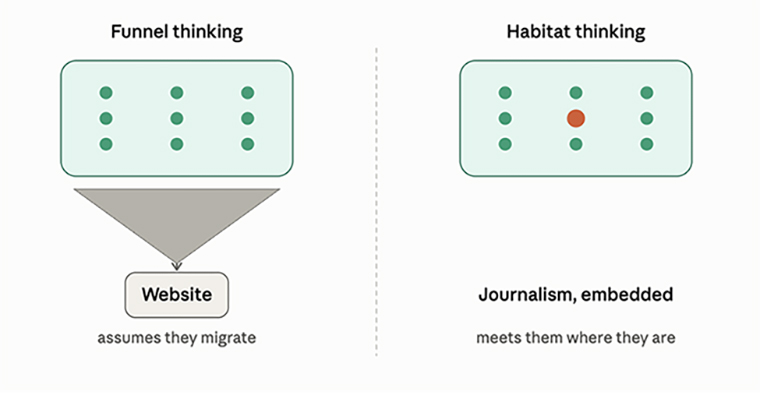
Say goodbye to the bridge. For years, the working assumption was funnel thinking: Platforms exist to pull people back to your homepage, where the real relationship, and the real revenue, supposedly happens. Closed, controllable, and built on one assumption that increasingly doesn’t hold: that the audience eventually migrates to you.
Habitat thinking starts from the opposite premise. Platforms aren’t a means to an end. They’re where this audience actually lives. Journalism has to exist there natively, not as a detour on the way to somewhere else.
In 2026, platforms overtook both TV and news Web sites as the primary source of news for the first time, and over half of under 24 year olds now name social and video as their main source. They are not passing through; they are already home. So you have to deliver relevant content within the platform to them.
Make them remember you and build relationships where they are. Show them what your journalistic values are.
The question stops being how to get them onto your page and starts being what you owe them while they are exactly where they are.
And if you do insist on conversion, think about two things first:
Does your subscription structure actually hold up? The one-tier-fits-all doesn’t work anymore.
Is your product actually ready? Because if this audience does make the trip, they’ll expect to find something close to what pulled them in on the platform in the first place. Show up with a generic homepage after promising something sharp and native, and you’ve broken the deal before it started.
Which brings us to the next point.
Lesson 2: Rethink “what does this get us?”
This is the question that kills more good decisions than any bad strategy does.
Long-term investment means two things: how your product needs to change, and how you actually measure success on these platforms in the meantime. A short-form video strategy will probably not convert into subscriptions next quarter. That does not make it the wrong strategy, it makes it the wrong question.
I would rather ask: What is our long-term goal regarding our social strategy, and what are the right KPIs for this platform?
Platform presence is a long-term bet on trust and visibility, not a sales funnel with a two week close. That’s not a marketing decision you back with a spreadsheet. It’s a judgment call, the same one every long-term bet requires.
Judge platform presence the way you’d judge any long-term investment: by whether the logic holds, not by whether it paid off by Friday.
Lesson 3: Think braver about monetisation
Once you accept platforms are not going anywhere, the real work starts: figuring out how to actually make money there, without pretending a subscription paywall is the only option.
Brut has built a real business on this logic. A big part of its revenue now comes from brand partnerships and native branded content that is an authentic fit to their content.
Mediahuis went a different direction and built SPIL from scratch: an editorial product for Gen Z, made in direct collaboration with the creators already reaching that audience, rather than trying to out-publish them (they will present their strategy at my Young Audiences Summit in September, so make sure you’ll be there).
They deliberately work with external creators who are responsible for the paid partnerships, which allows their editorial creators to concentrate on their journalism.
One related idea worth adding here came from my colleague Jodie Hopperton in a piece worth reading in full. Her question: If distribution already happens on platforms, why should a subscription only work on the publisher’s own Web site or app?
Her proposal is an authentication layer that lets a subscription travel with the person, not the destination. An FT subscriber asks ChatGPT a question and gets premium FT reporting back. A New York Times subscriber unlocks subscriber-only analysis inside Gemini. A local newspaper subscriber gets exclusive reporting through WhatsApp.
The publisher still gets paid directly. The platform becomes an authenticated distribution channel, not a gatekeeper, and not a new paywall to build from scratch.
It’s not as far off as it sounds. Spotify’s Open Access programme already lets participating publishers authenticate existing subscribers for premium podcast content. Jodie’s read on why this hasn’t scaled yet: It’s not a technical problem. It’s a prioritisation problem. Publishers won’t be satisfied with basic authentication; we’ll want analytics, billing, support workflows, APIs, and a long list of feature requests — and none of that is core to an AI platform’s business today.
Her advice: Don’t show up with 100 competing asks. Start with the smallest version that creates value for everyone, prove it works, and build from there.
If you’d like to subscribe to my bi-weekly newsletter, INMA members can do so here.
Related Articles
-

WSJ executive councils show how publishers build communities th...
19 October 2026 -

Bundling is a pricing decision, rebundling is an organisational...
18 October 2026 -

5 lessons from the INMA Young Audiences Summit
28 September 2026 -

AI’s effect on super user math
15 September 2026 -

At Mediacorp’s CNA, loyalty means giving audiences a reason to ...
20 August 2026 -

Indian Express builds a video-first future around trusted journ...
20 July 2026 -

Economist launches subscription tier targeting younger audience...
20 July 2026 -

AI adoption in newsrooms should move from experiment to strateg...
12 July 2026
Upcoming Events
-

Subscriber Acquisition Master Class
10-17 November 2026
-

Media Advertising Summit
New York, United States
07-10 December 2026
-

AI-Native News Product Master Class
18-25 February 2027
-

Media Subscriptions Summit
Oslo, Norway
08-12 March 2027
-

World Congress of News Media
New York, United States
25-30 April 2027
-

Branded Content & Partnerships Master Class
20-27 May 2027
-

Subscriber Retention Master Class
17-24 June 2027
-

Conferencia Latinoamericana
15-16 July 2027
-

South Asia News Media Festival
New Delhi, India
19-22 July 2027
-

Asia/Pacific News Media Summit
19-20 August 2027
-

CEO Roundtable at Kilkenny
Kilkenny, Ireland
24-26 August 2027
-

Media Innovation Week
Amsterdam, The Netherlands
27 September - 01 October 2027








