

5 lessons from the INMA Young Audiences Summit
Young Audiences Initiative Blog | 28 September 2026

Over three days as part of my recent Young Audiences Summit, I put the creator economy in journalism front and center. And I quickly realised something: There are a few big themes we really shouldn’t lose sight of right now.
I found the summit genuinely inspiring, the speakers were fantastic. Here’s what we actually learned.
Lesson 1: Creators are not the threat
This fear has been sitting in the room every time our industry talks about creators, as if attention were a zero sum game and every minute spent on a creator’s video is a minute stolen from a newsroom’s homepage.
Three days at the summit made it clear how backwards that framing is. The real opponent was never each other; it’s misinformation. Legacy media and creators aren’t competing for the same seat. And the moment either side treats the other as the enemy, misinformation is the only party that wins.
The data backs this up in an almost uncomfortable way: Per the Reuters Institute Digital News Report 2026, 70% of publishers worry creators are stealing their audience’s attention. Yet among people who actually use creators regularly for news, creators score higher on every single attribute measured, including trust and impartiality, than traditional media does.
The fear and the evidence are pointing in opposite directions.
At the same time, we were also invited to think harder about the term creator journalist itself. My first guest, Liz Kelly Nelson of Project C, walked us through her organisation’s own definition, five criteria in total: someone who produces genuine journalistic work, original reporting, opinion, or aggregation; usually covers a niche rather than general news; is perceived as a trusted messenger by a loyal audience; works independently, outside a traditional news organisation; leverages the creator economy for a sustainable career.
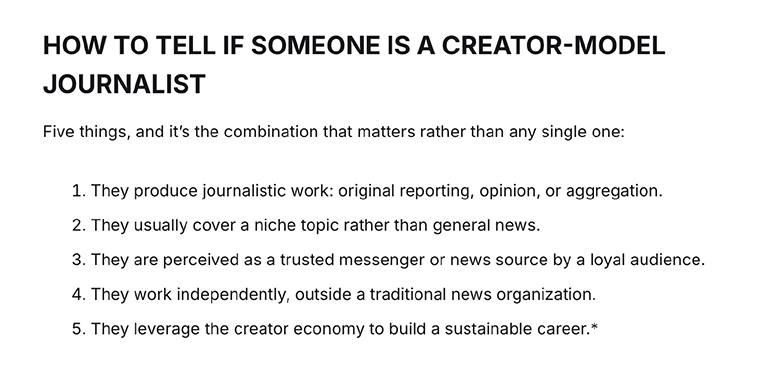
I wanted to understand the fourth point a little better. Does that mean someone in a newsroom who works like a creator is not allowed to call themselves a creator journalist?
Liz explained that the line isn’t about excluding anyone. It’s about building a deliberate lobby for independent creator journalists specifically, people who don’t have an institution behind them. And, as we heard again on day three of the summit, they often don’t have much financial runway either.
Her own point: We need to talk a lot more, going forward, about what structures actually exist to support that group.
And this brings us to the next point: the newsrooms.
If independent creator journalists need structures, partnerships, funding, distribution, credibility by association, publishers are exactly who can help them build this. But to do so, the newsroom has to be able to change.
Lesson 2: We need to pivot
“The newsroom as we know it is dead,” Rebecca Hutson from The News Movement told us.
I am not sure if I would agree — or let’s put it this way: My Swiss heart would say it a little less directly.
I do think newsrooms are in a moment of change, and the creator economy plays a big part in it. New roles, real readiness to pivot, and in more than one case, entirely new structures built around creator journalism are the consequences.
Birgit Coenen, chief growth officer at Spilnews, explained to us that they built their Gen Z newsroom exactly for this purpose outside of the legacy structures at Mediahuis: “Every existing frame had to be breakable. A newsroom or entity with an operational flow cannot afford to fail.”
Now more than one year in, they are at a point where their legacy titles can learn from Spilnews. Their “laboratory” works. And btw: I also asked them how much time they got from Medihuis. Apparently they got “some years,” which I think is a very important message. If you invest in a project like this, you have to mean it.
What also stuck me: Spilnews is already going one step further and is starting to build an agency for creator journalists. And between the lines, you also could hear that DMG is thinking about something similar.
Which brings us exactly back to Liz’s point from above. Thinking about how creator journalists work and how you as a publishing house can play a role in this industry shift is — in my opinion — a big opportunity.
Lesson 3: There is no single way in
The good news: You don’t need the one correct model to start. You can build your own creators from within.
You can collaborate with niche creators who already own the trust of an audience you want to reach. Or you can use creators for paid partnerships, brand work that stays honest about what it is.
Spil, the Daily Mail, The Washington Post Creator Network, and The News Movement each showed a different version of this working, live, with real numbers behind it. If you want to deep dive into their stories, you’ll find the recordings here.
Lesson 4: This only works with time, room, and trust
It’s easy to talk about newsroom transformation from the outside. Johanna Rüdiger from Deutsche Welle grounded it from the inside. Not only is she working full time building up creators for DW, she is also a creator journalist herself: “The Cringe Mountain is a reality, and you simply have to climb it.”
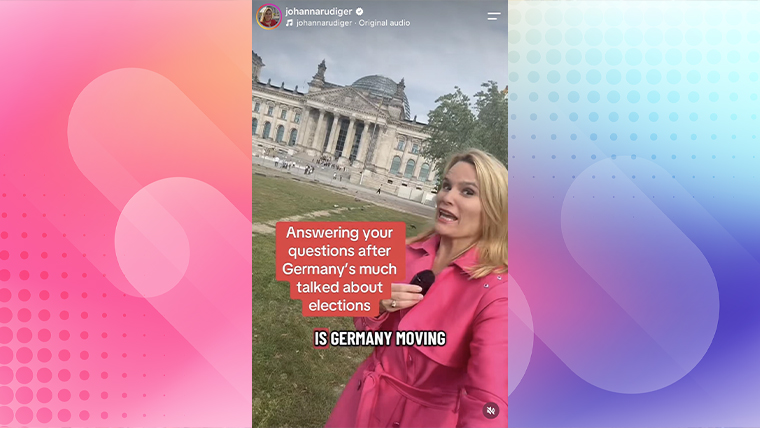
Now think about your work within your news organisation and feeling the people around you are not supporting you. Instead they are quietly judging while you climb. The moment people sense they’re being watched with raised eyebrows instead of support, the mountain turns into a wall.
So if you want creator strategies to actually take root in your newsroom, drumroll, we’re right back here again: It all comes down to culture. If you actually want your organisation ready for any of this, you can’t just tolerate change as a line in a strategy deck. You have to be genuinely open, curious, even excited about the new.
Lesson 5: Find your niche
Two questions came up more than once during the summit, and they stuck with me because they came from two very different kinds of newsrooms.
How do I do this as a business magazine whose audience is already narrower than a general interest paper?
Or:
How do I do this as a hyperlocal newsroom?
The good news, and I mean this genuinely: The more specific you already are, the better position you’re in. Because if there’s one thing creators are unreasonably good at, it’s owning a lane. They don’t try to be everything to everyone. They pick one problem, one audience, one obsession, and go deep enough that nobody else can compete on that ground.
That’s not a limitation. That’s the entire business model. And it’s something newsrooms can borrow without hiring a single creator.
Ask yourselves honestly: What’s your superpower? What do you actually stand for? Why does someone choose you over the 11 other places they could get the same headline?
And if you can’t answer that in one sentence right now, I would suggest it’s time for a proper identity workshop.
If you’d like to subscribe to my bi-weekly newsletter, INMA members can do so here.
Related Articles
-

WSJ executive councils show how publishers build communities th...
19 October 2026 -

AI’s effect on super user math
15 September 2026 -

What I told 40 CEOs (and won’t gatekeep from you)
30 August 2026 -

At Mediacorp’s CNA, loyalty means giving audiences a reason to ...
20 August 2026 -

Indian Express builds a video-first future around trusted journ...
20 July 2026 -

Economist launches subscription tier targeting younger audience...
20 July 2026 -

Grupo RBS builds social-first video operation to expand audienc...
20 July 2026 -

AI adoption in newsrooms should move from experiment to strateg...
12 July 2026
Upcoming Events
-

Subscriber Acquisition Master Class
10-17 November 2026
-

Media Advertising Summit
New York, United States
07-10 December 2026
-

AI-Native News Product Master Class
18-25 February 2027
-

Media Subscriptions Summit
Oslo, Norway
08-12 March 2027
-

World Congress of News Media
New York, United States
25-30 April 2027
-

Branded Content & Partnerships Master Class
20-27 May 2027
-

Subscriber Retention Master Class
17-24 June 2027
-

Conferencia Latinoamericana
15-16 July 2027
-

South Asia News Media Festival
New Delhi, India
19-22 July 2027
-

Asia/Pacific News Media Summit
19-20 August 2027
-

CEO Roundtable at Kilkenny
Kilkenny, Ireland
24-26 August 2027
-

Media Innovation Week
Amsterdam, The Netherlands
27 September - 01 October 2027








