

Punch builds an AI-ready newsroom without sacrificing trust
Conference Blog | 06 August 2026

Artificial Intelligence may be changing how journalism gets produced, but at Punch Newspapers, one thing remains firmly human: editorial responsibility.
Speaking at the INMA Africa Newsroom & Tech Summit, Oyetunji Abioye, editor of Punch Newspapers, described a newsroom using AI across research, editing, headline development, SEO, style-guide compliance, and AI — while drawing a firm line around human accountability.
Punch’s editorial philosophy, he said, is simple: “Accuracy first, speed second, trust always.”
The organisation’s adoption of AI follows the same hierarchy, Abioye said: “Our objective was never to use AI because it was fashionable. Our objective was to make our journalists more productive while protecting editorial quality.”
AI as an assistant, not an author
For reporters, the boundary is explicit. Punch journalists use AI to brainstorm, generate follow-up ideas, identify trending topics, refine story angles, conduct background research, summarise lengthy reports, proofread, improve grammar and transcribe interviews.
But they are not permitted to use AI to write news stories.
“AI assists our journalists. It never replaces them,” Abioye said. “Every published story remains the responsibility of a human journalist.”

That principle is reinforced operationally: Reporters are required to use AI for proofreading before filing, Abioye said, while responsibility for the journalism itself stays with the reporter and editor.
AI continues through the editing chain. Line editors use it to edit copy, improve clarity, proofread, refine sentence structure, and suggest stronger headlines. Title editors use it to generate multiple headline options, develop alternative digital headlines, and review front-page presentations.
Editors can even upload a front page as a PDF or JPEG and ask AI to assess headline strength and story positioning, Abioye said. The technology can suggest alternatives, but it does not make the decision.
“Editors, not AI, choose the final headline,” he said.
Punch formalised its boundaries through an AI Ethics and Responsible Use Policy after concluding that “technology without rules creates risks.” The policy makes human accountability mandatory and establishes clear limits on AI-generated text and imagery.
“AI supports journalism. It does not replace journalists,” Abioye said.
Under the policy, AI must not write news stories; AI-generated images cannot be used as news photographs unless clearly identified and editorially approved; journalists may not manipulate news photographs using AI; and every AI-assisted output must comply with Punch’s editorial policy and style guide.
Automating the work around journalism
Some of Punch’s most ambitious uses of AI happen around journalism rather than in place of it.
In its digital publishing workflow, a story published in WordPress is automatically sent to an AI-powered SEO engine built with Gemini. The system generates an SEO title, meta description, keywords, and search metadata, then returns that information to the CMS. If the article changes, the metadata is regenerated.

Punch has also embedded its style guide into an AI-assisted system that helps edit stories for editorial consistency, preferred spellings, house style, writing standards, and quality control. The result is “faster editing with stronger consistency across hundreds of published stories,” Abioye said.
Audience intelligence without surrendering judgment
Punch also uses AI to analyse reader behaviour, story performance, engagement trends, audience interests, Web site performance, and user retention. But Abioye draws the same boundary here that he does elsewhere in the newsroom: Data should support editorial judgment, not dictate it.
“The objective is not to allow data to dictate editorial judgment,” he said. “The objective is to make smarter editorial decisions supported by evidence.”
Changing the culture
The transition was not frictionless.
Abioye described initial resistance from staff, fear that AI would replace journalists, uneven AI skills across the newsroom, rapidly evolving tools, and the difficulty of developing responsible-use policies while the technology itself was changing.
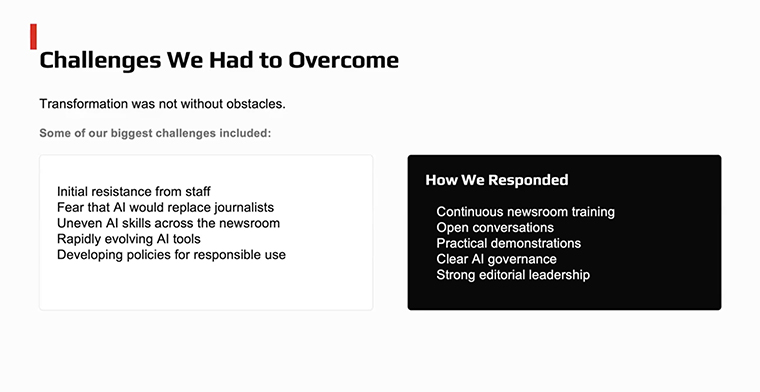
Punch responded with continuous newsroom training, open conversations, practical demonstrations, clear AI governance, and strong editorial leadership. The company also made some AI-assisted checks part of newsroom accountability. Reporters can be sanctioned for filing stories without first using AI to proofread them, Abioye said, while line editors can similarly face consequences for failing to run copy through the required AI-assisted editing process.
The newsroom Punch is building
For Punch, the future newsroom combines human judgment, AI, audience data, and strong editorial values. The point is not to maximise the amount of AI in the newsroom but to use it where it improves journalism without weakening accountability.
“The winning newsroom will not necessarily be the one using the most AI,” Abioye said. “It will be the one using AI most responsibly.”
His final point returned to the company’s central concern: “AI is transforming journalism, but journalism has never been about technology alone. It’s about public trust. Every important editorial decision still belongs to a human editor.”
Banner image: Adobe stock image by Pixel-Shot.
Related Articles
-

Marketers should outsource tasks, not thinking
25 October 2026 -

WSJ executive councils show how publishers build communities th...
19 October 2026 -

AI’s effect on super user math
15 September 2026 -

At Mediacorp’s CNA, loyalty means giving audiences a reason to ...
20 August 2026 -

Tribun Network turns print “dots” into AI-powered insight
20 August 2026 -

Nation Media Group focuses editorial strategy on stories that m...
4 August 2026 -

Briefly News empowers journalists with AI tool suite Nova
4 August 2026 -

Indian Express builds a video-first future around trusted journ...
20 July 2026
Upcoming Events
-

Subscriber Acquisition Master Class
10-17 November 2026
-

Media Advertising Summit
New York, United States
07-10 December 2026
-

AI-Native News Product Master Class
18-25 February 2027
-

Media Subscriptions Summit
Oslo, Norway
08-12 March 2027
-

World Congress of News Media
New York, United States
25-30 April 2027
-

Branded Content & Partnerships Master Class
20-27 May 2027
-

Subscriber Retention Master Class
17-24 June 2027
-

Conferencia Latinoamericana
15-16 July 2027
-

South Asia News Media Festival
New Delhi, India
19-22 July 2027
-

Asia/Pacific News Media Summit
19-20 August 2027
-

CEO Roundtable at Kilkenny
Kilkenny, Ireland
24-26 August 2027
-

Media Innovation Week
Amsterdam, The Netherlands
27 September - 01 October 2027








