

BusinessDay moves from business content to business intelligence
Conference Blog | 06 August 2026

BusinessDay began with a bet that would shape the Nigerian publication for the next quarter-century: Credibility could be a business model.
Speaking at the INMA Africa Newsroom & Tech Summit, Dr. Innocent Unah, deputy editor-in-chief of BusinessDay Media Limited, traced the organisation’s evolution from a business newspaper founded in Lagos in 2001 to a multi-platform business intelligence company.
“It was just a belief, a belief in the value that had to be provided or that was not in existence at that time,” Unah said.
Founder Frank Aigbogun saw a gap in the information available to Nigerian business leaders and investors, Unah explained. The goal was to move beyond surface-level news and provide intelligence that could inform business decisions.
“Once you believe in the value to be created in the media space, it is an asset that is fundable,” Unah said. “African media leaders should treat conviction as the first investor pitch.”
That conviction also shaped BusinessDay’s approach to independence from the beginning: “Once you don’t start from the outset to be independent in terms of the editorial direction and content, to win back that independence anywhere down the line would be a tough nut to crack.”
Turning down the easy money
BusinessDay entered the market during Nigeria’s IPO era, when banks and other companies were raising capital and advertising money was flowing.
For a new publication, the temptation to pursue that revenue was significant. BusinessDay instead chose to build daily business intelligence for decision-makers rather than rely on IPO advertising and sponsorship.
“We built daily business intelligence for decision makers in the belief that somewhere down the line, the business leaders will pay for that insight and for that intelligence,” Unah said.
The company also resisted allowing commercial relationships to determine what appeared in its journalism: “We at BusinessDay also refused to let the relationship we have for commercial reasons dictate the shape, scope and direction of our editorial coverage.
Building an editorial firewall
At the center of the BusinessDay model is a clear separation between commercial revenue and editorial judgment. Major stories, Unah said, are anchored in verifiable numbers drawn from financial statements, market data and regulatory filings rather than press-release framing.
“We didn’t allow any monetary considerations to influence the direction of our storytelling. We allowed only data,” Unah said.
That principle extends to the company’s advertising, sponsorship, and events businesses, Unah said: “We made sure that there is a firewall between the various units that are revenue-facing from the newsroom. No unit of BusinessDay influences the editorial coverage of our content.”
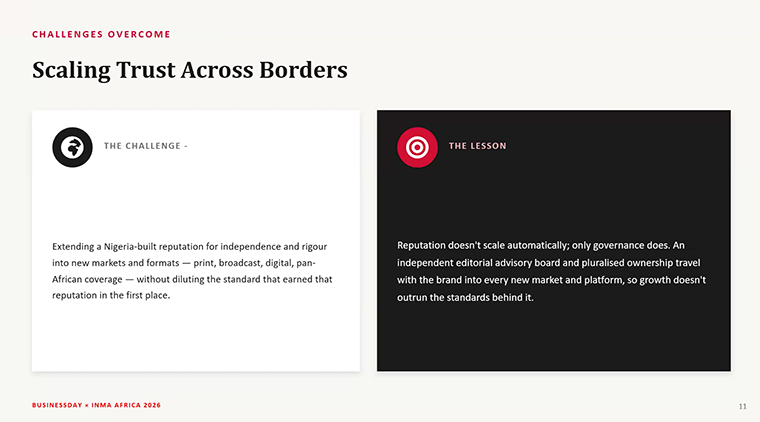
Governance provides another layer of protection. BusinessDay has a board of directors and an editorial advisory board populated by experienced industry leaders. That structure is designed to keep commercial pressure at arm’s length from the newsroom and prevent any single owner from determining editorial direction.
Betting on readers before the market forced the issue
As digital disruption weakened the economics of print, BusinessDay began moving toward paid digital subscriptions. Its digital transformation programme began in 2016 and led to the launch of a paid digital subscription product in 2018, one of the earlier paywall models among Nigerian newspapers, according to Unah.
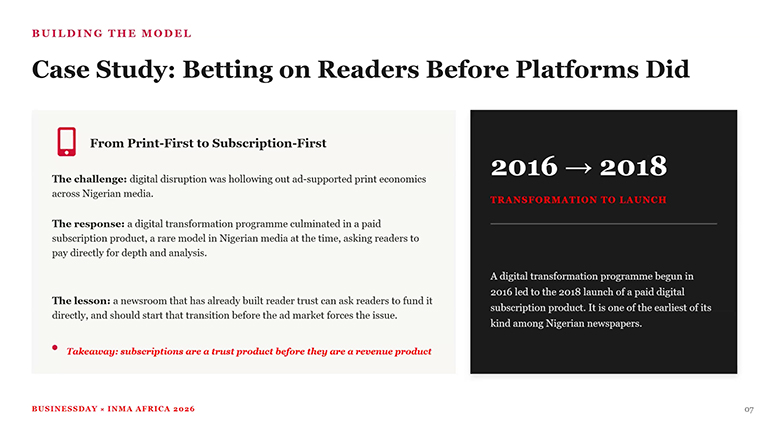
The logic was straightforward: Readers would pay if the journalism provided something they could not easily get elsewhere.
“Our news is not just run-of-the-mill news; it’s news with insights, with intelligence, with actionable information for business leaders and policymakers,” Unah said.
That meant trust had to come before the transaction.
“If you must ask your readers to pay for stories that you’re writing, then you must make sure that those stories are not just uncommon, and not just special and customised, but that it carries actionable insight for them,” Unah said. “Build trust among your readers first, then they will pay for the information you’re providing.”
One newsroom, many formats
BusinessDay has since expanded beyond the newspaper into a multi-platform intelligence business. Its products include daily and weekend print editions, BusinessDay Television, BusinessDay Intelligence, events and digital platforms.
“It’s one newsroom, many formats,” Unah said.
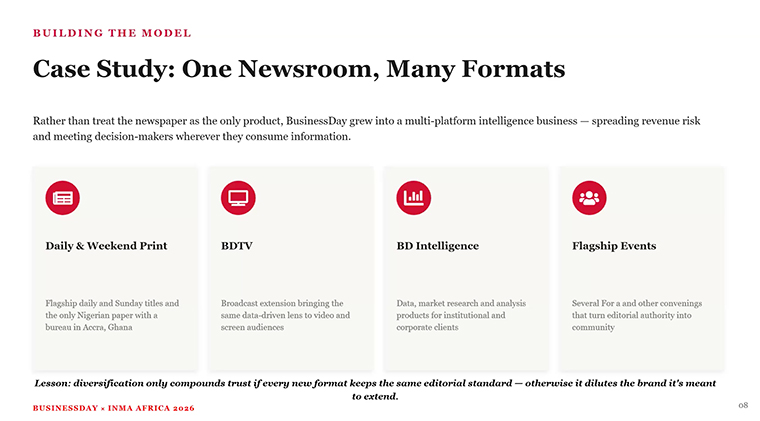
The expansion, however, comes with a condition: Every new format must carry the same editorial standards.
“Once we diversify, it also increases trust because every new format will maintain the editorial standard, not compromising for any financial or pecuniary considerations,” Unah said. “The risk of that is that it dilutes the brand, and over time, it can even dissolve it.”
Surviving without the advertising safety net
Rejecting advertising dependence meant accepting slower revenue growth, particularly in BusinessDay’s early years. Unah described the strategy as building a runway for patience: continuing to deliver data-driven journalism one story at a time while developing subscriptions, research, events and other revenue streams.
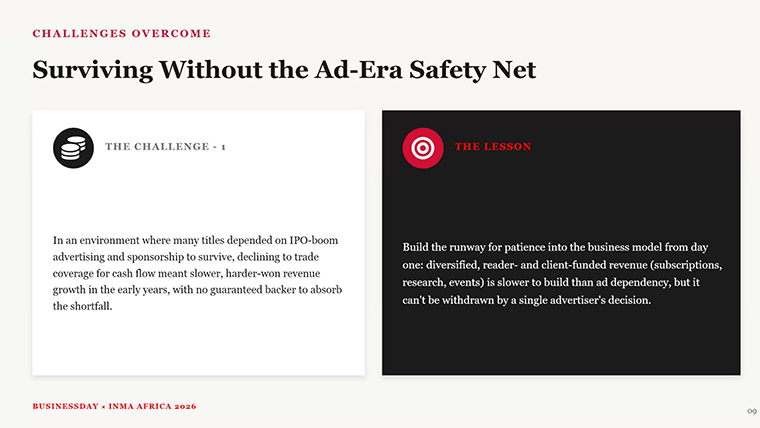
The advantage, he argued, is that the organisation is less exposed to any one advertiser’s influence. That long-term approach also reinforces the value BusinessDay believes it is ultimately selling: trust.
Adapting the newsroom to AI
Generative AI is the latest technology forcing BusinessDay to balance speed with editorial standards. The newsroom uses AI to assist with research, production, distribution and data analysis, but Unah said human judgment remains essential.
“We embed AI across our workflow from research to data analysis, but then we layer it with human editorial judgment,” Unah said.
Editors remain responsible for verifying stories and checking facts before publication: “We should use AI as an assistant and not as a reporter or a journalist. We don’t allow speed to cloud the need for factual data and for verification.”
A 5-point playbook for African newsrooms
Unah distilled BusinessDay’s experience into five lessons for African media organisations:
- Fund conviction first: Build internal belief in the value of journalism before chasing external capital.
- Firewall the newsroom: Create and defend a clear boundary between commercial revenue and editorial judgment.
- Let readers fund depth: Move toward subscriptions and data-product revenue before advertising economics force the transition.
- Diversify without diluting: Make every new platform or format carry the same editorial standard.
- Govern for the long game: Use independent oversight and pluralized ownership to protect reputation through growth and disruption.
BusinessDay’s formats and revenue streams have changed considerably since 2001, but the central discipline has not, Unah said: “Twenty-five years on, we are still moving. That discipline has remained the strategy for even the next several decades to come.”
Banner art: Adobe stock image by IDOL’foto.
Related Articles
-

Marketers should outsource tasks, not thinking
25 October 2026 -

WSJ executive councils show how publishers build communities th...
19 October 2026 -

Bundling is a pricing decision, rebundling is an organisational...
18 October 2026 -

AI’s effect on super user math
15 September 2026 -

The front door is gone — and Asia-Pacific publishers are rebuil...
26 August 2026 -

Tribun Network turns print “dots” into AI-powered insight
20 August 2026 -

Nation Media Group focuses editorial strategy on stories that m...
4 August 2026 -

Briefly News empowers journalists with AI tool suite Nova
4 August 2026
Upcoming Events
-

Subscriber Acquisition Master Class
10-17 November 2026
-

Media Advertising Summit
New York, United States
07-10 December 2026
-

AI-Native News Product Master Class
18-25 February 2027
-

Media Subscriptions Summit
Oslo, Norway
08-12 March 2027
-

World Congress of News Media
New York, United States
25-30 April 2027
-

Branded Content & Partnerships Master Class
20-27 May 2027
-

Subscriber Retention Master Class
17-24 June 2027
-

Conferencia Latinoamericana
15-16 July 2027
-

South Asia News Media Festival
New Delhi, India
19-22 July 2027
-

Asia/Pacific News Media Summit
19-20 August 2027
-

CEO Roundtable at Kilkenny
Kilkenny, Ireland
24-26 August 2027
-

Media Innovation Week
Amsterdam, The Netherlands
27 September - 01 October 2027








