

The front door is gone — and Asia-Pacific publishers are rebuilding the habit
Conference Blog | 26 August 2026

Speakers at the INMA Asia-Pacific News Media Summit 2026 came from nine markets and reached the same diagnosis by different routes: The single point of arrival publishers spent two decades optimising has dissolved. What replaces it is not a better funnel but a stronger habit.
“A robust community is emerging,” INMA Executive Director and CEO Earl J. Wilkinson told attendees. “I think the Asia-Pacific region’s contributions to this global conversation are just growing.”
No more front door
Part of that contribution is timing. Several markets here met platform-led news distribution years ahead of everyone else.
Amy Ross Arguedas, senior research fellow at the Reuters Institute for the Study of Journalism and co-author of the Reuters Institute Digital News Report 2026, supplied the baseline. Social and video platforms have overtaken television and news Web sites as the main source of news — a threshold Indonesia, Malaysia, and the Philippines crossed years ago while the rest of the world caught up.
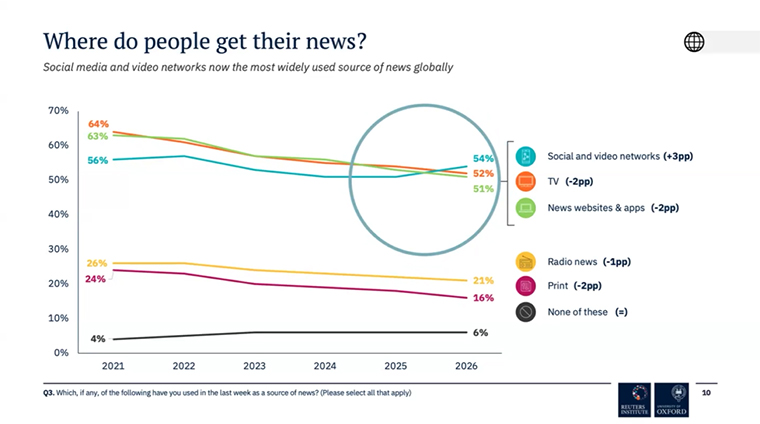
The pivot is no longer generational, with growth across all age groups rather than only among the young — though the region is not uniform: In Japan and Taiwan, television and news Web sites remain stronger.
Publishers described the same thing from the inside. “There’s no longer one big front door for us for people to discover news anymore,” said Alvin Chong, supervising editor of growth and innovation at Mediacorp, whose flagship news brand is CNA.
At the South China Morning Post, Chief Technology Officer Jun Zhang reported daily active users on its own site and app falling while views of its content on social platforms grew 50% to 70% over 12 months.
Kerstin Hasse, lead of INMA’s Young Audiences Initiative, said the language of loss is itself wrong for the youngest cohort. Among 18- to 24-year-olds, more than half have never engaged with news through a newspaper or news media Web site at all.
“This is not a churn,” she said. “This is a generation that’s never walked through your front door.”
Habit is what replaces it
Arlene Burgos, chief content officer at the Philippine Daily Inquirer, framed it as habits, not visits — asking what recurring job a newsroom helps its audience do and when.
Her evidence was ABS-CBN’s TV Patrol, which returned online two days after the broadcaster’s free-TV shutdown in May 2020 and drew more than 8 million views overnight — because the 6:30 p.m. viewing habit had been built years earlier.
“A platform referral is rented attention,” she said.
News Corp Australia arrived at the same conclusion through what print production calls furniture — the crossword, the TV guide, the feature that sits in the same spot every day.

Amy Bissett, director of distribution, called retention the industry’s “collective white whale” and fixed a business columnist in an unmoving homepage position — spot seven, between 5 a.m. and 10 a.m., across more than 10 homepages. Article engagement rose 15% month-on-month, and business subscribers now have the highest tenure of any section.
“Readers don’t just want speed,” she said. “In fact, they want respite.”
At CNA, loyalty is a repeated choice rather than a subscription. Its Fast product averages 27% daily return rates, and its games feature has pulled lapsed users back to re-register despite there being no paywall.
“The important thing is, after every view, after every click ... did we give them a reason to choose us again?” Chong said.
AI belongs in delivery, not just efficiency
Zhang drew the week’s sharpest distinction between two kinds of AI adoption:
-
Sustaining AI improves workflows, efficiency, and editorial support — useful, but defensive.
-
Disruptive AI reinvents the audience experience and the distribution of journalism, and that, he argued, decides whether publishers survive or thrive.
“AI itself won’t kill journalism,” he said. “Failing to invent how we deliver the news to the users will kill the news company.” He described publishers as bottling plants turning out one finished product when they should be water utilities, moving reporting into whatever format audiences want.
Maekyung Media Group has turned a six-decade, 10-million-article archive into an AI knowledge search answering natural-language questions with citations back to the original reporting — one of several practical AI applications across search, audio, and financial intelligence.

Subscribers to its main business newspaper Web site rose roughly 213% between January 2024 and June 2026. Suho Park, of the group’s AI transformation task force, put the endpoint as a question for the industry: whether a media company remains a publisher of articles or becomes a trusted knowledge engine.
Tribun Network reached a similar place from local print. CEO Darlan Dahi described a progression — newspapers gave the network geography, the Internet gave it reach, the network gives it signal, and AI turns that signal into intelligence — in turning print “dots” into patterns across 42 Web sites.
At New Zealand’s Stuff Group, Chief Product Officer Ben Haywood said agentic coding tools had “completely transformed the risk economics of product development,” making experimentation cheap enough to restructure teams.
Every deployment came with a human attached
For all that, nobody described a system that runs itself.
George Nishihama, managing editor of The Wall Street Journal’s Japan edition, was blunt that AI translation is “not a one-and-done deal”. Generic large language models mishandled context, syntax, and idioms, so Dow Jones rebuilt the process around expert vetting, prompt engineering, curated glossaries, and post-publication sampling, with human translators becoming “system orchestrators.” Errors persisted anyway, including a chatbot’s internal reasoning text leaking into a story field before publication.
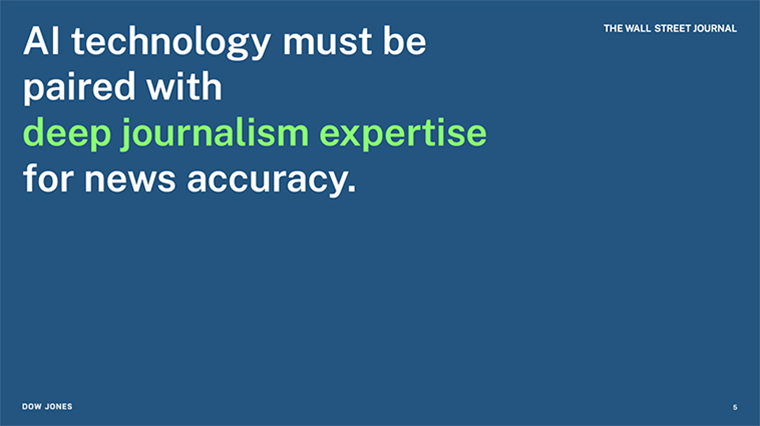
The pattern held everywhere. Maekyung runs AI-generated audio scripts through a secondary AI check and then mandatory human approval. Stuff kept “a human in the loop at every stage.” Chong was direct that the editor still needs to be there. Dahi called the risk of AI setting the news agenda an ethical question: “the decision is in the human journalism.”
Haywood’s caution was about temperament as much as process — building with AI is addictive, and the pull to skip the thinking is strong: “You run the AI, not the other way around,” he said.
Trust is the asset — the business model is the gap
Sue-Anne Lim, CEO of Universal McCann Malaysia, argued advertising has moved through reach and data into a third era of community, and that trust has become the scarce commodity brands cannot manufacture.
“AI can write the article,” she said. “But it cannot be the reason a reader trusts the article.” She rated 200,000 organic shares and views above 20 million paid impressions, and told publishers their priority customer should be their audience, not advertisers.
The Reuters findings cut both ways. Trust in news has fallen to its lowest level since the report began, yet trust in individual news brands has held steady, and only 3% of people say creators meet all their news needs.
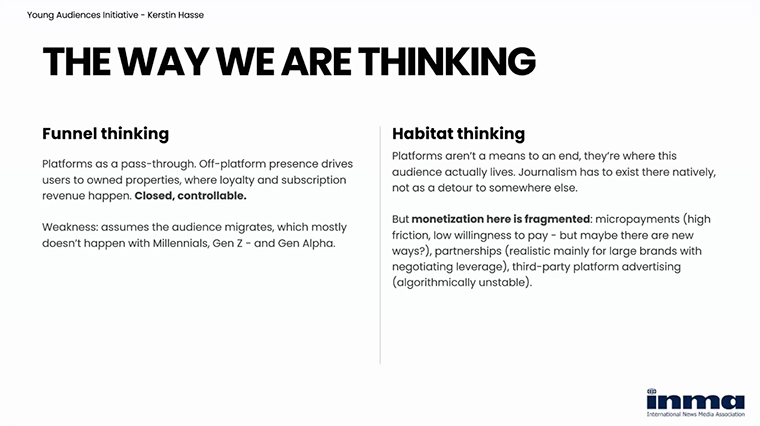
What nobody claimed to have solved is how to be paid in the places audiences now live. Hasse was explicit that habitat thinking is strategically right and economically unresolved — fragmented monetisation, high friction, and returns that take more patience than short-term thinking allows.
Her closing instruction was to stop treating platforms as a waiting room: “Don’t look at third-party platforms as just a station where they take the train to go back to your Web site or app. Look at them as places where you can build relationships with audiences.”
Banner photo: Adobe stock image by BZXO.
Related Articles
-

Marketers should outsource tasks, not thinking
25 October 2026 -

Bundling is a pricing decision, rebundling is an organisational...
18 October 2026 -

AI’s effect on super user math
15 September 2026 -

At Mediacorp’s CNA, loyalty means giving audiences a reason to ...
20 August 2026 -

Tribun Network turns print “dots” into AI-powered insight
20 August 2026 -

Nation Media Group focuses editorial strategy on stories that m...
4 August 2026 -

Briefly News empowers journalists with AI tool suite Nova
4 August 2026 -

Economist launches subscription tier targeting younger audience...
20 July 2026
Upcoming Events
-

Subscriber Acquisition Master Class
10-17 November 2026
-

Media Advertising Summit
New York, United States
07-10 December 2026
-

AI-Native News Product Master Class
18-25 February 2027
-

Media Subscriptions Summit
Oslo, Norway
08-12 March 2027
-

World Congress of News Media
New York, United States
25-30 April 2027
-

Branded Content & Partnerships Master Class
20-27 May 2027
-

Subscriber Retention Master Class
17-24 June 2027
-

Conferencia Latinoamericana
15-16 July 2027
-

South Asia News Media Festival
New Delhi, India
19-22 July 2027
-

Asia/Pacific News Media Summit
19-20 August 2027
-

CEO Roundtable at Kilkenny
Kilkenny, Ireland
24-26 August 2027
-

Media Innovation Week
Amsterdam, The Netherlands
27 September - 01 October 2027








