

AI won’t kill journalism — but failure to reinvent delivery might
Conference Blog | 19 August 2026

News publishers face an urgent choice in the AI era: Use the technology primarily to make existing newsroom workflows more efficient or use it to fundamentally rethink how journalism reaches readers.
For Jun Zhang, chief technology officer of the South China Morning Post (SCMP), the second path is the more consequential one, he said at the recent INMA Asia-Pacific News Media Summit.
“AI itself won’t kill journalism,” Zhang said during a panel discussion. “Failing to invent how we deliver the news to the users will kill the news company.”
News publishers have spent too much time building products and user experiences around Google search optimisation rather than their own audiences, Zhang said. At the same time, readers have increasingly moved away from publisher Web sites and apps to social platforms, where they encounter news through Facebook, Twitter, Instagram, and other channels.
At SCMP, daily active users on the publisher’s own site and app have continued to decline, Zhang said, while views of its content on social platforms grew between 50% and 70% over the past 12 months, depending on the platform.
The pattern does not mean people no longer want news, he said. Instead, audiences are consuming it in different places and formats.
An innovator’s dilemma
Zhang framed the industry’s AI challenge through the “innovator’s dilemma,” arguing that companies facing disruptive technologies can fail when they apply those technologies only to their existing users, products, and business models.
For publishers, he said, that creates two forms of AI adoption.
The first is “sustaining AI.” Using AI to improve workflows, support editorial teams, increase efficiency, and assist with activities such as coding, data analysis, sourcing, discovery, proofreading, and content creation.
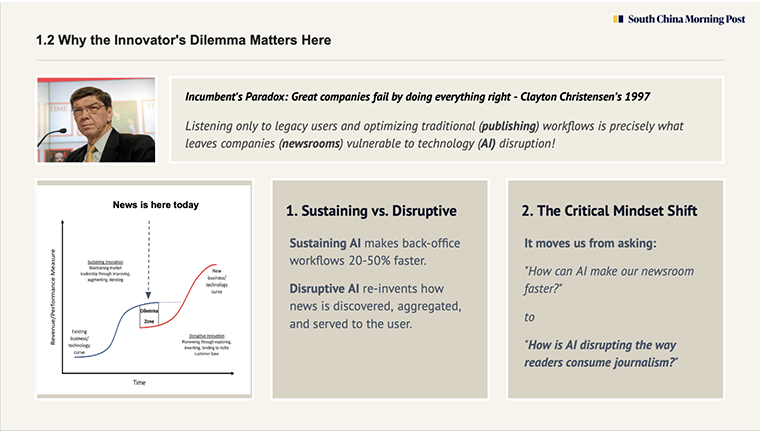
The second is more disruptive: using AI to reinvent the audience experience and distribution of journalism.
The former is useful but defensive, Zhang said. The latter will determine whether publishers can “survive or thrive.”
That distinction is central to SCMP’s strategy. Zhang said original reporting, investigative journalism, and editorial integrity are a publisher’s enduring strengths. AI can learn from previously recorded material, but it cannot independently observe events, conduct interviews, or determine the truth of what is happening in the world.
“AI needs a human to tell it and needs a human to explain to it what’s happening every day in the world,” Zhang said. “Our editors, our news reporters are the best professionals to do that.”
Building for distribution
The most important AI opportunity for publishers lies in distribution and attention rather than content creation, Zhang said.
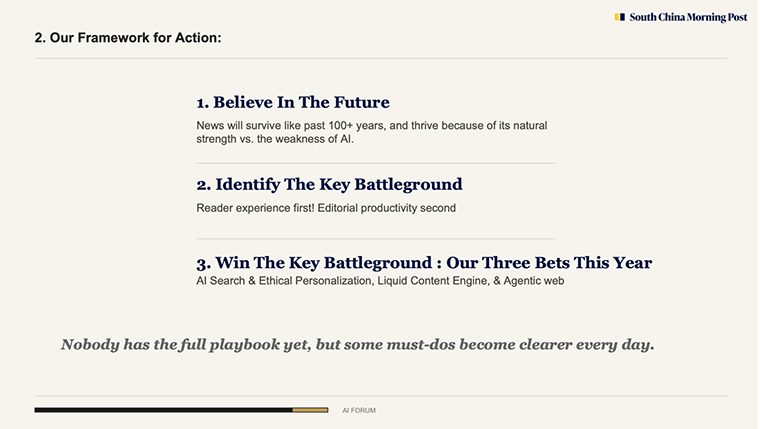
SCMP is focusing on three products: AI-powered search, ethical personalisation, and a “liquid content engine.” It is also adopting AI within the newsroom, but Zhang described that work as a day-to-day service and learning process rather than a primary strategic bet.
The first priority is AI search. Zhang said publishers should not leave users dependent on Google to find articles on their own sites, particularly as search engines increasingly answer questions directly.
Many news organisations still rely on old keyword-search systems that can produce irrelevant results, he said. SCMP recently deployed a new search product using large language models and newer search technology, which Zhang said returns more relevant and recent articles. It also clusters results by topic, turning search into a tool for discovery and learning.
For organisations with limited resources, Zhang said AI search is the most practical first investment. “That’s really the most basic approach,” he said, adding that SCMP’s deployment required about one month of development and two months of debugging and testing.
Personalisation with editorial judgment
SCMP’s second initiative is ethical personalisation, designed to make recommendations more relevant without allowing algorithms to create narrow filter bubbles.
“Relevance is human nature for information-seeking behaviour,” Zhang said. “It’s not a flaw.”
The company’s proposed model combines algorithms with editorial judgment through a hybrid feed architecture. Rather than optimising for clicks, Zhang said the system is intended to prioritise quality reading and post-read value, while maintaining serendipity and topic diversity.
It also incorporates multiple formats, including text, audio, and video, and gives editors visibility into algorithmic settings, article weights, and potential outcomes. That transparency, Zhang said, can help editorial and technology teams better understand one another’s decisions.
The product was in early testing, with a public launch planned for September.
From bottling plant to water utility
The third initiative is liquid content — using AI to adapt a publisher’s original journalism for different social platforms, formats, and times of distribution.
Zhang described traditional publishing as a bottling plant, producing a single finished product. The alternative, he said, is to become a water utility that can move original reporting “into any format to where the people want it.”
SCMP’s early liquid content tool allows editors to select a distribution platform and publishing time, while AI helps crop, re-edit, and prepare content for channels including Instagram and TikTok. Human editors review every output before publication and remain responsible for the final result, Zhang said.
He also pointed to unresolved questions regarding agentic interfaces, in which AI agents could interact with publishers on behalf of users. The technology may be relatively simple to build, he said, but the commercial implications are not.
If users access a publication through an agent rather than visiting its site every day, publishers will need to determine how to define subscriber identity, create loyalty, and build viable business models.
For now, Zhang said publishers should protect what they do best — producing original, trustworthy journalism — while becoming much more ambitious about how that work is delivered.
Banner art: Adobe stock image By Urupong
Related Articles
-

Marketers should outsource tasks, not thinking
25 October 2026 -

The front door is gone — and Asia-Pacific publishers are rebuil...
26 August 2026 -

WSJ Japan finds AI translation is “not a one-and-done deal”
24 August 2026 -

Tribun Network turns print “dots” into AI-powered insight
20 August 2026 -

Nation Media Group focuses editorial strategy on stories that m...
4 August 2026 -

Briefly News empowers journalists with AI tool suite Nova
4 August 2026 -

Why are audiences going to AI answer engines for news?
30 June 2026 -

In the happiest country in the world, AI helps Iltalehti overco...
18 June 2026
Upcoming Events
-

Subscriber Acquisition Master Class
10-17 November 2026
-

Media Advertising Summit
New York, United States
07-10 December 2026
-

AI-Native News Product Master Class
18-25 February 2027
-

Media Subscriptions Summit
Oslo, Norway
08-12 March 2027
-

World Congress of News Media
New York, United States
25-30 April 2027
-

Branded Content & Partnerships Master Class
20-27 May 2027
-

Subscriber Retention Master Class
17-24 June 2027
-

Conferencia Latinoamericana
15-16 July 2027
-

South Asia News Media Festival
New Delhi, India
19-22 July 2027
-

Asia/Pacific News Media Summit
19-20 August 2027
-

CEO Roundtable at Kilkenny
Kilkenny, Ireland
24-26 August 2027
-

Media Innovation Week
Amsterdam, The Netherlands
27 September - 01 October 2027








