

In the happiest country in the world, AI helps Iltalehti overcome news avoidance
Newsroom Innovation Initiative Blog | 18 June 2026

As Finland’s leading digital news outlet, Iltalehti’s Web site sees 2.6 million unique readers per week — a remarkable number, considering the population of the country is approximately 5.6 million. But, as with other newspapers around the world, it is challenged by rising news fatigue and avoidance.
During this week’s Webinar, presented by the INMA Newsroom Innovation Initiative, members heard from Timo Kämäräinen, AI director at Alma Media Corporation, who explained the unique challenges the country — and subsequently the news organisation — face.
For the past eight years, Finland has topped the World Happiness Report’s list of Happiest Countries. At the same time, more than 1,300 kilometres of its border is shared with Russia, which means “the war in Ukraine is not an abstract geopolitical event for us. It is close, it is real, and it is constant presence in our news cycle.”
That dichotomy of a country that is known for having a happy population and a news environment shaped by nearby conflict prompted Iltalehti to leverage AI for sentiment analysis and manage news fatigue head-on.

A global issue, a local approach
Kämäräinen noted the 2026 Reuters Institute Digital News Report shows news avoidance is rising globally. Although Finland is one of the least-affected countries, with news avoidance at 31%, the problem is growing.
“Our response was to build a system that gives the newsroom real visibility into the emotional tone of our journalism,” he explained. “Specifically, we analyse the sentiment and some user needs of every single article published in Iltalehti.”
That information feeds into dashboards and tools embedded in journalists’ daily workflows, helping editors and producers make more informed content decisions. It is not, he clarified, about telling them what to write, but rather about providing data they didn’t have access to in the past.
The project was launched about two years ago with five clear objectives:
- Build a sentiment analysis framework and AI model to categorise every article by emotional tone and user need.
- Create a newsroom dashboard allowing editors to monitor sentiment trends and predict headline performance.
- Use the data to reduce news fatigue to manage the emotional tone of stories.
- Support journalistic quality and help journalists understand the emotional impact of their work — without compromising critical reporting.
- Improve subscription retention based on the hypothesis that content balance affects reader loyalty.
The system works on two levels, Kämäräinen noted: “At the top level, every article gets a primary sentiment classification, and those are positive, neutral, or negative.” However, that’s just the start.
“We also assign more nuanced qualities, things like provoking analytical set, breaking news, entertaining, useful questioning, and inspiring. This multilayered approach is important because negative, for example, alone isn’t very useful; a story can be negative and deeply analytical or negative and simply sensational.”
Using the multi-layered analysis offers richer insights into the tone and impact of the articles, allowing journalists “to see patterns, not just snapshots.”
Machine learning
These AI-driven insights are viewed in multiple ways. For example, editors can looks at a full month of article sentiments and see if they were too heavy in certain areas.
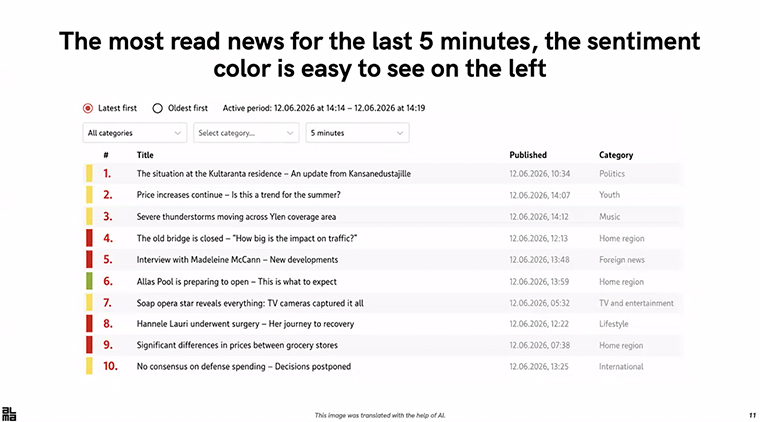
“This view helps editors and reporters as well spot patterns that never see article by article,” Kämäräinen said, adding the real-time feed of the most-read articles “is one of the most used views in the newsroom.”
A colour indicator on one side shows the base sentiment classification of each story which, Kämäräinen said, “is incredibly practical in a busy newsroom. At a glance, an editor can see if the top of the reading list is dominated by a single tone and make a quick decision about what content to promote next.”
Sentiment is also surfaced at the reporter level, and each journalist has their own dashboard tracking the sentiment of their most recent articles.
“This isn’t about surveillance or evaluation, it’s about reflection,” he said. “It opens up a new kind of conversation in the newsroom. A journalist can look at their own work and ask, ‘Am I telling the full story, for example, or am I covering this bit in a way that serves, or am I falling in the emotional groove?’”
Headlines are also eyed with sentiment in mind; Iltalehti’s headline generation tool integrates sentiment analysis directly into the writing process:
“When a journalist is writing a story, the tool generates five headline options. Along each headline, we provide a sentiment classification, so a journalist can see at a glance if a headline is likely to perform well and it reads as constructive, or if [another one] has higher click potential, but it’s negative.”
This, he said, gives journalists ownership and agency, allowing them to choose what they want to prioritise for each piece of content.

What they’ve learned
Leveraging AI analysis provided the editorial team with tools that allow them to “reflect on the impact of their journalism at every stage of the process while planning, while writing, and after publishing.”
But, Kämäräinen pointed out, “these tools don’t rewrite journalism. They don’t change the world as it is.” They do, however, allow the newsroom to make more informed content decisions.
“And, in a newsroom that publishes at the pace we do, making better informed decisions consistently adds up to something different and maybe even significant.”
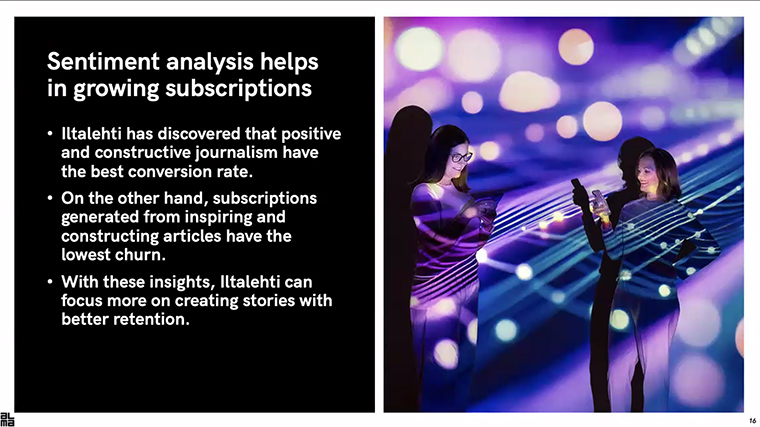
Commercially, the investment in the tool paid off, but not in dramatic ways. Instead of quick spikes, Iltalehti’s growth has been more nuanced, with positive, constructive journalism delivering higher conversion rates than predominantly negative stories. And subscribers who entered through the positive and inspiring gateway show the highest retention rate.
That’s an insight that matters, he said: “These are readers who came in through content that gave them something — perspective, hope, solutions — and they stay and come back. That insight is shaping our editorial strategy. We are intentionally creating more stories in the sentiment categories that drive loyalty.
“So this sentiment analysis is very beneficial for us in many, many ways.”
Related Articles
-

Marketers should outsource tasks, not thinking
25 October 2026 -

AI’s effect on super user math
15 September 2026 -

At Mediacorp’s CNA, loyalty means giving audiences a reason to ...
20 August 2026 -

Tribun Network turns print “dots” into AI-powered insight
20 August 2026 -

Nation Media Group focuses editorial strategy on stories that m...
4 August 2026 -

Briefly News empowers journalists with AI tool suite Nova
4 August 2026 -

Indian Express builds a video-first future around trusted journ...
20 July 2026 -

Grupo RBS builds social-first video operation to expand audienc...
20 July 2026
Upcoming Events
-

Subscriber Acquisition Master Class
10-17 November 2026
-

Media Advertising Summit
New York, United States
07-10 December 2026
-

AI-Native News Product Master Class
18-25 February 2027
-

Media Subscriptions Summit
Oslo, Norway
08-12 March 2027
-

World Congress of News Media
New York, United States
25-30 April 2027
-

Branded Content & Partnerships Master Class
20-27 May 2027
-

Subscriber Retention Master Class
17-24 June 2027
-

Conferencia Latinoamericana
15-16 July 2027
-

South Asia News Media Festival
New Delhi, India
19-22 July 2027
-

Asia/Pacific News Media Summit
19-20 August 2027
-

CEO Roundtable at Kilkenny
Kilkenny, Ireland
24-26 August 2027
-

Media Innovation Week
Amsterdam, The Netherlands
27 September - 01 October 2027








