

WSJ Japan finds AI translation is “not a one-and-done deal”
Conference Blog | 24 August 2026

Publishers weighing AI-powered translation should expect ongoing maintenance, not a one-time setup, said George Nishihama, managing editor of The Wall Street Journal’s Japan edition, during the INMA Asia-Pacific News Media Summit 2026.
“Many mistakenly think that once they get it right, they set it up ... that’s it,” Nishihama said. “That is not the case.”
Nishihama traced his outlet’s translation journey from the early 1990s, when he worked as a bilingual reporter for Reuters in Tokyo and relied on paper dictionaries and a thesaurus for financial terminology. The Wall Street Journal of Japan launched in 2009 with fully manual translation, accurate but labour-intensive, with humans translating every phrase, sentence by sentence.
Then, in 2024, Dow Jones launched its first fully automated, AI-powered translation service, choosing South Korea to meet a client’s demand for a real-time Dow Jones newswires feed in Korean. The publication needed to translate thousands of short, business-critical items daily but lacked a local translation team capable of handling that volume manually.
Context, syntax, and idioms
Standard machine translation tools translated words literally without financial context, Nishihama said, while generic large language models introduced three major problems: context, syntax, and idioms.
Korean and Japanese both carry hierarchical honorifics depending on the audience, he said, but AI tools shifted tone inconsistently within a single article. In syntax, a sentence such as “the company said on Monday that it was introducing a new product on Friday” could get scrambled, making the launch appear to happen on Monday. Idioms such as “signed at the 11th hour” were translated literally, confusing Korean readers.
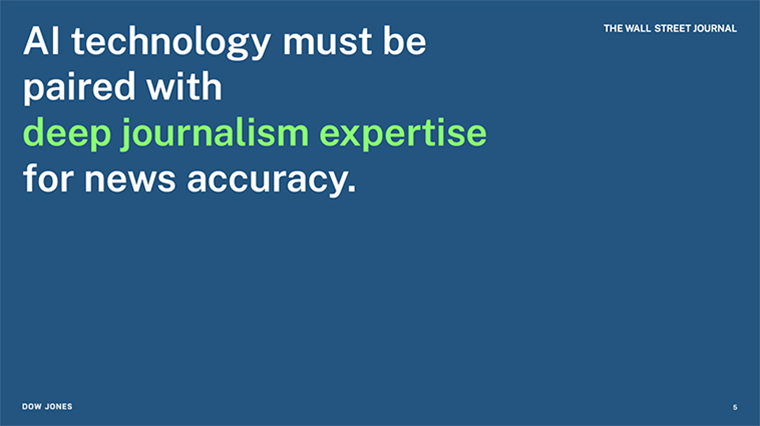
“Generic AI alone could not guarantee the level of accuracy that we were aiming for,” Nishihama said. “To make it work for financial media, AI technology must be paired with deep expertise in journalism.”
Flipping the workflow
Dow Jones restructured its process around four steps: baseline vetting of multiple AI models by financial-journalism experts, prompt engineering, curated contextual glossaries to prevent terminology hallucinations, and post-publication quality-assurance sampling.
The system evolved into an agentic workflow, Nishihama said, with a preprocessing programme cleaning the source text, a translation agent doing the heavy lifting, a proofreading agent checking items such as proper nouns, and a failover agent catching formatting errors or triggering a backup AI model.
Every automated translation carries a disclaimer noting it was produced via automated technology, with the original English serving as the authoritative record, Nishihama said.
The approach was expanded to French, Dutch, and Arabic and integrated into existing Japanese, Chinese, and German services, doubling the volume of real-time Chinese and Japanese stories compared to manual translation. It also enabled new products, including Dow Jones Yomiuri Shimbun Pro, a bilingual premium service launched with Japan’s largest general-circulation newspaper.
Human translators, Nishihama said, have shifted into roles as “system orchestrators” overseeing AI output rather than translating from scratch, a shift he called a significant newsroom mindset change.
Unexpected errors
Nishihama also described unresolved risks, including instances in which mixed languages, such as Korean and Chinese, or fragments resembling Russian, appeared in the translated copy, and one case in which a chatbot’s internal “thinking” text leaked into a story field before publication.
Asked whether any translation error had prompted safeguard changes, Nishihama said he was not aware of one, though he noted a recent case in which confusing English syntax led to a mistranslation significant enough that the outlet issued a correction.
“Your English writing ... needs to be good writing,” he said. “It needs to be clear ... . If you don’t get that right, the AI would mistranslate.”
Banner art: Adobe Stock by AbuAbdillah.
Related Articles
-

Marketers should outsource tasks, not thinking
25 October 2026 -

AI’s effect on super user math
15 September 2026 -

At Mediacorp’s CNA, loyalty means giving audiences a reason to ...
20 August 2026 -

Tribun Network turns print “dots” into AI-powered insight
20 August 2026 -

Nation Media Group focuses editorial strategy on stories that m...
4 August 2026 -

Briefly News empowers journalists with AI tool suite Nova
4 August 2026 -

Indian Express builds a video-first future around trusted journ...
20 July 2026 -

Grupo RBS builds social-first video operation to expand audienc...
20 July 2026
Upcoming Events
-

Subscriber Acquisition Master Class
10-17 November 2026
-

Media Advertising Summit
New York, United States
07-10 December 2026
-

AI-Native News Product Master Class
18-25 February 2027
-

Media Subscriptions Summit
Oslo, Norway
08-12 March 2027
-

World Congress of News Media
New York, United States
25-30 April 2027
-

Branded Content & Partnerships Master Class
20-27 May 2027
-

Subscriber Retention Master Class
17-24 June 2027
-

Conferencia Latinoamericana
15-16 July 2027
-

South Asia News Media Festival
New Delhi, India
19-22 July 2027
-

Asia/Pacific News Media Summit
19-20 August 2027
-

CEO Roundtable at Kilkenny
Kilkenny, Ireland
24-26 August 2027
-

Media Innovation Week
Amsterdam, The Netherlands
27 September - 01 October 2027








