

Philippine Daily Inquirer focuses on reader habits, not visits
Conference Blog | 23 August 2026

Views are easy to count. Habits are harder to build — and far more valuable.
That distinction sits at the heart of Arlene Burgos’ approach to audience strategy. Drawing on her experience at Inquirer and ABS-CBN, the Philippine Daily Inquirer’s chief content officer explained at the INMA Asia-Pacific News Summit that legacy newsrooms should stop treating platforms as destinations and start using them as gateways to deeper, direct audience relationships.
Build habits, not visits
Burgos has experienced multiple waves of change in news distribution — from SMS and social media to mobile apps and third-party platforms.
Her first lesson was straightforward: “It’s habits, not visits.”
For the Philippine Daily Inquirer, the distinction is evident in how its print and digital products serve different audiences’ needs. Digital platforms deliver “news in a hurry” and “news now,” while the newspaper offers a broader synthesis of the previous day’s events.
The products may differ, but both can become part of an audience’s routine.
“A newsroom should ask what recurring job are we helping our audience to do, and when do they need us?” Burgos said.
That means designing journalism around specific moments in people’s day: a morning briefing to start the day informed; a midday practical-service update covering transport, weather, prices, schools or government services; an evening “what matters tomorrow” product; or topic-based alerts that users actively choose.
Burgos described this as a “content windowing system” — planning when and where to meet audiences, then creating reasons for them to return.
The power of a community
Burgos’ experience at ABS-CBN demonstrates why audience habits can matter even more than individual pieces of content.
When ABS-CBN’s free-TV operations were shut down in May 2020, its flagship newscast TV Patrol returned online two days later and drew more than 8 million views overnight. But the audience behind those numbers had been built long before the crisis, Burgos said.
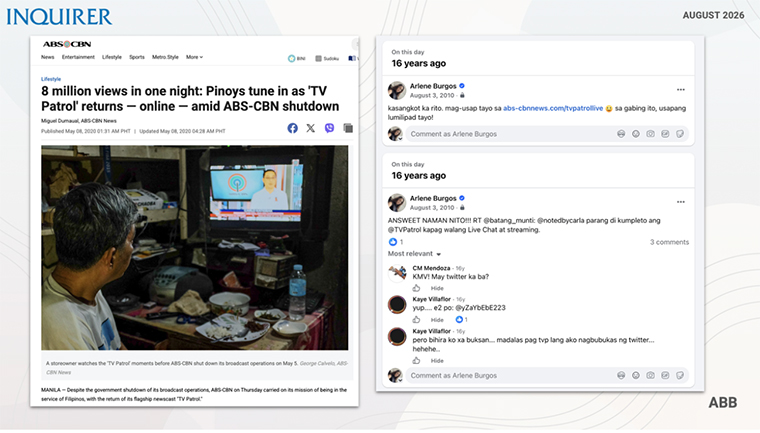
Years earlier, TV Patrol had begun livestreaming and interacting with viewers during the broadcast. A handful of regular chatters grew into hundreds and then thousands. Eventually, the newsroom formed a chat group and a fandom emerged around the programme’s 6:30 p.m. viewing habit.
“We were citizens glued together by our 6.30 p.m. prime time news viewing habit. We were a community,” Burgos recalled.
The experience illustrates a broader point: Strong audience relationships are built through repeated interaction. By the time TV Patrol lost its traditional distribution channel, it had already become part of people’s routines — and its audience actively wanted it back.
Burgos also pointed to examples from Indonesia, including Tempo and the Malaka Project, where content and community reinforce each other. Malaka, for example, uses short, accessible explainers on social platforms to draw audiences into longer videos and podcasts. Repeated exposure can turn viewers into habitual followers and, eventually, advocates.
Use platforms, but don’t depend on them
Burgos is not suggesting legacy newsrooms abandon social platforms. In mobile-first Asian markets, they remain essential for discovery. The key is to give each platform a clear role — whether reaching new audiences, serving existing communities, testing formats, or listening to audience questions.
“We should publish natively for the platform, but build a relationship natively in our own ecosystem,” she said.
That requires changing how success is measured. Instead of focusing only on views and shares, newsrooms should track registrations, newsletter sign-ups, app installations, follows and return visits, as well as completion, saves, replies, and meaningful comments. They should also monitor whether social audiences become direct audiences over 30, 60 or 90 days, alongside brand recognition and trust.
As Burgos put it, “A platform referral is rented attention.”
The goal, then, is not to reject platforms but to use them as a bridge toward relationships the newsroom can sustain on its own.
Give audiences a reason to take the next step
For legacy brands such as Inquirer, Burgos identified five foundations for building direct relationships with audiences: utility, identity, access, personality, and participation.
Utility means service journalism that helps people make decisions today. Identity means coverage that makes Filipinos, both at home and abroad, feel seen. Access comes through explainers, accountability reporting and journalism that clarifies complex issues. Personality comes from trusted reporters and editors with identifiable expertise. Participation can include questions, tip lines, polls, live explainers, and community listening.
Importantly, the next step does not always have to be a visit to the homepage.
“The objective is not to force every social user to visit the homepage immediately but maybe just to give them a compelling reason for the next step,” Burgos said.
That next step could be subscribing to a morning briefing, following a reporter, receiving election explainers, saving a local guide, or engaging directly with the newsroom.
Align the newsroom around audience needs
Building an audience-led newsroom also means changing how editorial decisions are made.
Burgos stressed that audience-led journalism does not mean letting analytics dictate every story. Instead, it means combining editorial judgment with evidence about whom the newsroom serves, what those audiences need and whether journalism actually helped them.
She recommended establishing a regular audience-and-editorial rhythm: reviewing stories that generated return visits, subscriptions, registrations, saves, replies, completion, and trust — not just traffic.
Newsrooms should also identify underserved needs and communities, bring editorial, product, data, visual and video teams into the same conversation, and give reporters feedback that connects their work to audience impact.
Just as importantly, success should be defined more broadly. Repeat engagement, informed public service, distinctive reporting, and community contribution should be valued alongside pageviews.
Her advice was simple: “Be useful.”
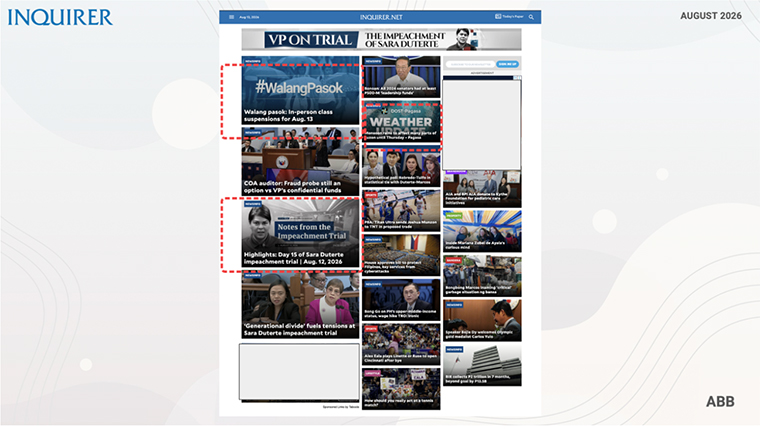
From rented attention to trusted relationships
Burgos ultimately brought the discussion back to the broader challenge facing legacy newsrooms. In the Philippines, social media has become a major source of news, while trust in news remains a concern.
That makes the task larger than distribution: Newsrooms need to create experiences that are useful, credible, and worth returning to.
“In Asian legacy newsrooms like ours,” Burgos said, “the question is no longer whether we should use third-party platforms. I think we should; of course, we should. The question is whether every platform interaction gives people a reason and an easy path to come back to us directly.”
That is the heart of her message: Platforms can help newsrooms find audiences, but they should not own the audience relationship.
“The strategic asset is the repeat trusted permission relationship a newsroom builds through its own products, its people, and its community,” Burgos concluded.
Banner photo: Adobe Stock by Mrammon.
Related Articles
-

Arena Holdings learns reaching millions isn’t the same as servi...
8 October 2026 -

The Inquirer, Maeil ask: Is our content useful?
23 September 2026 -

Prothom Alo’s World Cup content flywheel engages millions
31 August 2026 -

BusinessDay moves from business content to business intelligenc...
6 August 2026 -

Content creators just get user needs (and newsrooms don’t)
2 August 2026 -

South Asia’s publishers no longer expect young readers to come ...
27 July 2026 -

The reality check of user needs: “Update me” drives most demand...
13 July 2026 -

Why are audiences going to AI answer engines for news?
30 June 2026
Upcoming Events
-

Subscriber Acquisition Master Class
10-17 November 2026
-

Media Advertising Summit
New York, United States
07-10 December 2026
-

AI-Native News Product Master Class
18-25 February 2027
-

Media Subscriptions Summit
Oslo, Norway
08-12 March 2027
-

World Congress of News Media
New York, United States
25-30 April 2027
-

Branded Content & Partnerships Master Class
20-27 May 2027
-

Subscriber Retention Master Class
17-24 June 2027
-

Conferencia Latinoamericana
15-16 July 2027
-

South Asia News Media Festival
New Delhi, India
19-22 July 2027
-

Asia/Pacific News Media Summit
19-20 August 2027
-

CEO Roundtable at Kilkenny
Kilkenny, Ireland
24-26 August 2027
-

Media Innovation Week
Amsterdam, The Netherlands
27 September - 01 October 2027








