

The Inquirer, Maeil ask: Is our content useful?
Newsroom Innovation Initiative Blog | 23 September 2026

One big question on news executives’ minds right now is: How can I ensure my content will be relevant? Or, more bluntly, why would anyone come to my news brand when they can get answers from AI answer engines?
Focus on needs served
At The Inquirer in the Philippines, their audience and their needs are squarely in focus.
“A newsroom should ask: What recurring job are we helping our audience do — and when do they need us? And then, we act,” said Chief Content Officer Arlene Burgos at the recent INMA Asia Pacific News Media Summit. “So build habits, and not isolated visits, and rally your community around that.
“A useful editorial question is: ‘If this story succeeds, what will the audience know, feel, or be able to do that they could not before?’”
Burgos cited the example of a Philippine TV channel that ceased to broadcast through conventional means but succeeded through streaming on social media. How? Because its journalists built a community around the shared habit of watching the news at the same time every day and genuinely connecting with the audience.
Such platforms are essential for discovery, but Burgos warned against depending on them.
“Each platform should have a specific role,” she said, whether it is for reaching new people, serving existing communities, testing formats, listening for questions, or moving users further down the funnel.
“Our mantra is: We should publish natively to the platform but build the relationship natively within our own ecosystem.” The Inquirer’s goal is to give the social media user a compelling reason to visit their own news products.
What about new metrics, beyond pageviews? Burgos suggested newsletter signups, app downloads, follows, qualified registrations, return visits, completion, saves, replies, meaningful comments, and conversion metrics for social audience to direct audience. Look at the content driving these metrics, and give reporters feedback that connects their work to impact and audience value, she said.
The content that works best for this purpose includes:
Service journalism that helps people make decisions today, such as weather content.
Identity-related coverage that helps your audience feel seen.
Access journalism.
Explainers that clarify complex issues.
Accountability reporting.
Personality-based opinions from trusted journalists with identifiable expertise and accessible voices.
Community listening through call-outs, live poll, and similar tools.
“In short, be useful,” Burgos said.
“The future of a legacy newsroom will not be secured by winning every algorithm. It will be secured by becoming a habit people would genuinely miss — a newsroom they return to because it helps them understand their lives, their communities, and their country.”
Focus on utility
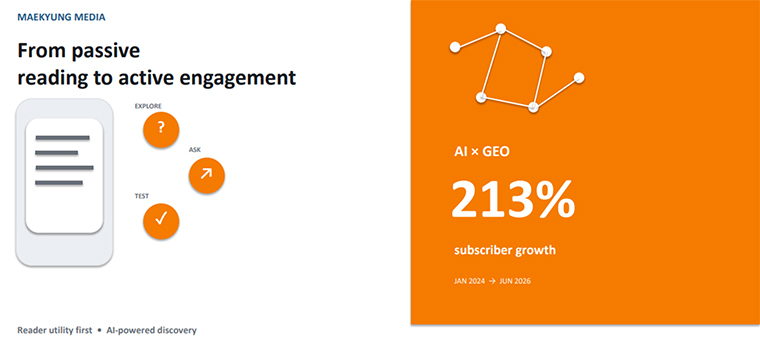
At Maekyung Media’s Maeil Business Newspaper in South Korea, the goal is to drive active engagement, rather than passive, by underscoring the utility their content provides.
To help readers actively and effortlessly explore the site rather than simply reading, Maeil created three AI-driven agents.
One agent, MAI, delivers news through personalised briefings, based on the user’s consumption habits and interests: “We envision MAI as a personal finance and news assistant right in the palm of our reader’s hand,” journalist Park Suho told conference attendees.
Another agent combines financial data, such as earnings and disclosures, with Maeil’s journalism into a research brief for readers. Its goal is to be an investing co-pilot.
A third converts Maeil’s journalism into education modules. “When complex macroeconomic terms or novel industry jargon surface in the news, the AI converts them into digestible materials,” he said. “It delivers interactive quizzes, adaptive feedback, and conversational tutoring, backed by Maeil’s journalistic archive.”
Maeil also offers a daily audio podcast, a conversation between an anchor, and a journalist covering key economic issues. AI selects eight articles out of the 150 published daily, writes the script, and generates the voices. A journalist checks the work before the podcast goes live to ensure accuracy.
Bloomberg and The Daily Mail UK are also thinking about ensuring their journalism is genuinely useful. As Katie Boyce, head of digital editorial at Bloomberg, said: “Audiences expect to be able to take something away from the journalism they’re consuming. It’s not enough anymore just to give a headline or answer a simple question. AI and social have really taken that over.”
If you’d like to subscribe to my bi-weekly newsletter, INMA members can do so here.
Banner photo: Adobe stock image by Midnight Studio.
Related Articles
-

Arena Holdings learns reaching millions isn’t the same as servi...
8 October 2026 -

Prothom Alo’s World Cup content flywheel engages millions
31 August 2026 -

BusinessDay moves from business content to business intelligenc...
6 August 2026 -

Content creators just get user needs (and newsrooms don’t)
2 August 2026 -

South Asia’s publishers no longer expect young readers to come ...
27 July 2026 -

The reality check of user needs: “Update me” drives most demand...
13 July 2026 -

Why are audiences going to AI answer engines for news?
30 June 2026 -

Süddeutsche Zeitung Dossier finds success with daily briefings
17 June 2026
Upcoming Events
-

Subscriber Acquisition Master Class
10-17 November 2026
-

Media Advertising Summit
New York, United States
07-10 December 2026
-

AI-Native News Product Master Class
18-25 February 2027
-

Media Subscriptions Summit
Oslo, Norway
08-12 March 2027
-

World Congress of News Media
New York, United States
25-30 April 2027
-

Branded Content & Partnerships Master Class
20-27 May 2027
-

Subscriber Retention Master Class
17-24 June 2027
-

Conferencia Latinoamericana
15-16 July 2027
-

South Asia News Media Festival
New Delhi, India
19-22 July 2027
-

Asia/Pacific News Media Summit
19-20 August 2027
-

CEO Roundtable at Kilkenny
Kilkenny, Ireland
24-26 August 2027
-

Media Innovation Week
Amsterdam, The Netherlands
27 September - 01 October 2027








