

Reuters Digital News Report shows accelerated shifts in 2026
Conference Blog | 18 August 2026

As audiences have stepped away from traditional news outlets, they’ve embraced a news ecosystem driven by creators, platforms, video, and AI.
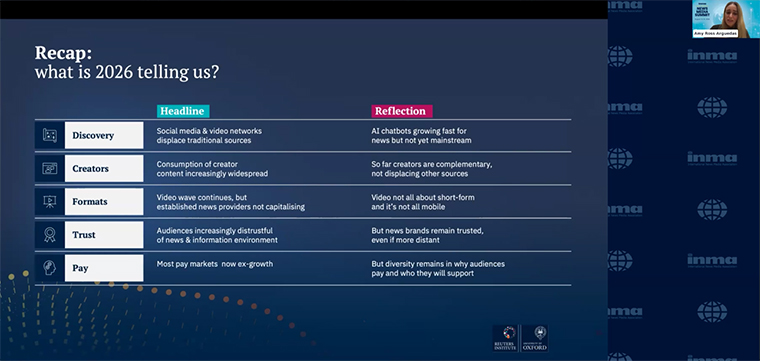
During the INMA Asia-Pacific News Media Summit, Amy Ross Arguedas — a senior research fellow at Reuters Institute for the Study of Journalism and co-author of the Reuters Institute Digital News Report 2026 — explained that if 2026 feels different, it’s not your imagination.
“After several years of overall stability, 2026 proved to be very different.”
The data didn’t just show change; it accelerated. She outlined the key areas impacted by the shifts.
The social shift
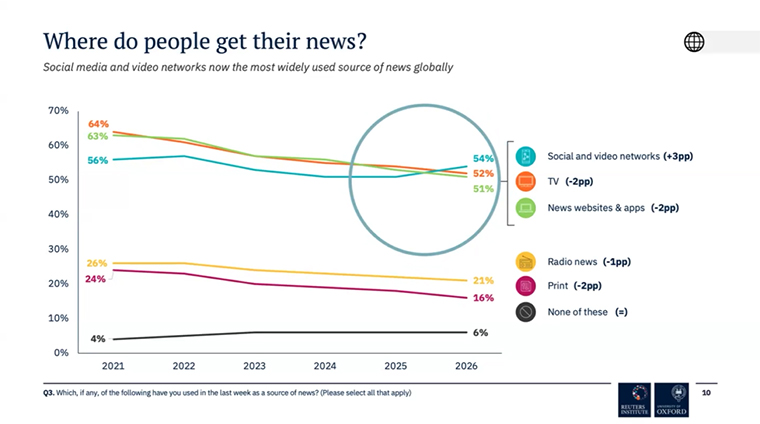
The biggest shift is seen in discovery, as social and video platforms have officially overtaken television and news Web sites as the primary source of news. In some places, including Indonesia, Malaysia, and the Philippines, this happened years ago. But now the rest of the world has caught up.
“At the same time, we see some differences within the Asia-Pacific region,” Arguedas said. “In markets like Japan and Taiwan, television and news Web sites are still stronger than social and video networks. So again, it’s not 100% even in all of the markets.”
Even people in their 30s and 40s — once dependent on news apps and Web sites — now turn to social platforms for information. The pivot is no longer generational; it’s universal.
“What we’ve seen here is basically a growth across the board, across all age groups in terms of social media and video networks as the main source of news,” she said. “We see this growth happening across all age groups; it’s not only among young people.”
YouTube, TikTok, and Instagram have all experienced rapid growth, and WhatsApp is surging as well: “Globally, 20% say that they use TikTok for news, but we see higher levels in some of the Asian markets like Indonesia and Malaysia. Thailand is among the highest in the world, with 55% using TikTok for news in the past week. So it is really explosive growth.”
Surprisingly, Facebook is also riding this wave. Although it began to decline as a news source in 2016, that flattened last year, and this year it saw an uptick that is worth noting: “For now, it looks like things have turned around a little bit for Facebook in terms of being a source of news.”
Chatbots rise, trust declines
Arguedas also noted the rise of AI chatbots. Only 10% of people use them for news, but the growth is fast and concentrated in markets already accustomed to platform-led news.
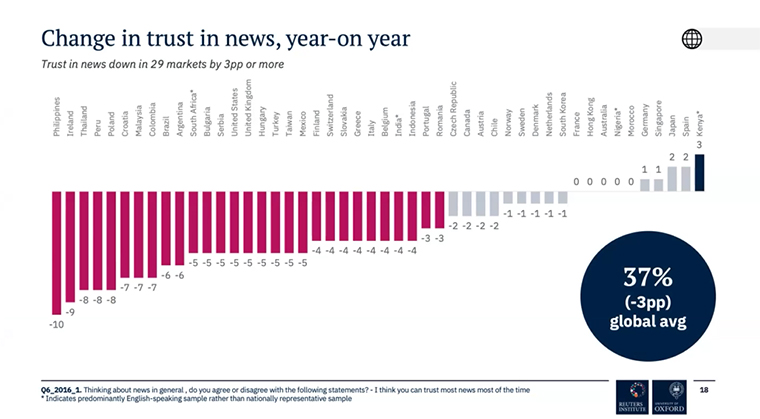
At the same time, trust in news continued to decline, dropping to its lowest level since the report began. People feel increasingly sceptical of the information ecosystem, although trust in individual news brands remains stable. Even in countries with steep declines in overall trust, many outlets maintained or even grew their credibility.
Journalism, Arguedas said, “is not irrelevant.”
And even though creators and influencers are now part of the news habit for more than a quarter of global audiences, they’re viewed as less trustworthy and less knowledgeable. For now, they supplement rather than replace traditional outlets; only 3% of people say creators meet all their news needs.
Finally, when it comes to paying for news, most payments still go to traditional news organisations, but other sources — including digital-only outlets — are gaining traction. The most common reason people pay is to get information they can’t find elsewhere, but the second-most common motivation should encourage publishers everywhere: “To support journalism because they think it’s important to society.”
Banner photo: Adobe Stock by InfiniteFlow.
Related Articles
-

Marketers should outsource tasks, not thinking
25 October 2026 -

The 3 editorial pillars of Chile’s first streaming news channel
23 September 2026 -

AI’s effect on super user math
15 September 2026 -

At Mediacorp’s CNA, loyalty means giving audiences a reason to ...
20 August 2026 -

Tribun Network turns print “dots” into AI-powered insight
20 August 2026 -

Nation Media Group focuses editorial strategy on stories that m...
4 August 2026 -

Briefly News empowers journalists with AI tool suite Nova
4 August 2026 -

Indian Express builds a video-first future around trusted journ...
20 July 2026
Upcoming Events
-

Subscriber Acquisition Master Class
10-17 November 2026
-

Media Advertising Summit
New York, United States
07-10 December 2026
-

AI-Native News Product Master Class
18-25 February 2027
-

Media Subscriptions Summit
Oslo, Norway
08-12 March 2027
-

World Congress of News Media
New York, United States
25-30 April 2027
-

Branded Content & Partnerships Master Class
20-27 May 2027
-

Subscriber Retention Master Class
17-24 June 2027
-

Conferencia Latinoamericana
15-16 July 2027
-

South Asia News Media Festival
New Delhi, India
19-22 July 2027
-

Asia/Pacific News Media Summit
19-20 August 2027
-

CEO Roundtable at Kilkenny
Kilkenny, Ireland
24-26 August 2027
-

Media Innovation Week
Amsterdam, The Netherlands
27 September - 01 October 2027








