

The 3 editorial pillars of Chile’s first streaming news channel
Young Audiences Initiative Blog | 23 September 2026

As creative director at Turno Media, Nicolas Copano leads Chile’s first streaming news channel. During the INMA Young Audiences Summit, he explained how it has reshaped the country’s media landscape and built a following amongst younger audience.
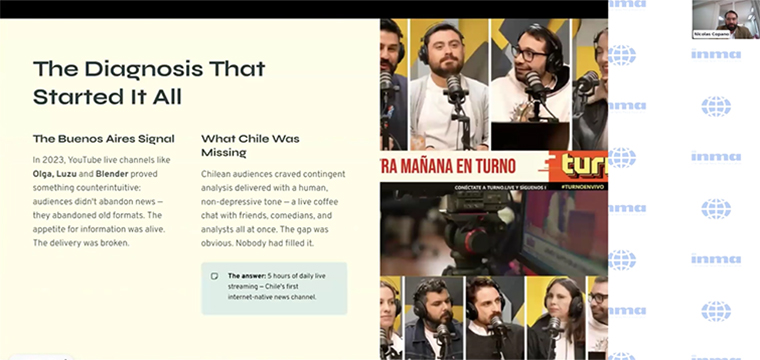
The project began as an attempt to launch an FM radio station, but, with “all broadcast frequencies taken” in Chile, he turned to YouTube instead, which ultimately led to a five‑hour‑a‑day live streaming channel that now ranks among the most‑watched in the country.
With live broadcasts airing from 8 a.m. to 1 p.m. Monday through Friday, Turno delivers interviews, panel discussions, commentary, guests, and breaking news cut‑ins across YouTube, Instagram, and X.
CNN-inspired
The idea for Turno was sparked in 2019 when Copano visited CNN in Atlanta, where he was struck by a small breaking‑news operation run by a single operator. The setup reminded him of gaming streams, and he began imagining how gaming‑style graphics and production techniques could be applied to news.
Returning to Chile, he built a studio in his home during the pandemic, using open‑source software to mix video and create a livestream format that blended traditional news sensibilities with gaming aesthetics. His early project, Copano.News, went viral during the pandemic and later moved to FM radio, but he said “it wasn’t enough.”
Needing more, he began expanding his efforts into a full streaming channel.
Beginning with a two‑person team, Copano has expanded the staff as the format evolved. Today, Turno boasts a 20‑person team, including hosts, producers, social media staff, and a newsroom that manages daily programming.
That programming is organised into three blocks. The early‑morning segment, Turno AM, runs from 8 a.m. to 10 a.m. and focuses on news coverage, journalists, book authors, and public authorities. The mid‑morning block, Turno en Vivo, highlights artists, comedians, and popular cultural figures. The final block is a Q&A session with a featured guest.
All segments can be interrupted by breaking news alerts, which delivers the latest headlines from top news outlets.
“What we foster is creativity and curiosity,” he explained.
Three editorial pillars
Turno’s editorial philosophy is built on three pillars: radical transparency, technology‑first operations, and a commitment to progress.
1. Radical transparency includes what Copano called “opinion tax,” meaning hosts must root their perspectives in verified facts. “Without solid facts in the table,” he said, “offering a perspective is off limits.”
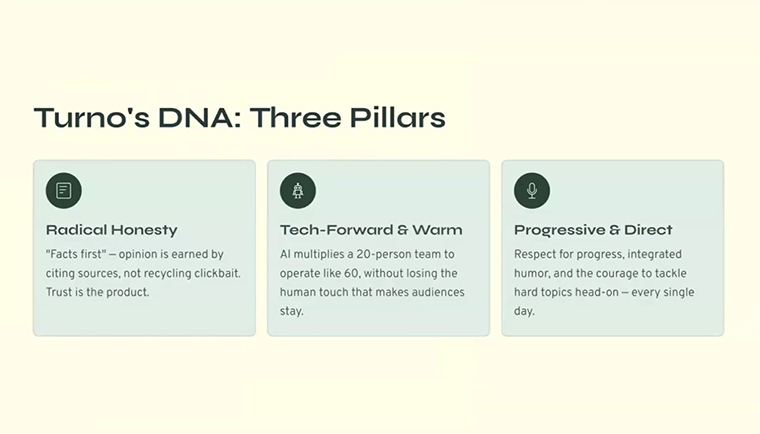
2. Technology‑first empowerment means Turno does not hire new staff until it has confirmed that software cannot amplify an existing team member’s capabilities. Copano said the team invests heavily in what he calls “cyber journalism.”
3. Progress reflects Turno’s intention to be uplifting: “The Internet is saturated with doomscrolling and we are here to counter it,” he said.
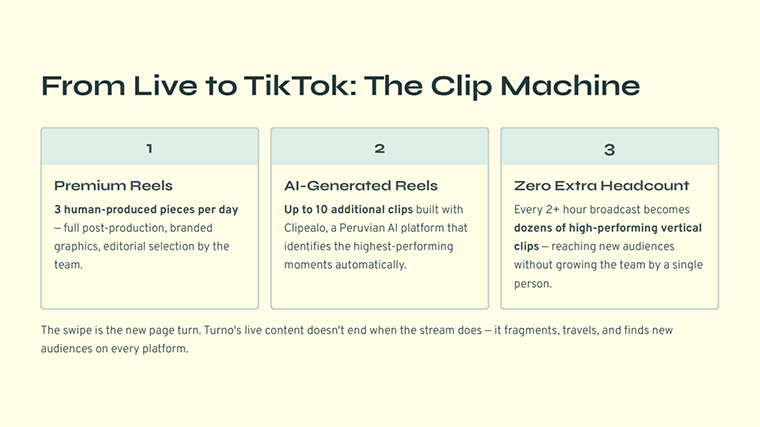
The channel’s production workflow relies heavily on Artificial Intelligence. The “clip machine,” as he called it, is central to Turno’s strategy for generating millions of views on Instagram and other platforms.
The team produces three types of videos: premium reels, fully polished videos enhanced with post‑production and motion graphics, and AI‑driven reels created through bulk clip production.
Turno also maintains an active community through YouTube chat and WhatsApp. Copano said the WhatsApp groups, which include 3,000 members, allow the team to “keep the conversation going around the clock,” share updates, and invite viewers to tune in. The channel sends a WhatsApp newsletter summarising daily broadcast highlights.
Financially, Turno generates revenue through YouTube channel memberships, sponsors, special events, and YouTube ads. Memberships range from US$5 to US$20, and sponsorships start at US$3,000. Sponsors receive integrated video treatment, including logos and branded cards embedded directly into reels circulating on social media.
Copano emphasised that Turno’s cost structure is significantly lower than traditional media, which he said has created what he calls “a jello sensation” in the industry: “Turno is a problem,” he said, “but it’s a funny problem.”
Now, mainstream outlets have begun imitating Turno’s format.
Turno’s relevance is more important than its performance metrics, though the metrics are strong, Copano said. In 2025, the channel generated more than 105 million views and 5.6 million real interactions, with 100,000 YouTube subscribers. Turno has become a trusted news source in a “media desert,” and during election cycles, audiences choose Turno over traditional outlets, Copano said.
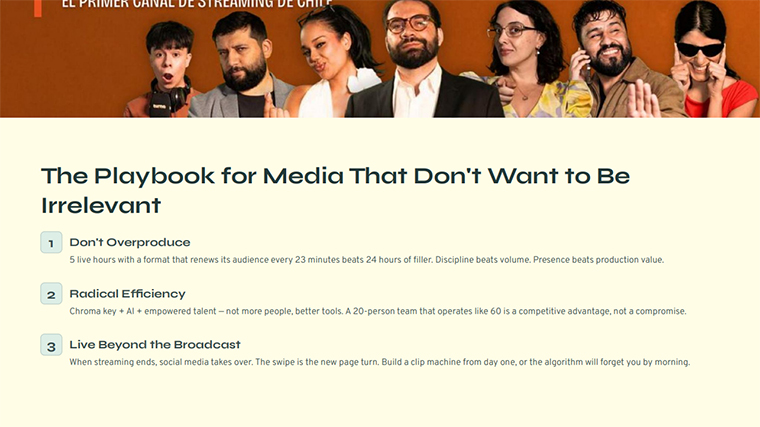
Copano offered suggestions from his experiences, beginning with the importance of not overproducing. “Never spend your budget,” he said, citing Muhammad Ali as inspiration. Newsrooms often overproduce content and create ventures “with no destination,” he said, whereas Turno focuses on sharpening what works.
He also emphasised radical efficiency, saying AI is essential to Turno’s workflow and allows a lean human team to supervise trends and scale output.
Finally, he highlighted the importance of extending the brand beyond the broadcast through bite‑sized video segments and offline events. “Expanding our tangibly human footprint,” he said, “is what sets us apart.”
Copano also addressed the role of personal branding. Although he is a recognisable figure, he is careful to ensure Turno’s success does not depend on him. He takes vacations twice a year without losing any audience members, which shows the platform can succeed on its own merit instead of resting on his shoulders. Instead, Copano sees his role as being the person to “go first” when testing new time slots or formats, then pass the experience to other talent.
Perhaps the ultimate sign of success is that viewers often approach him in public to express appreciation for Turno: “The people say thank you to the experience of a new space,” he said. “Turno opened a new space to journalism experience.”
Related Articles
-

Marketers should outsource tasks, not thinking
25 October 2026 -

AI’s effect on super user math
15 September 2026 -

At Mediacorp’s CNA, loyalty means giving audiences a reason to ...
20 August 2026 -

Tribun Network turns print “dots” into AI-powered insight
20 August 2026 -

Nation Media Group focuses editorial strategy on stories that m...
4 August 2026 -

Briefly News empowers journalists with AI tool suite Nova
4 August 2026 -

Indian Express builds a video-first future around trusted journ...
20 July 2026 -

Economist launches subscription tier targeting younger audience...
20 July 2026
Upcoming Events
-

Subscriber Acquisition Master Class
10-17 November 2026
-

Media Advertising Summit
New York, United States
07-10 December 2026
-

AI-Native News Product Master Class
18-25 February 2027
-

Media Subscriptions Summit
Oslo, Norway
08-12 March 2027
-

World Congress of News Media
New York, United States
25-30 April 2027
-

Branded Content & Partnerships Master Class
20-27 May 2027
-

Subscriber Retention Master Class
17-24 June 2027
-

Conferencia Latinoamericana
15-16 July 2027
-

South Asia News Media Festival
New Delhi, India
19-22 July 2027
-

Asia/Pacific News Media Summit
19-20 August 2027
-

CEO Roundtable at Kilkenny
Kilkenny, Ireland
24-26 August 2027
-

Media Innovation Week
Amsterdam, The Netherlands
27 September - 01 October 2027








