

News Corp Australia leans into print history for digital retention success
Conference Blog | 18 August 2026

At News Corp Australia, the future of digital retention relies on something decidedly old-school: furniture. In a time when publishers are struggling with retention — something Amy Bissett, the company’s director of distribution, referred to as the industry’s “collective white whale” — News Corp Australia decided to look to the past for answers.
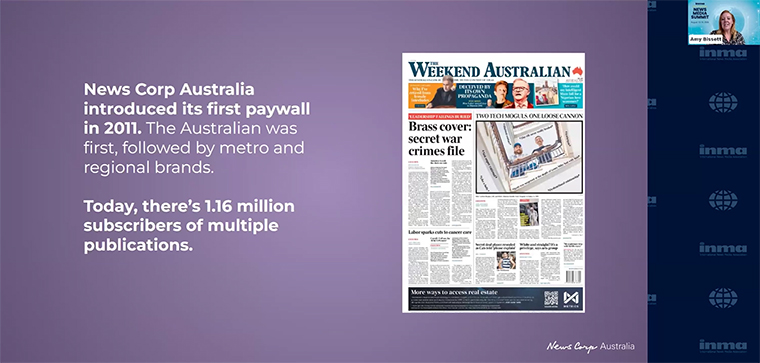
With 1.16 million subscribers across its portfolio, Bissett told attendees at the recent INMA Asia-Pacific News Media Summit that acquisition is not the problem: “For us, we knew how to get them in,” she said. “It was how do we get them to stay?”
The door to discovery
That question led her team to reconsider what subscribers experienced each day when they entered “the digital front door.” They discovered a chaotic scene that had moved far away from the comfortable, predictable rituals of print.
To reinforce her argument, Bissett shared three examples from “print’s golden ages” — The New York Times crossword, the Australian’s TV guide, and The Sun’s old page three feature.
Although their content is unrelated, they share a significant common thread: They appear in the same place every single day.
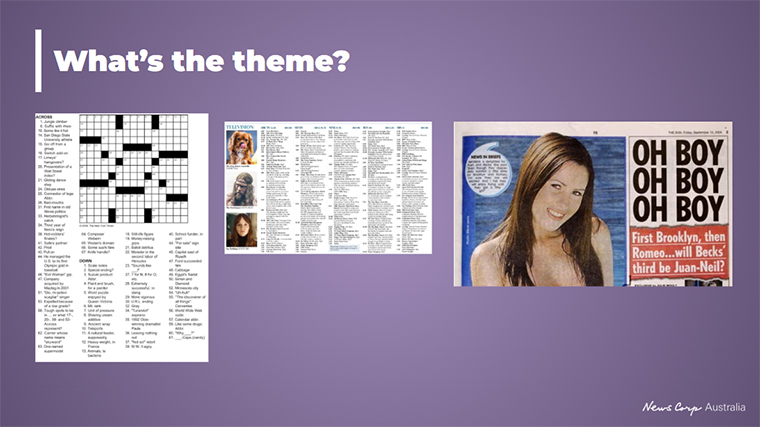
“In print lingo, this is the furniture. It never changes. It is in the paper every day.”
Readers are fiercely loyal to this furniture: “If you print a crossword wrong,” she said, “the calls and e-mails are more ferocious than spelling a defendant’s name wrong in court.”
Move the TV guide and “your loyalists will wonder if they’ll want to continue having their paper delivered.”
In other words, moving the furniture is serious business.
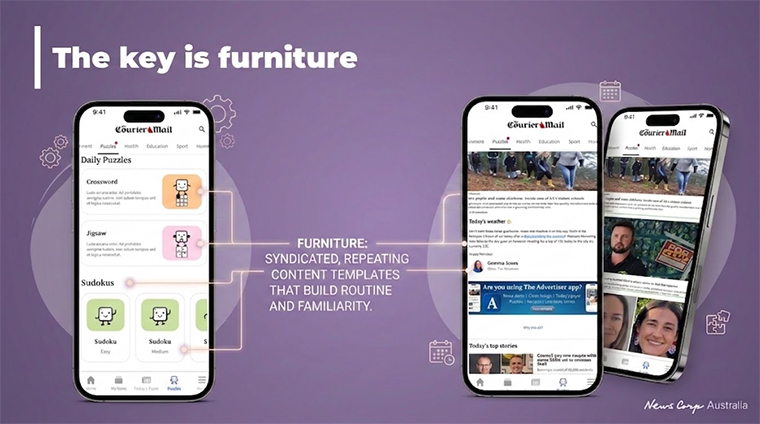
“Furniture creates consistency. Consistency creates familiarity, and familiarity is what turns a casual reader into a subscriber for life,” Bissett said.
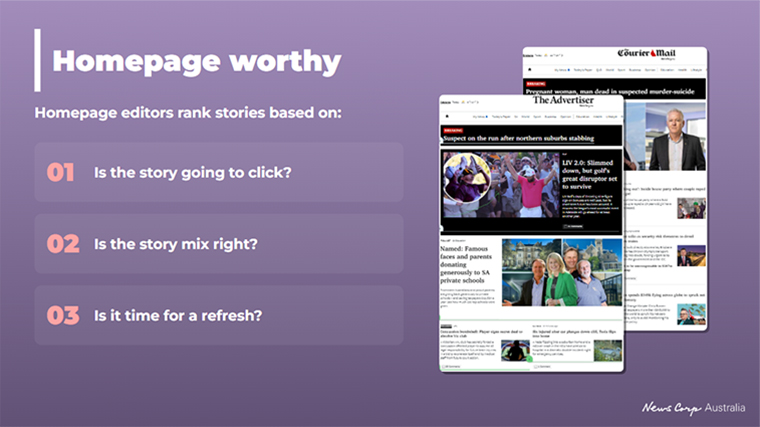
But digital newspapers have thrown that concept out the window. Digital news expires quickly, and homepages change constantly. Editors refresh stories dozens of times a day, but Bissett maintained that freshness is an obsession of the newsroom, not something readers are seeking: “The vast majority of our audience come in once a week if we’re lucky,” she said.
Unlike Netflix, publishers lack “the sort of bingeability” that keeps audiences returning automatically, and habit is hard to build when the product resets daily. In the quest to create a fresh homepage, she said publishers destroyed that critical element of familiarity.
Redecorating the homepage
Bissett and her team decided to see how providing structural furniture would lend consistency to digital homepages.
Their experiment began in the business vertical, anchored by a columnist known as ASX Trader — David Bird, a market commentator with a large social following. His Monday columns consistently drew strong engagement, prompting the team to imagine a seven-day rhythm of business commentary.
But the breakthrough wasn’t the columnists themselves; it was the way they were distributed.
News Corp Australia introduced a static national position — spot seven — across more than 10 state and community homepages. “We started putting the business columnist in that spot … between 5 and 10 a.m. every day,” she explained. “So when the audience came during peak time, it would always be there.”
The placement didn’t move. The artwork didn’t change. The headshot always looked directly at the reader. “Same spot, same look, same time, and it didn’t budge.”

Although this “radical” approach violated the core instincts of homepage editors, it yielded immediate results. Business subscribers — previously dominated by “one and done” readers who churned after 30 or 60 days — began staying longer.
“The tenure of the business subscribers … was increasing,” she said.
These were readers who arrived via Google, often drawn by breaking business news or salacious corporate gossip. Although it was not the “quality audience” publishers typically prize, Bissett said the numbers mattered: “I have always, always been a big fan of volume,” she said. “Get as many as you can … and then work out what the stay strategy is.”
A bigger rollout
After the first month, the strategy began to have a snowball effect, Bissett said. The team built a landing page with headshots and archives.
Marketing launched a national campaign: “Your business week, expert business insights every single day.” A newsletter followed, anchored by ASX Trader, with exclusive Monday insights. Six weeks after its launch, Bissett said it boasts “a larger open rate than an AM newsletter.”
Performance metrics reinforced the approach. Article engagement rose 15% month-on-month. The static placement began driving acquisition — “around three subscriptions now per article.”
Most importantly, “business subscribers now have the highest tenure of any section across our business.” She attributes that to discoverability and familiarity: “They know where it is. They know where it’s going to be. And they know the look of it. There’s that sense of familiarity.”
Bissett acknowledged there are risks and downsides to this approach. Launching columnists under their own names means “when they leave … our investment leaves.” She now believes they should have been given handles — like the ASX Trader — so that if the talent leaves or needs to be replaced, the column continues.
And while subscription revenue is strong, she sees opportunities to “monetise these a little bit neater.”
The experiment has already expanded. Seven columnists have launched in the health vertical, using the same approach. Whether it will work remains to be seen, but the team is committed to testing.
What excites Bissett most is how the strategy has reshaped their homepage philosophy: “It has fundamentally changed the way we think about our homepage.”
She now sees three layers: the fast (breaking news), the personalised (evergreen content tailored to reader interests), and the slow — the furniture.
“Dedicated furniture, unmoving, familiar, predictable content that is always on the homepage, and anchor points that slow it all down.”
In a fast-moving digital word, readers will find comfort in these reliable, relatable anchor points, she said:
“Readers don’t just want speed. In fact, they want respite. Predictable furniture provides comfort in the chaos. And now we realised that it is very important when it comes to retention.”
Related Articles
-

Bundling is a pricing decision, rebundling is an organisational...
18 October 2026 -

Agents, liquid content, vibe coding raise questions for news me...
9 September 2026 -

What news CEOs are investing in — and what they are killing
8 September 2026 -

Nation Media Group focuses editorial strategy on stories that m...
4 August 2026 -

Grupo RBS builds social-first video operation to expand audienc...
20 July 2026 -

Inside Denník N’s successful subscription strategy
15 July 2026 -

AI adoption in newsrooms should move from experiment to strateg...
12 July 2026 -

10 years later, user needs must be twinned with content formats...
1 July 2026
Upcoming Events
-

Subscriber Acquisition Master Class
10-17 November 2026
-

Media Advertising Summit
New York, United States
07-10 December 2026
-

AI-Native News Product Master Class
18-25 February 2027
-

Media Subscriptions Summit
Oslo, Norway
08-12 March 2027
-

World Congress of News Media
New York, United States
25-30 April 2027
-

Branded Content & Partnerships Master Class
20-27 May 2027
-

Subscriber Retention Master Class
17-24 June 2027
-

Conferencia Latinoamericana
15-16 July 2027
-

South Asia News Media Festival
New Delhi, India
19-22 July 2027
-

Asia/Pacific News Media Summit
19-20 August 2027
-

CEO Roundtable at Kilkenny
Kilkenny, Ireland
24-26 August 2027
-

Media Innovation Week
Amsterdam, The Netherlands
27 September - 01 October 2027








