

Universal McCann Malaysia explores the commodity of trust in advertising
Conference Blog | 23 August 2026

The advertising business has changed dramatically in little more than two decades. First came mass reach. Then came data, targeting, and personalisation. Now Sue-Anne Lim believes the industry is entering a third phase: community.
The CEO of Universal McCann Malaysia said this shift reflects a growing recognition that brands cannot build lasting equity through fragmented interactions alone. At the INMA Asia-Pacific News Media Summit 2026, Lim said advertisers are increasingly looking for three scarce commodities — attention, context, and trust — and news publishers are uniquely positioned to offer all three.
From reach to data — and now community
Lim began by putting the scale of today’s advertising market into perspective. Global advertising spend surpassed US$1 trillion in 2025.
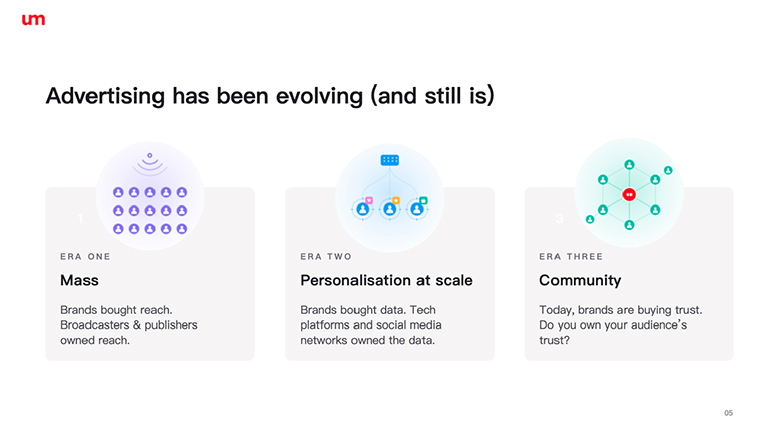
Lim described the industry’s first era as one of mass reach. Before the rise of Google, Meta, and TikTok, broadcasters and publishers controlled large audiences, while brands bought access to them. Advertising was relatively simple: A single-minded message could be delivered to a large segment of consumers.
The second era arrived with big technology platforms and the rise of data. Audiences could be broken down into increasingly specific segments based on interests, behaviour, recency and actions. Hyper-personalisation allowed brands to speak to consumers almost one-to-one.
But Lim said this fragmentation has also created a problem for brands. When different consumers see completely different versions of the same campaign, there is no longer necessarily a unified experience or perception of the brand. Over time, that can erode brand equity.
That is why she sees community as the next stage.
“Reach and data were things you leveraged from platforms,” Lim said. “What advertisers want now is much harder to manufacture — trust.”
Trust is becoming the scarce commodity
The timing is particularly significant because trust in the information environment is under pressure.
Lim highlighted data showing that global trust in news has fallen to its lowest point in a decade, while four in 10 people now actively avoid the news. Yet 38% still turn to a trusted source when they need to verify whether something is true.
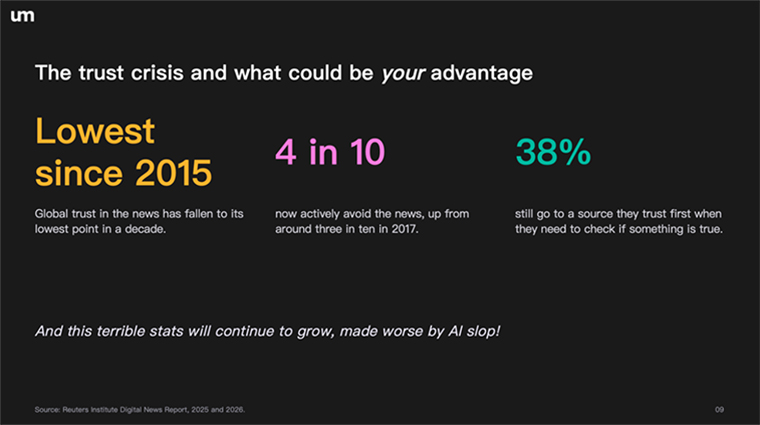
The proliferation of AI-generated content adds another layer of uncertainty. Lim was careful to distinguish AI itself from what she called the “rubbish content” increasingly circulating online. The problem for audiences is that it is becoming harder to determine what is truthful, what is fake, and what is a scam.
For news publishers, however, this challenge also presents an opportunity. As Lim put it: “AI can write the article. But it cannot be the reason a reader trusts the article.”
The value of a newsroom therefore extends beyond the content it produces. It lies in the brand equity built over time and in the communities that have come to trust that brand.
At the same time, AI is changing the way audiences find information. Lim pointed to a growing “zero-click” environment, with around 69% of news searches now ending without a click-through to a news site. Google referrals to news sites also fell by 33% in 2025, according to Lim.
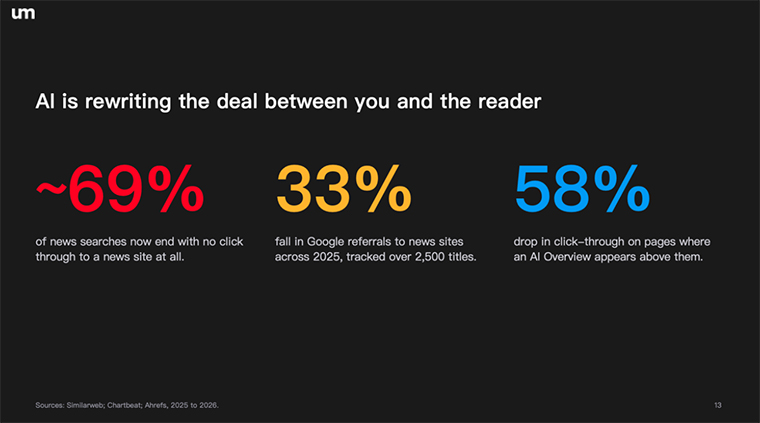
For publishers, this means that simply attracting a click may no longer be enough. Their long-term value increasingly depends on whether audiences recognise them as trusted sources — and whether those audiences choose to remain part of their communities.
Attention is more than an impression
The same distinction applies to social platforms.
Nearly half of Malaysians now get their news on TikTok, one of the highest rates anywhere in the world, according to Lim. Attention has moved into the feed, while creators and influencers increasingly control discovery.
But discovery does not automatically translate into trust.
UM’s data showed that trust is strongly determined by proximity. Friends and family rank highest, followed by verified buyer reviews and other buyers, while influencers rank significantly lower. Lim noted that although influencer followers and advertising spending are rising, trust has not kept pace.
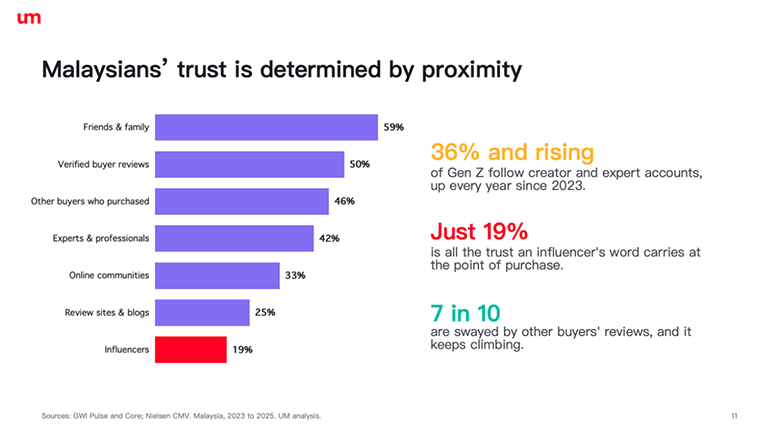
Lim’s conclusion was particularly relevant for brands increasingly relying on creators to drive consumer action: “Influencers can make you want something. But not necessarily enough for you to believe them.”
For advertisers, therefore, attention needs to be understood in terms of quality, not simply volume.
Lim identified three things that brands cannot buy at scale from a platform: attention that is not paid, context that means something, and trust that has a rub-off effect.
An audience that actively chooses to engage can be more valuable than a much larger audience exposed passively to an advertisement. Lim illustrated the point by noting that “200,000 organic shares and views are worth much more than 20 million paid impressions.”
Context matters too. Brands are increasingly sensitive to the environments in which they appear, rather than simply whether their logo or message can be placed in front of consumers.
And then there is trust’s “rub-off effect” — the idea that when a brand appears alongside a credible and trusted environment, some of that credibility can transfer to the brand itself.
Rethinking what news publishers sell
So what does this mean for news media?
Lim offered four practical directions for publishers looking to capture the advertising spend that brands are already moving into new channels.
- Sell brands the community, not the leftover impressions. As Lim put it, “your loyal, engaged audience is really worth far more than the remnant inventory that you’re really pricing to clear.” The message is to place greater value on the relationship publishers have built with their audiences, rather than treating audience attention as simply another unit of inventory.
- Give brands meaningful environments, not just eyeballs. Based on UM’s experience, Lim said clients are increasingly looking for “more sponsorships and activations,” particularly where audiences are genuinely engaged. “People are genuinely engaged. They have a unified experience of the brand, and that really beats a banner pop-up,” she said. For advertisers, the environment in which a brand appears can be just as important as the audience size.
- Publishers should recognise the value of their subscribed audiences. Rather than viewing advertising as something that simply takes value from an audience, she suggested that brands can help “reward your audience with quality content and experience itself.”
- Publishers should explore bespoke partnerships and ownable IPs. Brands, she said, are “really open for bespoke partnerships,” including “formats, data partnerships, commerce.” The key, she argued, is “community integration” — creating something that brands and publishers can build together rather than treating advertising as a one-way transaction. “That ... can create a win-win situation where you can work very closely with brands.”
The bottom line, Lim said, is this: “Your priority customer should be your audience, not advertisers.”
Banner art: Adobe stock image by suldev.
Related Articles
-

Nurture brand-based relationships to secure reader trust
15 October 2026 -

Fædrelandsvennen campaign turned trust into its brand message
10 August 2026 -

Saturday Night Fitness provides Media24 audience with connectio...
10 August 2026 -

Investment games surge at news companies, highlight audience pa...
16 July 2026 -

10 years later, user needs must be twinned with content formats...
1 July 2026 -

Local broadcaster WPLG leaves ABC network affiliation, leans on...
3 June 2026 -

Audiences are reading less fact-based content yet newsrooms con...
25 May 2026 -

“Liquified” news strategy blends customised, relevant news
7 April 2026
Upcoming Events
-

Subscriber Acquisition Master Class
10-17 November 2026
-

Media Advertising Summit
New York, United States
07-10 December 2026
-

AI-Native News Product Master Class
18-25 February 2027
-

Media Subscriptions Summit
Oslo, Norway
08-12 March 2027
-

World Congress of News Media
New York, United States
25-30 April 2027
-

Branded Content & Partnerships Master Class
20-27 May 2027
-

Subscriber Retention Master Class
17-24 June 2027
-

Conferencia Latinoamericana
15-16 July 2027
-

South Asia News Media Festival
New Delhi, India
19-22 July 2027
-

Asia/Pacific News Media Summit
19-20 August 2027
-

CEO Roundtable at Kilkenny
Kilkenny, Ireland
24-26 August 2027
-

Media Innovation Week
Amsterdam, The Netherlands
27 September - 01 October 2027








