

Die Zeit is growing subscriptions beyond its home page
Readers First Initiative Blog | 29 June 2026

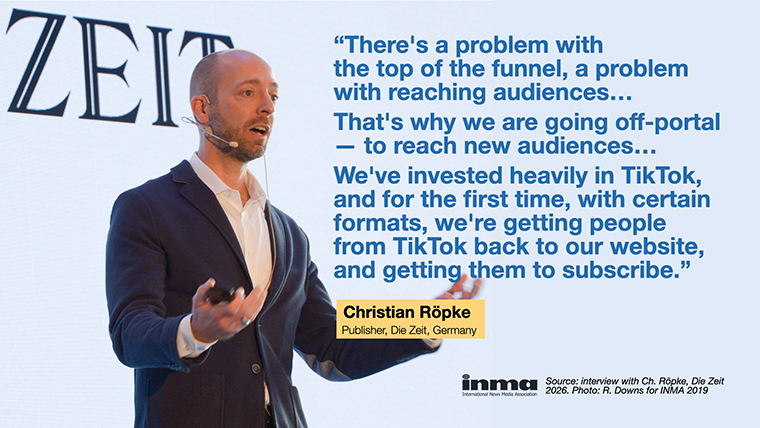
After years of growth, Germany’s Die Zeit faced a problem with the top of the funnel and decided its front doors — a home page and an app — were no longer enough. “We are going off-portal to reach new audiences,” Publisher Christian Röpke told INMA.
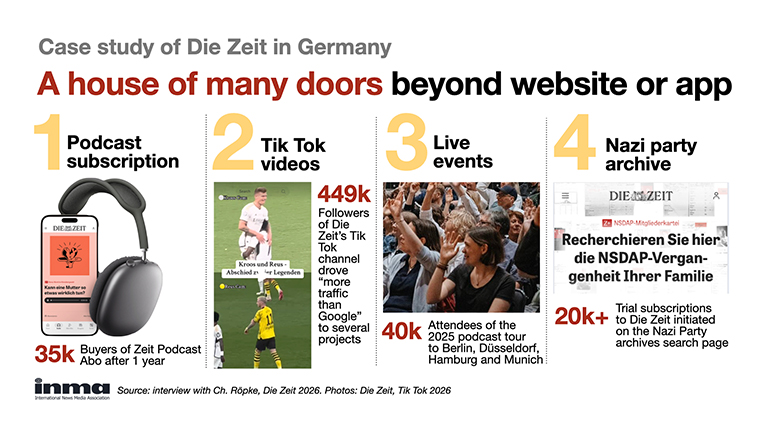
The big idea is to build many doors: a podcast someone discovers on Spotify, a video that catches a teenager on TikTok, a live show in a packed Hamburg arena, or a database project that answers an embarrassing question about a family’s Nazi past that a reader has carried for decades.
Each is a different way into the brand, and most of them open long before — or entirely apart from — the newspaper’s Web site or app. Internally, the language is “vertical offerings” and “off-portal.”
Functionally, Die Zeit is assembling a portfolio of category entry points — in other words different occasions, on different platforms, for different people, as defined by Professor Jenni Romaniuk and Ehrenberg Bass Institute’s research.
A house of many doors
Die Zeit is a mature and large subscription business behaving like a startup with nothing to lose — and the reason is that the old front door was beginning to jam.
After years of growth, in 2025, Die Zeit’s subscriptions crossed a historic record of 500,000, of which 280,000 were digital.
While the new starts held up, absolute cancellations started to slow down the newspaper’s growth. Even with a stable churn rate, a larger base shed more subscribers each month until that arithmetic swallowed the gains.
Meanwhile, the pool of the Web site users who had never subscribed kept shrinking. The honest question became where the next subscribers would come from, and the answer was unlikely to be more of the same entrance.
One door had been left almost untouched by commercial logic. While the rest of the company ran on “subscription first,” the podcasts were entirely free, drawing roughly 15 million downloads a month across politics, society, culture, knowledge, work, and leisure.
That was years of groundwork sitting un-monetised, and, more valuable still, a standing relationship with dozens of thousands of people who were not subscribers.
A subscription funnel redefined
Die Zeit applied a deliberately narrow test to what to build next:
Topics where it had a genuine “right to play” without cannibalising the core newspaper …
that reached new audiences …
and that ideally opened a new access point for the subscription business.
The podcast subscription cleared all three. In March 2025, the company placed 16 of its roughly 30 podcasts behind a paywall — exclusive shows, bonus episodes, early access, the full archive — listenable on zeit.de, Spotify, and Apple, at €4.99 a month after a four-week trial.
Within little more than a year, the podcasts passed 35,000 active subscriptions.
The figure that should hold every publisher's attention: Around 80% of those subscribers had never previously held a digital subscription with Die Zeit.
“It’s a totally new audience — a young audience,” Christian Röpke told INMA. “They have never been in contact with Die Zeit, apart from the podcasts on Spotify, and now we’re pulling them into a subscription.”
This is not the funnel subscription marketers usually draw: casual reader, to habitual reader, to subscriber. These people came through a door the newspaper never controlled.
And the door swings both ways: About 20% of “existing” digital subscribers have now linked their subscription to Spotify or Apple, deepening a relationship that used to live only on the Web site.
Video platforms, events, and AI search as points of entry
TikTok is becoming another door for Die Zeit — and a surprising one. “For several of our recent projects, TikTok was the biggest referrer, bigger than Google,” Röpke said.
When engagement spikes on TikTok among younger audiences, Die Zeit can see registrations spiking on the site, suggesting a causal relationship.
Physical events do the same work: Last year some 40,000 people attended four large live podcast shows Zeit Verbrechen (English: Zeit Crime) across Germany.
Almost none of them have prior subscriptions; all of them now are in a direct relationship the brand can build on.
The single biggest subscription driver was the one Die Zeit built around its historic Nazi party membership archive, fully searchable thanks to AI, which generated “tens of thousands” of trial subscriptions.
Most of the current AI conversation is about productivity and cost. Die Zeit’s experience points the other way: The largest prizes may come when technology lets us serve needs we simply couldn’t serve before.
Die Zeit’s archive of millions of Nazi party documents worked because it answered questions Germans care about at a personal level: Was a relative involved? What happened in my town?
The biggest challenge? Not technology but keeping the archive project alive against the newsroom's instincts. “Our journalists are like nomads, and they always move on to the next thing,” Röpke said, where a product like the Nazi archive search is “too good to just let it go away.”
As discovery fragments and traffic turns volatile, the new entry points may prove a more durable engine of growth than any single channel, even Die Zeit’s own Web site and app.
“New opportunities become visible once you stop assuming subscribers must enter through the Web site,” believes Christian Röpke.
Interested in Die Zeit’s subscription innovations? Publisher Christian Röpke will be the guest of INMA’s Subscription Masters Webinar series on October 14. Mark your calendar!
Greg’s Readers First newsletter is a public face of a revenue and media subscriptions initiative by INMA, outlined here. INMA members can subscribe here.
Banner photo: Adobe Stock By Mojahid Mottakin.
Related Articles
-

WSJ executive councils show how publishers build communities th...
19 October 2026 -

Bundling is a pricing decision, rebundling is an organisational...
18 October 2026 -

7 themes from Madrid show publishers trading traffic for relati...
28 September 2026 -

5 lessons from the INMA Young Audiences Summit
28 September 2026 -

AI’s effect on super user math
15 September 2026 -

What I told 40 CEOs (and won’t gatekeep from you)
30 August 2026 -

At Mediacorp’s CNA, loyalty means giving audiences a reason to ...
20 August 2026 -

Indian Express builds a video-first future around trusted journ...
20 July 2026
Upcoming Events
-

Subscriber Acquisition Master Class
10-17 November 2026
-

Media Advertising Summit
New York, United States
07-10 December 2026
-

AI-Native News Product Master Class
18-25 February 2027
-

Media Subscriptions Summit
Oslo, Norway
08-12 March 2027
-

World Congress of News Media
New York, United States
25-30 April 2027
-

Branded Content & Partnerships Master Class
20-27 May 2027
-

Subscriber Retention Master Class
17-24 June 2027
-

Conferencia Latinoamericana
15-16 July 2027
-

South Asia News Media Festival
New Delhi, India
19-22 July 2027
-

Asia/Pacific News Media Summit
19-20 August 2027
-

CEO Roundtable at Kilkenny
Kilkenny, Ireland
24-26 August 2027
-

Media Innovation Week
Amsterdam, The Netherlands
27 September - 01 October 2027








