

Gemini Notebook to bring news subscriptions in, Google tells INMA
Conference Blog | 26 October 2026

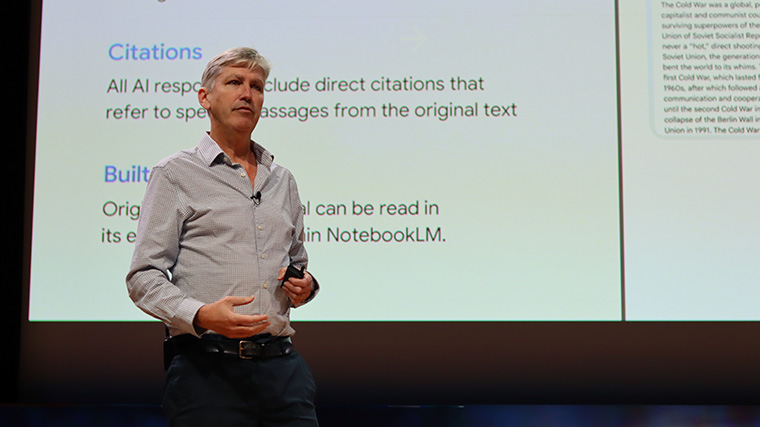
Google plans to let news subscribers bring paywalled articles into Gemini Notebook, co-founder Steven Johnson told delegates at INMA’s Media Tech & AI Week in San Francisco.
Expert Intelligence launched with more than 100,000 eligible ebooks purchased through Google Play Books. News-subscription access and expansion to other AI products are plans, not features ready to switch on.
No news-subscription launch date was established.
The feature has not been built yet, but Johnson was clear on the direction: “We are going to start allowing folks to do subscription linking,” he said.
How it would work
Gemini Notebook has built-in research agents, including Deep Research, that go out on the Web and gather sources on a topic. Under the plan, publishers would opt into subscription linking. If a user subscribes to a participating publication, the agent would recognise that and retrieve relevant articles from it, adding them as sources in the notebook.
The protections already used for books would apply. If a subscriber shares a notebook, the recipient sees the article listed as a source but can’t use it unless they also subscribe. That gives a publisher’s journalism visibility inside other people’s notebooks and a reason for them to sign up, Johnson said.
“We wanted it to be a Google-wide kind of initiative with everyone agreeing to the way that we were going to protect the knowledge, but we have gotten to that place now,” Johnson said. The framework started in Gemini Notebook and is coming to Gemini and AI Mode in Search.
Publishers interested in taking part should contact Google’s news partnerships team. Johnson said Google would make it “a lot easier for news organisations to come and play with expert intelligence over the coming months.”
Why it matters to publishers
Johnson framed the opportunity as a combination of AI and journalism. “It’s that fusion of general intelligence from the models, human-vetted editorial intelligence from authors and writers and publications. That’s what Notebook I think uniquely is positioned to offer,” he said.
Speaking later on The Debrief, INMA’s podcast recorded live at the close of the conference, Jodie Hopperton, lead of INMA’s Product & Tech Initiative, said the appeal is that publishers keep their brand while readers decide how to consume it.
“What’s great about that is you get the brand, but the consumer chooses the experience,” she said. “They choose the format. They choose how they digest the news.”
She also welcomed the name Expert Intelligence, saying: “It really nods to the fact that journalism is at the high end of content.”
Robert Whitehead, lead of INMA’s Digital Platform Initiative, said: “It took me by surprise that they’re leaning so heavily into credible sources. I was delighted.”
Kerstin Hasse, lead of INMA’s Young Audiences Initiative, said subscribers sharing notebooks with friends could become a new route to readers.
“That unlocks completely new possibilities of marketing your brand, talking about the value of your journalism,” she said.
Writing tools and analytics
Johnson said Google expected the writing and editing features to roll out in about a month. Users will be able to draft inside a notebook alongside their sources, select a paragraph, and ask Gemini Notebook to fact-check it against those sources. It will suggest corrections inline that can be approved with one click.
“I’ve always wanted to make Notebook a first-class writing tool as well as a research tool,” he said.
Johnson’s session came a day after INMA released 9 Newsrooms Put Gemini Notebook to Work, Hopperton’s report on a three-month lab in which nine publishers built public notebooks from their own journalism. Two participants joined Johnson on stage: Alvin Chong, supervising editor for growth and innovation at Mediacorp, and Sarah Hoek, operations manager for strategic projects at Daily Maverick.
Their top request was seeing what users ask. Currently, publishers can see aggregate user and query counts but not what readers asked or the answers they received.
“We think we’ve figured out a way to get more qualitative information out of the user interactions with notebooks while still respecting privacy,” Johnson said. An agent analyses usage logs and summarises patterns.
Rather than reporting an individual’s exact question, it might report that users were concerned about water delivery in a particular neighbourhood and asked several questions about it. The same insight would help publishers in Expert Intelligence see which questions their content isn’t answering, he said.
Embedding notebooks on publishers’ own sites, another request, is still being worked out.
The background
Google renamed NotebookLM to Gemini Notebook in July. It is built around grounding — answers come from the sources users upload, with citations linking to the original passage.
Upcoming Events
-

Subscriber Acquisition Master Class
10-17 November 2026
-

Media Advertising Summit
New York, United States
07-10 December 2026
-

AI-Native News Product Master Class
18-25 February 2027
-

Media Subscriptions Summit
Oslo, Norway
08-12 March 2027
-

World Congress of News Media
New York, United States
25-30 April 2027
-

Branded Content & Partnerships Master Class
20-27 May 2027
-

Subscriber Retention Master Class
17-24 June 2027
-

Conferencia Latinoamericana
15-16 July 2027
-

South Asia News Media Festival
New Delhi, India
19-22 July 2027
-

Asia/Pacific News Media Summit
19-20 August 2027
-

CEO Roundtable at Kilkenny
Kilkenny, Ireland
24-26 August 2027
-

Media Innovation Week
Amsterdam, The Netherlands
27 September - 01 October 2027








