

Anandabazar Patrika helped turn Durga Pujo into a fashion movement
Ideas Blog | 10 August 2026
Durga Pujo in Bengal is more than a festival; it’s a shared cultural heartbeat. It arrives in conversations long before the dhaak beats, in the quiet excitement of planning outfits. It is, in many ways, the most democratic expression of style — where everyone, from every para, participates.
It is this very spirit that Trends Saj Parbon 2025 chose to celebrate.
Instead of treating Pujo as a seasonal retail opportunity, Saj Parbon leaned into what it truly represents — a collective cultural moment shaped by people. At the heart of the campaign was a simple, familiar truth: every day of Pujo feels different, and so should the way we show up.
The idea of Five Days, Five Looks wasn’t an imposition; it was an articulation of something Bengalis already live and breathe.
A fresh approach
From Sasthi Swag to Dope Dashami, the campaign gave these everyday style choices a language, making them more visible, shareable, and connected. But what made it resonate wasn’t just the styling; it was the sense of belonging it created.
The campaign opened with Gaan e Fusion, a launch that didn’t separate fashion from culture but wove it seamlessly into music and performance. A ramp walk set against live music wasn’t just a spectacle; it mirrored the energy of Pujo itself: vibrant, expressive, and immersive.
Across digital platforms, the storytelling felt less like advertising and more like conversations we overhear during Pujo. Whether it was a GRWM video before heading out pandal hopping, a spontaneous shopping trail, or a playful fashion challenge, the content reflected real behaviours.
Collaborations with creators like Nayandeep Rakshit and other familiar faces (Solanki Roy, Gourab Chatterjee, Neel Bhattacharya, Trina Saha, Sauraseni Maitra, and others) added to this authenticity, making the campaign feel rooted rather than orchestrated.
Fashion as a shared activity
But the true scale of Saj Parbon revealed itself on the ground.
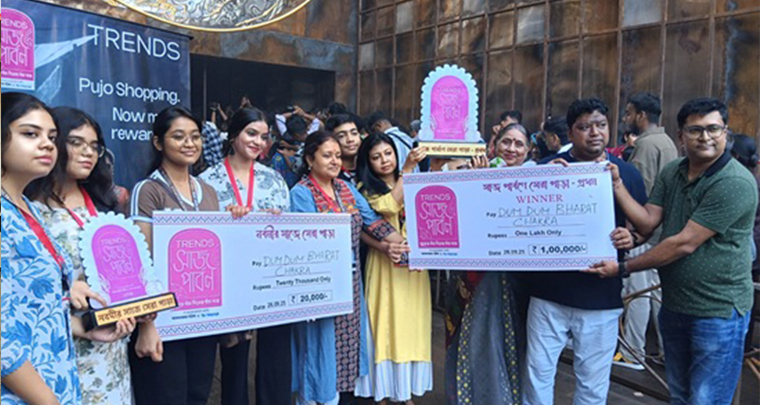
In over 600 paras and 50 RWAs across Bengal, fashion became a shared activity. Friends, families, and entire communities came together to plan and present their five looks — not for validation, but for the joy of participation. The microsite entries were not just submissions; they were stories — of groups coordinating colours, of first-time participants finding confidence, of neighbourhoods turning into runways.
Initiatives like Fashion on Wheels took this experience even further, physically bringing the brand closer to where Pujo lives: in the lanes, the clubs, the community spaces. And on Mahalaya, as celebrity judges travelled across districts to celebrate participants, the campaign recognised not just style but the people behind it.
The numbers, of course, tell their own story. Over 43,000 participants, a reach of more than 250,000 footfall and 41 million organic digital views. But beyond the metrics lies something more meaningful: a campaign that people didn’t just see but felt a part of.
Related Articles
-

How four publishers are winning advertisers with quality over v...
26 October 2026 -

The next business is brand partnerships, not ad inventory
25 October 2026 -

As the traffic ad model ends, publishers need a new advertising...
14 October 2026 -

Newsday’s Together Long Island initiative unites companies and ...
13 August 2026 -

ABP’s Anandabazar.com makes Durga Pujo more accessible to audie...
22 April 2026 -

News companies translate measurement into commercial results
2 April 2026 -

3 Swedish publishers support decision to expel Meta from IAB Sw...
18 March 2026 -

What publishers need to know about the changing advertising lan...
28 January 2026
Upcoming Events
-

Subscriber Acquisition Master Class
10-17 November 2026
-

Media Advertising Summit
New York, United States
07-10 December 2026
-

AI-Native News Product Master Class
18-25 February 2027
-

Media Subscriptions Summit
Oslo, Norway
08-12 March 2027
-

World Congress of News Media
New York, United States
25-30 April 2027
-

Branded Content & Partnerships Master Class
20-27 May 2027
-

Subscriber Retention Master Class
17-24 June 2027
-

Conferencia Latinoamericana
15-16 July 2027
-

South Asia News Media Festival
New Delhi, India
19-22 July 2027
-

Asia/Pacific News Media Summit
19-20 August 2027
-

CEO Roundtable at Kilkenny
Kilkenny, Ireland
24-26 August 2027
-

Media Innovation Week
Amsterdam, The Netherlands
27 September - 01 October 2027








