

As the traffic ad model ends, publishers need a new advertising playbook
Advertising Initiative Blog | 14 October 2026

The advertising transformation in news media is a universal shift, and no publisher is immune.
“Everything is happening to everyone,” Gabriel Dorosz, lead of the INMA Advertising Initiative, told INMA members during this week’s Webinar. The only differences are speed, timing, and impact, depending on each company’s revenue mix and market structure, he said.
Looking at the forces reshaping the industry, Dorosz delivered his findings in three parts: the transformation, the playbook, and the deeper strategic questions facing the future of news advertising.
The transformation
Together, four significant accelerants have altered digital media economics, Dorosz explained.
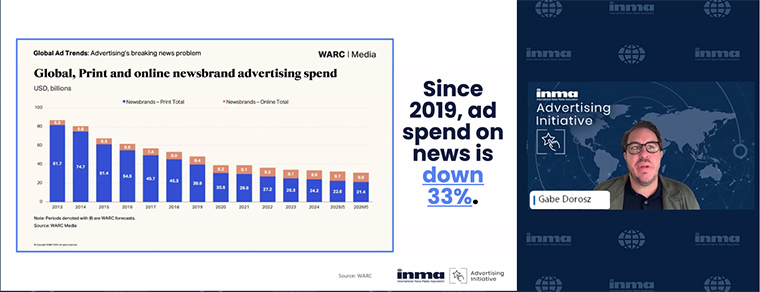
- Declining traffic. As traffic falls, so does display advertising revenue. “The business that is built on the idea of traffic is dead,” Dorosz said, sharing that ad spend on news has dropped 33% since 2019.
- Creators. As the primary source for young audiences to get information, creators increasingly serve as the first point of contact for news, entertainment, and commentary. This has shifted attention from traditional publishers to individuals on social platforms.
- Video consumption. Video, specifically mobile vertical video, has become the leading information medium for younger audiences. This has changed both consumption habits and advertiser demand.
- AI. AI affects every trend, including the fact that more than half of all Web traffic is no longer human. Bots, crawlers, and automated systems distort analytics, undermine monetisation, and complicate audience measurement. AI also fuels new advertising categories, such as generative search and LLM‑based ad placements, which are projected to grow rapidly.
At the same time, global advertising is increasing and will surpass US$1.6 trillion by 2030 — outpacing global GDP. But that growth is increasingly going to a small set of platforms, with Google, Meta, and Amazon capturing 60% to 90% of all global ad spend.
“Buyer demand is up for almost everything but what publishers sell,” Dorosz said. “What’s down? Display, open Web CPMs, print, and other forms of traditional media.”
But not all of it was bad news.
Dorosz pointed out that the most valuable audiences are becoming even more valuable. So-called “super users” — often just 1% of a publisher’s audience — generate 60% to 81% of total revenue across subscriptions and advertising. As traffic declines, the least valuable users disappear first, making engaged users disproportionately important.
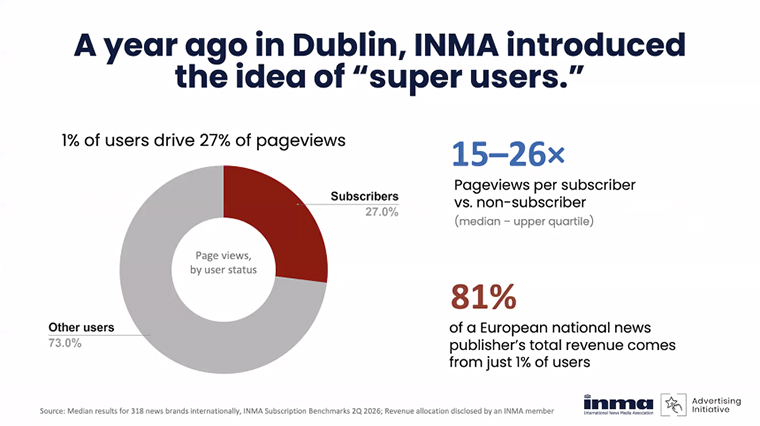
This has created a paradox: Publishers turn off ads for their most valuable users to protect subscription value, even though those users are the most receptive to advertising and the most valuable to brands.
“It’s not something we want our most valuable people experiencing, and so we built the business this way,” he said.
At the same time, the buy‑side is shifting toward quality inventory, prioritising low ad density, domain authority, and content quality. As supply shrinks, demand and CPMs rise for premium impressions.
Dorosz suggested the transformation is not just about decline but about reallocation: “As we’ve seen over the last couple of years, the publishers who have been focusing on quality outcomes and deal strategy are increasing CPMs.”
The playbook
His second chapter answered, “What should publishers do?” To do that, he introduced four principles.
1. Rethink inventory. Publishers should stop thinking advertising must be interruptive, cluttered, or standardised.
He shared examples of integrated formats publishers are using that outperform traditional display, such as Der Standard’s “liquid takeover,” which transformed the entire site visually for a climate campaign, and Russmedia’s “vibe‑coded utility inventory,” micro‑apps embedded in editorial content and sponsored by advertisers.
“The bigger thought is, if we’re free from the banner, what does the combination of AI, structured data, liquid content, your creativity, and partnership with clients enable you to build and sell that you couldn’t before?”
2. Sell solutions and outcomes. The market no longer wants reach alone; it wants results. Publishers who have embraced this shift are seeing the rewards.
Mediahuis built “In‑Market,” a product that identifies audiences actively shopping for specific products and allows advertisers to target them. Meanwhile, Hearst’s Aura IQ and The New York Times’ Brand Match use generative AI to create custom audiences for every campaign, combining first‑party data with content signals to deliver superior performance. And BBC’s partnership with Expedia uses traveller data to inform branded content storytelling, architecting campaigns for performance rather than mere engagement.
3. Bake advertising into product development. Advertising must become part of product design from the beginning, not something added at the end, Dorosz said.
“I think the transformation we need isn’t possible if advertising only shows up after the product is built. That is a big reason why I believe we end up with interruptive formats, awkward placements, and bad experiences.”
Events are a natural example: editorial, marketing, product, and advertising work together from the start: “Those things are all in balance. In fact, events, creators, branded content, and video are interesting because in some cases, yes, you can sell inventory, you can sell video inventory, but what attracts advertisers to bigger, deeper relationships, and quite frankly drives more money and margin for the publisher is integration.”
The New York Times is also adapting to integration and redesigned advertising inside games like Crossplay so ads appear naturally between moves, aligning with user behaviour rather than disrupting it.
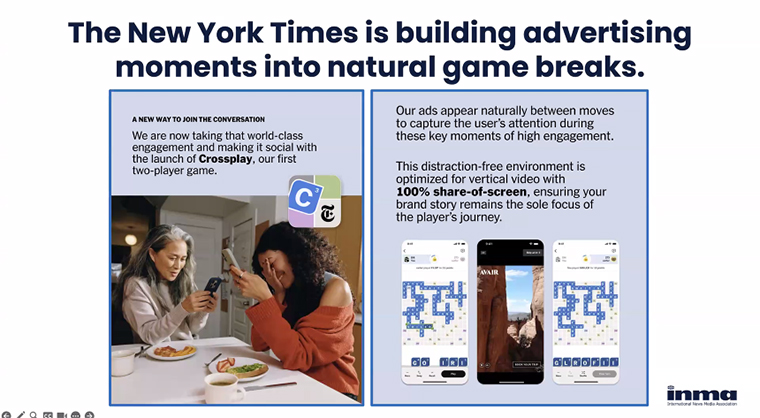
“These are things advertisers like,” he said. “They want to integrate advertising more naturally into audience context, and they want you to sell them more interesting opportunities than just banners.”
4. Structure for success. Publishers who are succeeding in this transformation have reorganised their teams, giving advertising a seat at the table. “You’re only going to succeed … if everybody works together toward the same goal at the same time.”
First‑party data is the moat of the future, enabling better CPMs, better measurement, and better positioning in the AI‑driven market. News publishers must move inventory from open programmatic to private marketplaces, preferred deals, and direct deals to capture more value, Dorosz said.
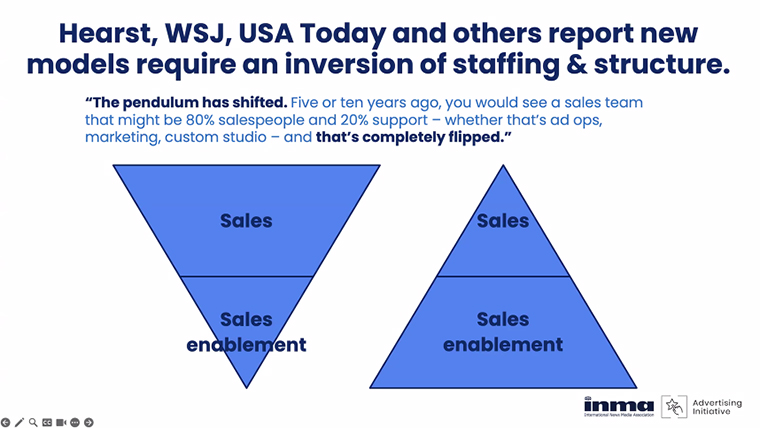
Finally, Dorosz said, team structures are inverting. Instead of 80% salespeople and 20% support, modern advertising teams are built around sales enablement, with fewer sellers and more strategists, marketers, analysts, and creators.
The deeper questions
Dorosz also looked at long‑term strategic questions: What does the market want? What can publishers sell? And what is defensible?
The market, he said, wants outcomes — repeatable, measurable business impact. Performance budgets have overtaken brand budgets, flipping the traditional 60/40 split. Platforms benefit because they deliver hard outcomes like conversions. Publishers excel at soft outcomes — awareness, brand lift, and intent — but must prove their value through advanced measurement.
News companies must determine what they can sell that aligns with market demand. They must identify defensible assets: first‑party data, engaged audiences, trusted content, premium environments, and integrated solutions.
“Make the ads worthy of the journalism,” he said. “The overarching insight that I am getting louder and louder about is … we need to start to transition from the old business, which I’ll call ad inventory, to the new one, which I think is best described as brand partnerships.
“Just like print to digital, protect the old business as long as possible, but it is not the future.”
Related Articles
-

In moving from an attention to an intention economy, who gets p...
16 September 2026 -

What’s really defensible in the age of AI?
30 August 2026 -

Latin American publishers must rewrite ad strategies around out...
20 July 2026 -

Platforms took the Croisette in Cannes, and the ad business is ...
6 July 2026 -

ABP’s Anandabazar.com makes Durga Pujo more accessible to audie...
22 April 2026 -

News companies translate measurement into commercial results
2 April 2026 -

3 Swedish publishers support decision to expel Meta from IAB Sw...
18 March 2026 -

Inside HT Digital Streams’ CDP‑driven, full‑funnel advertising ...
9 March 2026
Upcoming Events
-

Subscriber Acquisition Master Class
10-17 November 2026
-

Media Advertising Summit
New York, United States
07-10 December 2026
-

AI-Native News Product Master Class
18-25 February 2027
-

Media Subscriptions Summit
Oslo, Norway
08-12 March 2027
-

World Congress of News Media
New York, United States
25-30 April 2027
-

Branded Content & Partnerships Master Class
20-27 May 2027
-

Subscriber Retention Master Class
17-24 June 2027
-

Conferencia Latinoamericana
15-16 July 2027
-

South Asia News Media Festival
New Delhi, India
19-22 July 2027
-

Asia/Pacific News Media Summit
19-20 August 2027
-

CEO Roundtable at Kilkenny
Kilkenny, Ireland
24-26 August 2027
-

Media Innovation Week
Amsterdam, The Netherlands
27 September - 01 October 2027








