

In moving from an attention to an intention economy, who gets paid?
Product & Tech Initiative Blog | 16 September 2026

Shuwei Fang recently sparked a debate by arguing that we are moving from an attention economy to an intention economy. It is a useful distinction because it describes a change already beginning to reshape digital products, advertising, and commerce — a change that is happening but flying under the radar.
The attention economy rewards organisations that can capture and hold our focus. Publishers, platforms, and advertisers compete for clicks, minutes, opens, and views. Once attention has been secured, it can be converted into advertising revenue, subscriptions, influence, or a sale. Much of the modern Internet has been designed around this logic.
AI goes a step further. A capable AI assistant does not simply show us information and wait. It asks follow-up questions, remembers preferences, compares options, and takes action. A person can express an intention — plan a holiday, choose a new phone, understand a health question, or decide what to cook — and leave the system to work out which sources and steps are required.
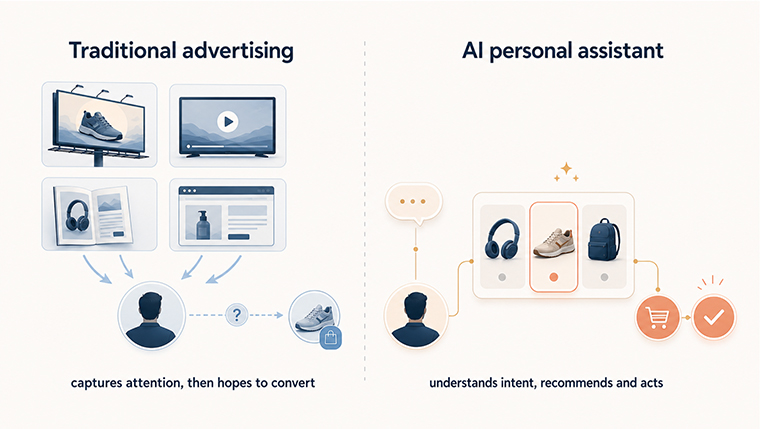
That changes the commercial journey. The familiar funnel from awareness to consideration and purchase does not disappear, but more of it can happen inside one interface. Brand discovery, product research, comparison, and transaction can be compressed into a conversation.
The AI may influence not only what the user notices but how their initial desire is defined and which options feel sensible.
There is an important difference between helping and manipulating. Advertising has always tried to shape intention, from a well-placed recommendation to an emotional campaign. AI can make that influence more personal and persistent because it knows more about the user, can test assumptions through dialogue, and may be trusted to act on their behalf.
The better the system understands someone, the more useful it can become. And the greater its power to steer.
This creates practical questions for technology leaders. Who decides which sources are consulted and which products are considered? How are commercial relationships disclosed? Can users see why one option was recommended over another? And what happens when the business model of the assistant conflicts with the interests of the person using it?
If AI becomes the place where intention is expressed and acted on, traditional advertising faces a more fundamental challenge. Display will still have a role in building awareness and reinforcing a brand, but it may become less effective as people move closer to a decision.
In some categories, and particularly close to a purchase decision, an intent-driven recommendation from an assistant that understands the user’s needs may be far more valuable than another impression.
This is not an either/or shift: People will continue to make both impulse and considered purchases, and the balance will vary enormously by category and stage of the journey.
That could shift both influence and advertising spend away from the open Web and towards the systems that interpret intention. The commercial prize will no longer be just the chance to appear beside relevant content but the ability to become part of the recommendation itself.
That makes disclosure, transparency, and trust essential: Users need to know when a suggestion is commercially influenced and why one option has been preferred over another.
For media companies, this raises uncomfortable questions: Do publishers retain a share of brand advertising because their journalism, reviews, and trusted voices still shape what people want? Can they translate the influence of journalists using, testing, and recommending products into new commercial models? Or does that value migrate to the AI interface, leaving publishers with less traffic, weaker customer relationships, and a smaller share of advertising revenue?
The challenge, then, is not simply how advertising survives the move from attention to intention. It is who gets paid for influencing the decision — the brand, the assistant, the publisher, or the journalist — and how that influence can be monetised without undermining the trust that makes it valuable in the first place.
If you’d like to subscribe to my bi-weekly newsletter, INMA members can do so here.
Banner photo: Adobe stock image by MDOsman.
Related Articles
-

As the traffic ad model ends, publishers need a new advertising...
14 October 2026 -

News companies are starting to build for agentic trading
13 September 2026 -

BCN, Time share lessons in selling ads to machines
9 September 2026 -

What’s really defensible in the age of AI?
30 August 2026 -

The media industry optimised buying, but it forgot to optimise ...
23 August 2026 -

Time is now selling ads to AI bots
17 August 2026 -

Latin American publishers must rewrite ad strategies around out...
20 July 2026 -

Platforms took the Croisette in Cannes, and the ad business is ...
6 July 2026
Upcoming Events
-

Subscriber Acquisition Master Class
10-17 November 2026
-

Media Advertising Summit
New York, United States
07-10 December 2026
-

AI-Native News Product Master Class
18-25 February 2027
-

Media Subscriptions Summit
Oslo, Norway
08-12 March 2027
-

World Congress of News Media
New York, United States
25-30 April 2027
-

Branded Content & Partnerships Master Class
20-27 May 2027
-

Subscriber Retention Master Class
17-24 June 2027
-

Conferencia Latinoamericana
15-16 July 2027
-

South Asia News Media Festival
New Delhi, India
19-22 July 2027
-

Asia/Pacific News Media Summit
19-20 August 2027
-

CEO Roundtable at Kilkenny
Kilkenny, Ireland
24-26 August 2027
-

Media Innovation Week
Amsterdam, The Netherlands
27 September - 01 October 2027








