

Latin American publishers must rewrite ad strategies around outcomes instead of pageviews
Conference Blog | 20 July 2026

Advertising, the economic engine that has long subsidised journalism, is undergoing a transformation just as sweeping as the one upending newsrooms.
At the recent INMA Latin America Media Summit, Gabriel Dorosz, who leads the INMA Advertising Initiative, warned that publishers can no longer rely on the open Web, print, and undifferentiated reach to sustain their business.
News publishers — particularly those in Latin America — must rebuild advertising around premium, machine‑legible, outcome‑oriented products anchored in first‑party data and audience trust, he said.
That shift is driven by four forces: falling traffic, the rise of creators, the dominance of mobile video, and the rapid acceleration of AI and agentic technology.
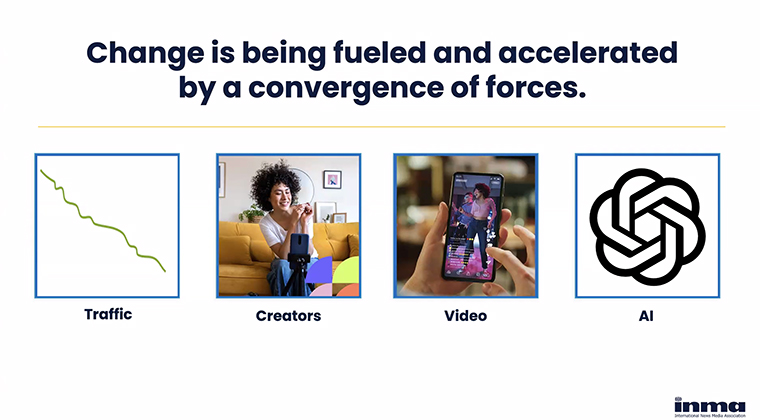
Four forces reshaping the market
The first force is straightforward but unforgiving: less traffic means less revenue.
Dorosz described “about a one‑to‑one relationship between traffic and your display revenue,” a ratio that leaves publishers exposed when pageviews decline and impression‑based models still dominate.
The second force is the rise of creators, who he framed as “the main characters of advertising” today:
- Creator ad spend is projected to grow around 26% globally in 2026, roughly four times faster than the ad industry overall, with similar growth rates in Latin America.
- Creator spend is projected to reach US$44 billion in 2026, 55% of it going to paid amplification, much of that through Meta.
- Creators are the No. 1 ad type buyers say they plan to increase focus on this year, with 57% of buyers expecting to put more budget into creator campaigns.
The third force is video. For younger audiences, video has become the primary information medium and short‑form mobile video the primary advertising medium.
Traditional IAB static displays aren’t being tracked anymore in projections. The last numbers suggested declines of about 10%-12%, with most of that display spend shifting to digital video by 2028. By that year, roughly 44% of the entire global ad market is expected to be digital video.
The fourth force is AI and agentic technology, which Dorosz described as “accelerating everything and being employed everywhere.”
AI affects how ads are conceived, where budgets flow, and how campaigns are bought and sold with 90% of ad spend projected to be AI‑enabled in some way by 2029 and 26% to flow through end‑to‑end AI platforms, buying, selling, trafficking, by 2030.
A new category, generative search advertising (including ads inside conversational tools), is projected to reach US$101 billion worldwide by 2030. Today, 44% of buy‑side teams say they are actively implementing agentic AI, reporting average reductions in campaign setup times of more than 90%.
Growth without the open Web
Despite the disruption, the advertising market itself is growing. “The advertising market is growing,” Dorosz said. “And it’s growing faster than global GDP.”
He put the global advertising market at roughly US$1-$1.3 trillion today, with forecasts suggesting it will reach US$1.6 trillion by 2030.
That growth, however, is increasingly consolidated. Google, Meta, and Amazon capture 60%-70% of global ad spend, and as much as 90% in some markets. In Latin America, Mercado Libre — not Amazon — takes the majority of retail media spend; Amazon holds only about 5%.
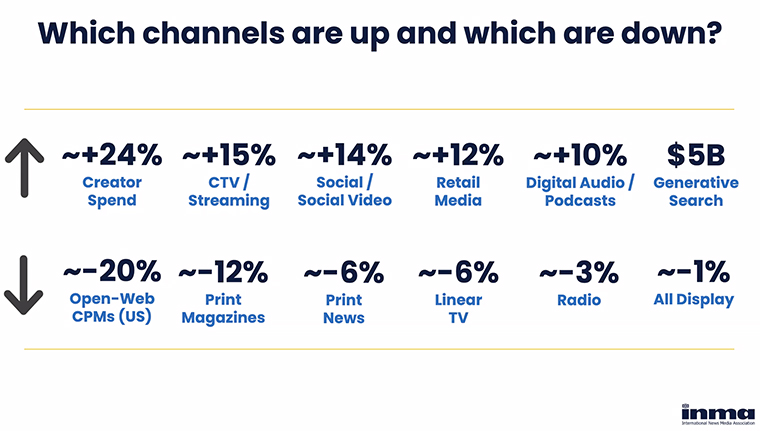
The biggest growth areas are creators, connected TV and streaming, social and social video, retail media, digital audio and podcasts, and generative search advertising, a category with no prior baseline that is projected at US$5 billion this year.
“Other than podcasts, none of those are traditional publisher channels,” Dorosz said.
By contrast, open Web CPMs, print magazines, printed news, linear television, radio, and all display inclusive of static IAB banners are down. Global news brand ad spend has declined 33% since 2019, a drop Dorosz said is “almost entirely driven by print declines,” with digital news ad spend remaining relatively flat.
News publishers are responding by diversifying. Up to 25% of publisher revenue is now “other,” not subscriptions, not traditional advertising, but events, licensing, B2B services, and branded content, which the Native Advertising Institute found up 19% globally.
Latin America’s different path
If the open Web model is weakening globally, Latin America is also where alternatives are being assembled fastest.
Dorosz described Latin America as a digital growth market, growing at around 12% while other regions slow. Brazil is one of the fastest‑growing digital markets in the world. The region is the most mobile and social intensive on Earth, with people spending more than three hours a day on social media on average and five of the 10 most active social markets globally located there. In Mexico, digital video already represents half of all digital spend.
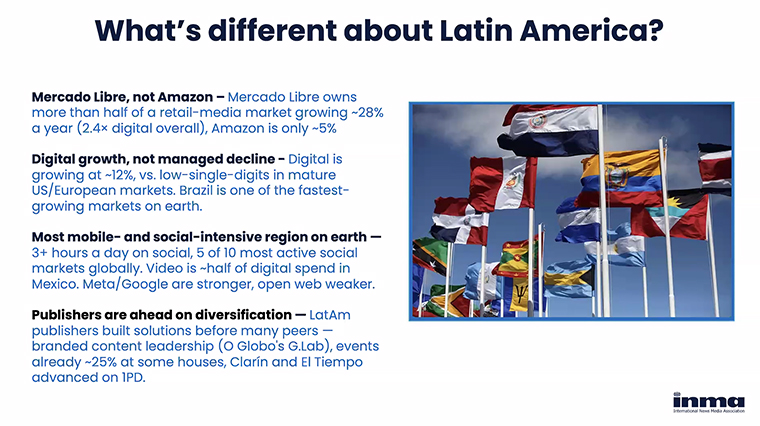
As a result, Meta and Google are stronger in Latin America and the open Web is weaker. Yet “perhaps because of that,” he said, publishers in the region are ahead on diversity, having “built diverse solutions before other peers around the world.”
Latin America leads in branded content and events, which at some houses are already 25% or more of revenue. Clarín and El Tiempo, he noted, are “very, very advanced” on first‑party data.
Latin America, he added, “isn’t really a single market,” and there is complexity across the board. But the region’s mix of mobile intensity, social behaviour, and early diversification offers a template: Publishers pushed off the open Web earlier are now building more varied, data-anchored models.
Rethink inventory
Dorosz’s first principle for a new playbook is to rethink inventory.
At a recent INMA World Congress in Berlin, he challenged publishers to think of advertising “as something worthy of the audience and the journalism, not something to apologise for or turn off once people pay to subscribe.”
He pointed to The New York Times as an example. The Times doesn’t sell IAB banners by default; most of its sold inventory is proprietary display in larger, more immersive formats that perform better and cost more. Dorosz tied that to The Times’ nine straight quarters of digital ad growth.
Der Standard in Germany, he said, ran a full‑site takeover for a climate ticket campaign, visually transforming its entire online presence for a day instead of layering a campaign on top of existing content. Roost Media, a publisher in Austria, launched what it calls “vibe coded utility inventory” — AI‑powered micro‑apps embedded in editorial and paid for by a sponsor.
News Corp, he added, shifted from serving horizontally published video in horizontal format regardless of device to serving the same video vertically or horizontally depending on how a user lands on the page, a change that “has driven a huge uplift in video views, and, therefore, video ad supply, premium video ad supply.”
Sell solutions and outcomes
The second principle is to sell solutions and outcomes instead of formats and reach.
Through first‑party data, Media House built “intent‑driven audience products” to let advertisers reach active shoppers, a performance‑driven product that outperformed benchmarks and drove conversions, winning an INMA Global Media Award.
Hearst and The New York Times “have effectively built targeting solutions with GenAI that enable any advertiser to build their own custom audience.”
Hearst’s product, Ora IQ, “combines first‑party data with proprietary content and AI agents to automate audience building, campaign analysis, and RFP responses.” The New York Times built GenAI tools that let an advertiser supply a brief and receive an audience segment drawn from thousands of Times’ articles, combined with first‑party data and machine‑learning models to reach that audience across the paper’s portfolio.
Both products, Dorosz said, “have consistently achieved performance premiums.”
Bonnier News Sweden, with 60% national daily reach, partnered with a company called Visual Art, which controls 85%-90% of in‑store digital screens in Sweden, to sell a single campaign across “upper funnel and point of purchase.” Procter & Gamble, which had never previously advertised with Bonnier News, became a client as a result, and clients are “actively approaching Bonnier.”
BBC StoryWorks, the BBC’s branded content studio, paired its storytelling with Expedia’s first‑party travel, behavioural and booking data, fusing the data to inform what stories and formats to build. Dorosz described this as branded content “architected for performance, not just engagement or brand goals.”
On the buy side, he pointed to quality scoring of inventory that weighs low ad density, fewer ads in view, domain authority and content quality, with higher‑scoring inventory prioritised and paid more. Publishers “focusing on quality, outcomes, and moving their inventory deals into direct channels are increasing their CPMs overall,” he said, citing People Inc. and The Guardian.
Bake advertising into products
The third principle is to bake advertising into products ahead of time instead of bolting it on after the fact.
Events, Dorosz said, work “because advertising, editorial, and marketing are all in balance.”
Semafor, a U.S. publisher focused on high‑level executive decision‑makers, runs a flagship event called the World Economy Summit. In one example he cited, the Verizon CEO was on stage with Semafor’s CEO, putting advertising and commercial “in the same context as editorial.” Semafor now drives more than half its commercial revenue from events.
Editora Globo has built brand value and commercial profitability through its repeatable Rio Gastronomia franchise. CEO Frederic Kachar told INMA in a Webinar that Editora Globo drives 40% of commercial revenue through events. In India, Dainik Jagran’s “Lights, Cities, Action,” a six‑month travelling film festival across 14 cities and eight states recognised at the INMA Global Media Awards. The festival used AI to produce creative assets and messages, including hundreds of thousands of personalised WhatsApp messages, and to manage registrations, freeing staff to focus on the live experience and commercial relationships.
Dorosz described creators as “subbrands” publishers should treat as tent poles or channels the way they would think about a show, referencing recent work from Group ORBS. Funke in Germany rebuilt a legacy print testing brand as a digital‑first operation around affiliate commerce, intent‑based buying guides and licensing, driving a 130% increase in digital revenue. The New York Times, whose first Wordle ads were “very interruptive” because they were added after the game was built, is now building advertising moments into natural game breaks as it develops new games.
Structure for success
The final principle is organisational: how publishers structure teams, data, and KPIs.
Bonnier News Sweden has embraced what it calls a “common strategy,” working as one company across subscriptions, advertising and product rather than treating advertising as a separate silo, which Dorosz said enables ideas to reach market faster. News Corp Australia works similarly and has recreated its primary KPI as “engaged reach,” pageviews divided by unique visitors, on the theory that “not all traffic is good.”
On first‑party data, Dorosz said he believes “more than ever” that it “is the moat for publishers … it is where you protect your value the most.” He cited El Tiempo’s mature first‑party data ecosystem, which powers traditional targeting products as well as performance products that have opened new spend in retail media and CTV. Nine Australia has built a portfolio of vetted attribution vendors connected to its first‑party data, while others use clean rooms, data partnerships and APIs for media‑mix models.
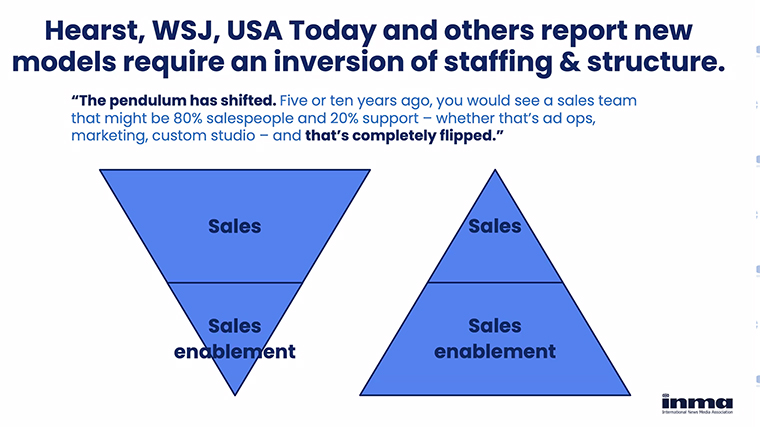
Staffing is changing, too. Hearst, The Wall Street Journal, and USA Today report advertising departments have flipped the old ratio: “five or 10 years ago, you would see a team that would be 80% salespeople and 20% support,” Dorosz said. “Well, that’s completely flipped.” Sales‑enablement roles, ad ops, marketing, custom studio, and data are now the majority, with direct sales the minority.
AI everywhere, agentic trading still early
AI is already being used “everywhere internally at publishers, including the newsroom,” Dorosz said, and ad sales is “one of the leading applications” of AI tools among publishers.
On agentic trading, AI‑driven buying and selling of advertising, he said the industry is in “a kind of Wild West phase,” with demand real but the market still early. Standards will determine who benefits, and publishers benefit if transactions move closer to inventory, where publisher data resides.
Agentic technology “isn’t the fix” for programmatic’s transparency or take‑rate problems, he added, and the buy side sees it as a challenge, too. If Google, Meta and Amazon capture most of the spend, agencies and ad‑tech lose out. Warren Wetzel from WPP has described publishers as “the intelligence layer.”
Dorosz’s recommendation: Prepare data and processes and conduct focused experiments, fixing first‑party data, structuring signals for quality, building agent readiness and infrastructure, and, if testing agents, keeping those tests “narrow, well defined, and read only” without exposing data.
He also urged participation in standards discussions at bodies like the IAB and structuring data around outcomes and audiences rather than reach and impressions.
The bottom line
“This is not a moment where you just make some small changes,” Dorosz said. “We have to stop competing on undifferentiated reach. We will lose against the platforms.”
Instead, he said, publishers must rebuild the advertising business “around premium, machine legible, outcome oriented products that are anchored in first party data and audience trust,” branded content, first‑party data in rich direct deals, short‑form vertical video, creator partnerships and events, with quality signals wired into the agentic buying standards being built now.
That means investing in data and measurement infrastructure, reorganising sales “from order takers to consultants,” and reorganising the offering “from formats to industry solutions.”
On the role of the commercial department in this transformation, Dorosz said the old separation between newsroom and commercial concerns, “church and state,” is no longer sustainable. Commercial, product, editorial, marketing and brand teams need to think about these things together, he said, looking at the same data and having good discussions, even as final strategic decisions rest with the CEO.
“We don’t have the luxury of being a business where we can pretend we don’t have to care about commercial concerns anymore,” he said. “This is about the survival of our business.”
Related Articles
-

As the traffic ad model ends, publishers need a new advertising...
14 October 2026 -

In moving from an attention to an intention economy, who gets p...
16 September 2026 -

What’s really defensible in the age of AI?
30 August 2026 -

Time is now selling ads to AI bots
17 August 2026 -

Platforms took the Croisette in Cannes, and the ad business is ...
6 July 2026 -

Schibsted’s Partnerstudio embraces AI transformation
4 March 2026 -

DMG Ireland turned reader polls into high-intent ad targeting
23 February 2026 -

The AI advertising Super Bowl? Not really
11 February 2026
Upcoming Events
-

Subscriber Acquisition Master Class
10-17 November 2026
-

Media Advertising Summit
New York, United States
07-10 December 2026
-

AI-Native News Product Master Class
18-25 February 2027
-

Media Subscriptions Summit
Oslo, Norway
08-12 March 2027
-

World Congress of News Media
New York, United States
25-30 April 2027
-

Branded Content & Partnerships Master Class
20-27 May 2027
-

Subscriber Retention Master Class
17-24 June 2027
-

Conferencia Latinoamericana
15-16 July 2027
-

South Asia News Media Festival
New Delhi, India
19-22 July 2027
-

Asia/Pacific News Media Summit
19-20 August 2027
-

CEO Roundtable at Kilkenny
Kilkenny, Ireland
24-26 August 2027
-

Media Innovation Week
Amsterdam, The Netherlands
27 September - 01 October 2027








