

What’s really defensible in the age of AI?
Advertising Initiative Blog | 30 August 2026

I spent last week at INMA’s CEO Roundtable in Vail, Colorado, where 40 news media CEOs from around the world spent three days on the future of the business. You can read INMA CEO Earl Wilkinson’s recap of the week here.
The question I explored in Vail was blunt: Is there advertising revenue left for publishers to capture in three years? Of course there is, but it’s time to get real about what lives and what dies, and the answer differs by model, market, and trajectory. So instead of one answer, I gave the room three key questions.
What does the advertising market want to buy?
What can publishers sell them?
And what’s defensible in the age of AI?
The market context makes the stakes crystal clear. The global ad market is heading past US$1.6 trillion by 2030, while global news ad spend has fallen 33% since 2019, to somewhere between US$30 billion and US$45 billion. Creator spend, CTV/streaming, social/social video, retail media, digital audio/podcasts, and generative search spends are all projected to increase double digits or above.
As I said in at the INMA South Asia conference in New Delhi: Advertising is booming. The print and open-Web model is not. The problem is what we sell and how we sell it.
Let’s start with what or how the market wants to buy. The business is moving from a focus on CPM and reach to a focus on outcomes: if not a guarantee, then a proxy for one. Hard outcomes (sales, leads, conversions) are territory the platforms win on the whole. Soft outcomes (awareness, brand effects, intent) are where publishers can compete.
And the timing is turning favourable, with more than one-third of advertisers in the U.K. saying they plan to increase brand-building investment in 2026. A market that buys brand, consideration, and intent is a market that needs quality publishers. Consideration, now the hardest thing for an advertiser to drive, according to WARC, is the sweet spot for publishers.
As a result of all of this, publishers are exploring all kinds of diversification strategies (see part two of this newsletter for a full breakdown), but you can’t do everything. You have to filter for what’s actually going to be defensible.
What’s ultimately defensible is some version of the idea of trust.
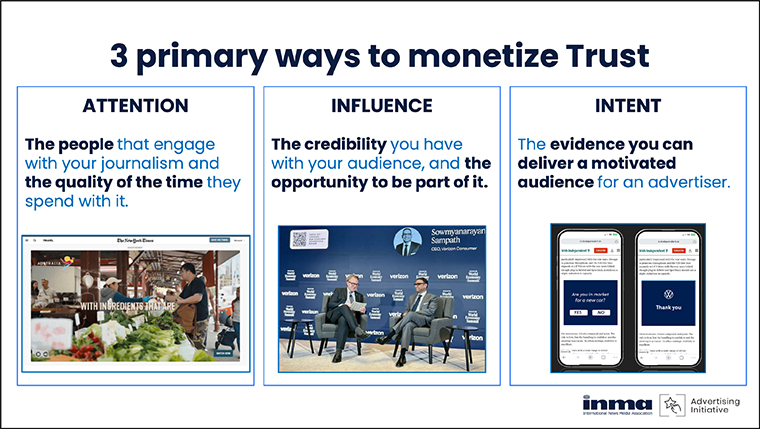
That word gets used as a comfort blanket in a lot of different ways, so in Vail I tried to make it specific and operational. I think ultimately you can boil it down to monetising trust three ways: attention (the quality of the time people spend with your journalism), intent (the evidence you can deliver a motivated audience), and influence (the credibility you’ve built and the opportunity for brands to be part of it, which is what powers events and branded content).
I think when I boil all this down, the most important question we have to answer about defensibility is whether or not we think AI ultimately eats the funnel or journey and the ad spend along with it.
My hypothesis
AI absorbs much of the research phase of the consumer journey, but platforms and agents can only capture and infer intent. They cannot create it. Desire is still formed upstream, in content and environments people trust, which is why Brian Morrissey now writes about “manufacturing intent” as the publisher opportunity and why McKinsey’s agentic advertising work frames the fight as one over who shapes decisions.
I think ultimately the answer to this question is not either/or but category specific. Razor blades, toilet paper, and a US$9 T-shirt can be swallowed whole by an agent. Advice categories (finance, B2B, healthcare) and desire categories (luxury, travel, fashion) run on trust and authority.
Think about the difference between razor blades and a mattress, the length of decision-making, the price, the stakes involved, even the decision-makers. Further, none of this is a binary; we will continue to make impulse purchases IRL and we will continue to make them online. We will continue to use a mix of sources, and we will continue to be unpredictable.
There is no future where 100% of the population conceded 100% of their purchase decisions to an agent. We just don’t work that way. So I think the pool of readable intent shrinks overall, making publisher-created intent scarcer and more valuable for publishers who can prove it.
And as I wrote about last week, scarcity can in fact be a strategy. The cleanest proof is People Inc.’s overall strategy, represented by their Q2 results: visits down 22%, rates up about 27%, session revenue roughly flat, and non-session revenue up 16% to 43% of digital, the 11th straight quarter of digital growth.
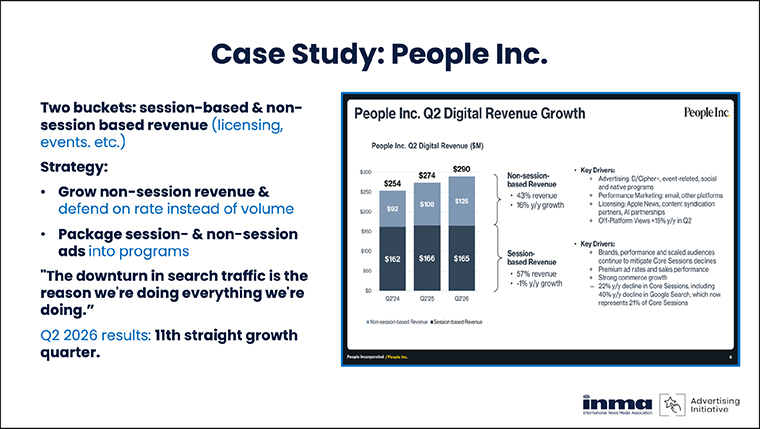
One CEO in the room called it earthquake territory: turning Google Zero into scarcity instead of crisis.
The tests
I left the CEOs with a rubric for every commercial product on their road maps:
Audience fit: Does it serve our users or degrade their experience?
Defensibility: Can a platform or agent do this cheaper/better?
Margin reality: What is the contribution after the people, tech, and ops it actually takes to deliver this?
Brand effect: Does it strengthen or erode trust in the product?
Strategic fit: Does it compound with reader revenue and our editorial strengths or pull against them?
Category relevance: Can we credibly succeed in these ad categories?
Scenario resilience: Does it survive across multiple futures or only one?
Cost to win: What’s the investment and the talent to do it well?
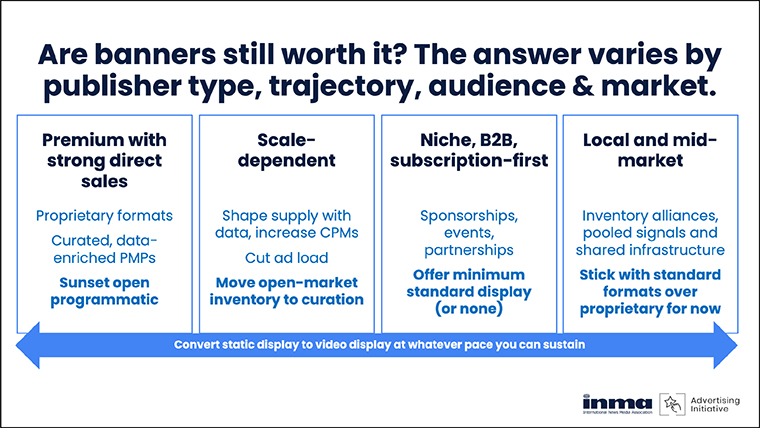
On that test, first-party data and logged-in audiences sold direct and through PMPs, proprietary high-impact formats, branded content and creative services, events and community, and brand-safe context all hold up. Undifferentiated open programmatic, reach sold as a commodity, affiliate built on traffic brokerage, and anything competing purely on price or volume against platforms do not.
The simplest version of the whole argument: Brand drives trust, trust drives habit, habit drives engagement, engagement drives useful data, data drives buyer preference, and all of it drives premium pricing. Build around that.
We’ll continue to explore all of this throughout the Advertising Initiative, and we’re going in-depth in New York at the Media Advertising Summit.
If you’d like to subscribe to my bi-weekly newsletter, INMA members can do so here.
Banner art: Adobe stock image by Asma.
Related Articles
-

As the traffic ad model ends, publishers need a new advertising...
14 October 2026 -

In moving from an attention to an intention economy, who gets p...
16 September 2026 -

Time is now selling ads to AI bots
17 August 2026 -

Latin American publishers must rewrite ad strategies around out...
20 July 2026 -

Platforms took the Croisette in Cannes, and the ad business is ...
6 July 2026 -

Schibsted’s Partnerstudio embraces AI transformation
4 March 2026 -

DMG Ireland turned reader polls into high-intent ad targeting
23 February 2026 -

The AI advertising Super Bowl? Not really
11 February 2026
Upcoming Events
-

Subscriber Acquisition Master Class
10-17 November 2026
-

Media Advertising Summit
New York, United States
07-10 December 2026
-

AI-Native News Product Master Class
18-25 February 2027
-

Media Subscriptions Summit
Oslo, Norway
08-12 March 2027
-

World Congress of News Media
New York, United States
25-30 April 2027
-

Branded Content & Partnerships Master Class
20-27 May 2027
-

Subscriber Retention Master Class
17-24 June 2027
-

Conferencia Latinoamericana
15-16 July 2027
-

South Asia News Media Festival
New Delhi, India
19-22 July 2027
-

Asia/Pacific News Media Summit
19-20 August 2027
-

CEO Roundtable at Kilkenny
Kilkenny, Ireland
24-26 August 2027
-

Media Innovation Week
Amsterdam, The Netherlands
27 September - 01 October 2027








