

BCN, Time share lessons in selling ads to machines
Advertising Initiative Blog | 09 September 2026

Advertising to humans was hard enough. Advertising to machines is now a separate job, and it has arrived faster than most publishers planned for.
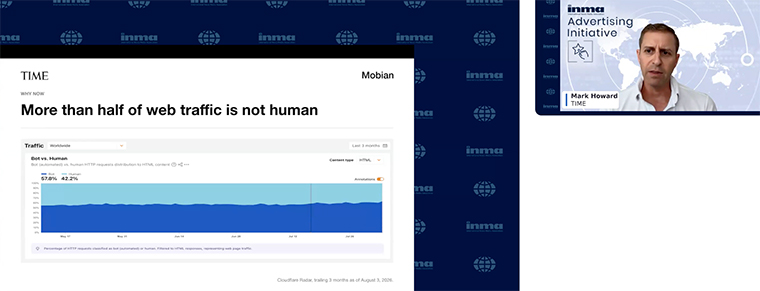
More than half of all Web traffic today is not human. At Time, agent and bot traffic some days runs ahead of human traffic. At the same time, the behaviour publishers built two decades of SEO practice around is shifting from searching to asking: AI delivers an answer before any list of links, the model decides which sites appear in it, and many queries end there with zero clicks.
That leaves media companies with the question their advertisers are already asking. If an AI model decides which brands turn up in an answer, how does a brand get into it?
During this week’s INMA Advertising Initiative Webinar, Advertising to Machines: The First AI Ad Products, Stefan Betzold, chief digital and product officer at BCN in Germany, and Mark Howard, chief operating officer at the U.S.-based Time, laid out two of the first commercial answers — and two different bets on where the money is.
BCN, the media sales house for three major German publishers, is selling influence over the answer itself through GEO Brand Impact, a product built on the authority its publisher brands already carry with the models.
Time has gone further into the plumbing, splitting its site into a human version and a machine-readable one, then building ads for the agents crawling the latter.
Both are measuring against a similar new KPI set, and both argue the discipline needs to sit inside every marketing team now rather than in a lab.
GEO brand impact at BCN
Generative Engine Optimisation, or GEO, is a new discipline in brand management and marketing measurement. Betzold told INMA members he believes GEO needs to become part of the marketing at every news media organisation.
User behaviour is changing from searching to asking, he said. Before the advent of AI, Google searches resulted in a listing of Web site links the user could choose from. Now, AI delivers the answer before any other results — and more importantly, the AI model decides which Web sites appear in this answer, if any, and searches often result in zero clicks.
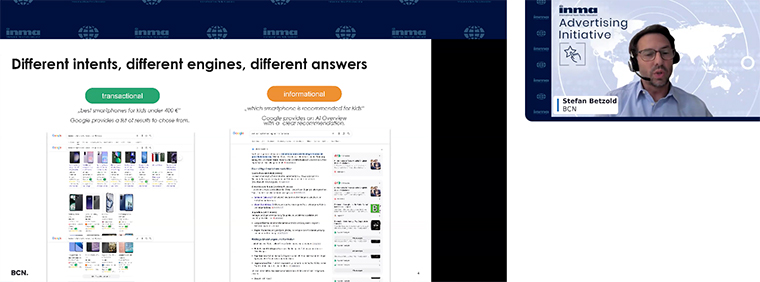
The responsibility then lies with the user to decide where to deep dive, and many queries do not go beyond these Google AI overviews or other Generative AI tools such as ChatGPT, Betzold said. The different user intentions behind searches results in drastically different responses. The old transactional search query of a few keywords gave the user control of result options, while the new informational query in the form of a question results in a clear answer via Gen AI.
As the media sales house for three major news publishers in Germany, BCN works with more than 300 brands and reaches 60 million people. For advertising, this means brands must somehow influence the AI LLM with the correct signals that tell it to recommend that brand in its limited answer, Betzold said.
“The retrievals also fan out in various queries that already use some pre-trained brands to look at. It’s so important to understand what brands and sources are cited. We need a new understanding of what kinds of questions the users are asking and prompting.”
Prompt research, therefore, is becoming a completely new discipline for every marketing team. Marketers must also explore if their brand is part of the AI visibility answer, to what extent, and if competitor brands are also recommended.
This requires a completely new KPI set that includes, according to Betzold:
Visibility/mentions: How often does the brand appear in AI mentions?
Citations: Is the relevant content cited as a source?
Sentiment: In what tone is the brand represented?
While there are some parallels to SEO, GEO represents a new playing field.
With SEO, the goal is to rank as high as possible on Google’s search results list. Important levers are structured content, topic relevance, and technical optimisation.
With GEO, the goal is to be named and recommended within the AI answer itself. Important levers are content authority, trusted sources, structure, and crawlability.
On average, only 10%-15% of the content cited in AI search results come from a brand’s own Web site. These answers are highly influenced from YouTube and online forums such as Reddit. To become a strong influence in these AI answers, publishing brands must have media authority. Additionally, more than 50% of Web content is now written by machines.
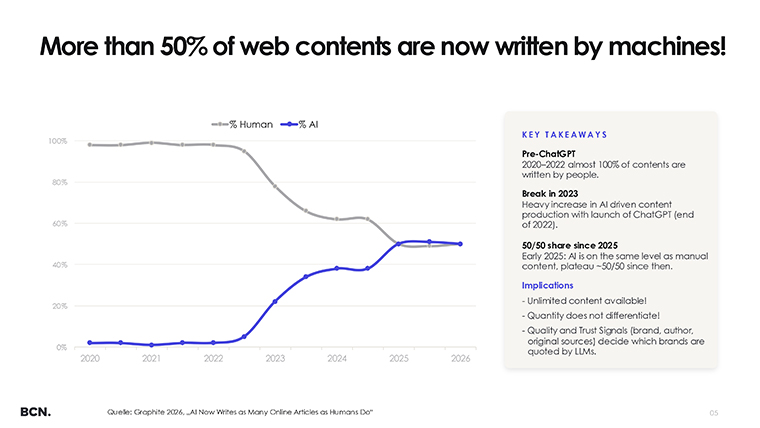
“That’s the great opportunity for us, to use the authority and brand trust we’ve built up over decades to try to influence the LLM with citations or driving the sentiments and trust signals,” he said.
BCN’s product, called GEO Brand Impact, is an integrated approach to optimise AI visibility. It’s a combination of four modules:
In-depth analysis: Analysis of current AI visibility to identify brand presence, benchmark performance, and uncover optimisation opportunities.
Strategic goals: Definition of relevant search intents and content strategies to position the brand within AI-generated responses and AI-powered systems.
Targeted content: High-quality, relevant GEO content created and embedded within trusted media brands to establish AI-relevant contexts and increase the likelihood of being referenced by AI systems.
Tracking and optimisation: Measurement of key metrics such as brand visibility, citation rate, and sentiment to continuously optimise brand presence and performance across AI-powered platforms.
The third module, targeted content, is the heart of GEO Brand Impact, Betzold said. Based on the defined strategy, the BCN Brand Stories teams creates content across the most relevant media brands with proven topic authority, resulting in fully AI-optimised content for LLM retrievals and citations.
Time builds advertising for AI agents
Time has taken a slightly different approach that thinks about AI agents and bots as not only a new audience that needs to be targeted, but the most important audience for where both the media industry and the internet are heading.
Mark Howard, chief operating officer at Time, said the news company served its first campaigns built for AI agents at the end of July. The campaigns were specifically targeted to agents and bots, not to humans.
One huge finding was that the referral traffic they get from the AI answer platforms converts at a significantly higher rate than regular search referral traffic.
“I think we need to study that and really understand not only the consumer behaviour changes, but what’s influencing the way that the answers are being generated,” Howard said.
The agents and bots represent an entirely different audience segment that must be treated very differently. They crawl the internet 24/7 without tiring and have no emotions to influence the findings. This is opposite to the way brands approach human advertising and marketing, which is through emotional storytelling.
“That approach will not work when we think about how to actually get into the AI answers information graph and be part of the answers,” Howard said.
More than half of all Web traffic today is not human, and that has happened faster than expected. With this new approach of advertising directly to AI, Time is seeing more agent and bot traffic every day — sometimes representing higher numbers than human traffic.
With this new data, Time started segmenting its content into the HTML site for human consumption and a machine-readable version of the site for AI consumption. The AI version strips out everything the agents don’t care about: videos, Javascript, advertising. It’s simply content data presented in a very clean way.
The same thing goes for advertising, Howard said. The agent-segmented ad is structured data with data tables and FAQs, with all non-relevant information stripped out. This is presented as sponsored content.
Time creates this in partnership with Mobian. The resulting data is interpreted the same way human-targeted campaign data would be — what agents and bots are coming to the page, and what they are using the content for (real-time results, indexing, or training).
“Having that full mix of seeing what the different agents are doing and being able to understand that in terms of how we deliver the agent ads becomes increasingly important,” Howard said.
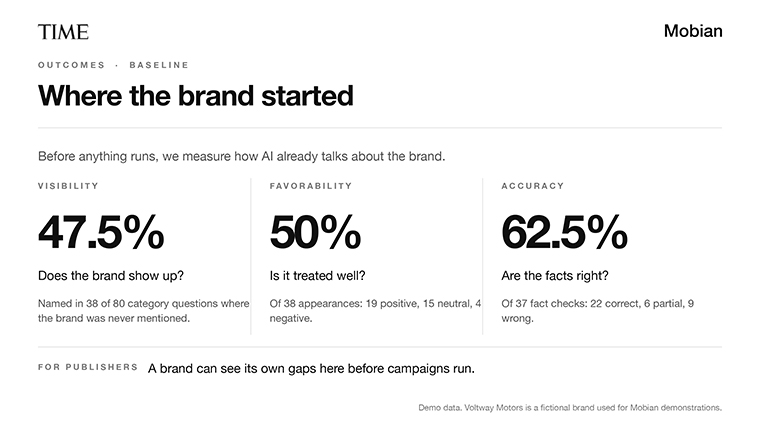
Similar to BCN’s approach, Time measures how the AI agents are talking about the brand:
Visibility: Does the brand show up?
Favourability: Is the brand treated well?
Accuracy: Are the facts right?
Through Mobian’s Brand Brief, which analyses what a brand says about itself through its paid advertising and compares it to how the AI answer platforms map to that, the team can identify the gaps to adjust the agent ad content for better results.
“We believe that over time, by communicating these brand facts, by getting them read, being on pages that the agents are crawling, and being able to prove it … there will be massive demand for this.”
Howard laid out what this means for media publishers:
Inventory: The agent version of the site is not monetised today. Serving an ad into it changes nothing for human readers.
Demand: The buyer is any brand that cares how AI describes it.
Proof: Every read is classified and every campaign is measured against a baseline, including when nothing moved.
Control: Approved agents only, sponsor named in the first line, every fact sourced.
“Brands do need to think of agents now as a highly influential and important audience, how they address them, and how they think about being part of that ecosystem.”
Related Articles
-

AI is now media’s operating environment
28 September 2026 -

5 lessons from the INMA Young Audiences Summit
28 September 2026 -

In moving from an attention to an intention economy, who gets p...
16 September 2026 -

Agents, liquid content, vibe coding raise questions for news me...
9 September 2026 -

What’s really defensible in the age of AI?
30 August 2026 -

What I told 40 CEOs (and won’t gatekeep from you)
30 August 2026 -

Latin American publishers must rewrite ad strategies around out...
20 July 2026 -

Dow Jones turns complex B2B data into “prosumer” content with c...
13 July 2026
Upcoming Events
-

Subscriber Acquisition Master Class
10-17 November 2026
-

Media Advertising Summit
New York, United States
07-10 December 2026
-

AI-Native News Product Master Class
18-25 February 2027
-

Media Subscriptions Summit
Oslo, Norway
08-12 March 2027
-

World Congress of News Media
New York, United States
25-30 April 2027
-

Branded Content & Partnerships Master Class
20-27 May 2027
-

Subscriber Retention Master Class
17-24 June 2027
-

Conferencia Latinoamericana
15-16 July 2027
-

South Asia News Media Festival
New Delhi, India
19-22 July 2027
-

Asia/Pacific News Media Summit
19-20 August 2027
-

CEO Roundtable at Kilkenny
Kilkenny, Ireland
24-26 August 2027
-

Media Innovation Week
Amsterdam, The Netherlands
27 September - 01 October 2027








