

AI is now media’s operating environment
Conference Blog | 28 September 2026

Over five days in Madrid, two days of study-tour visits to Spanish newsrooms and three days of conference sessions, AI came up in nearly every room. It was not treated as a distant disruption.
Publishers are already dealing with it on two fronts: outside, where answer engines are rewriting how audiences find news, and inside, where newsrooms are working out how to use the technology without losing their footing.
The picture that emerged during Media Innovation Week in Madrid is neither doom nor hype. The sector has moved past experimentation into the harder work of adoption, governance, and repositioning.
The traffic squeeze is measurable
INMA CEO Earl Wilkinson opened the conference with the numbers. Google organic traffic to publishers is down 33% in the past year, 68% of searches end without a click, and referrals from AI chatbots are still below 1%.
The CEOs at INMA’s recent roundtable, he said, believe that within two years, publishers will become either paid suppliers to AI or free raw material for it.
Spain offered local proof.
Media SEO consultant Clara Soteras tracks AI Overviews across the country’s five largest news sites. She said they appeared in roughly three in 10 searches in November 2025 and now appear in about half, nearly doubling in eight months. They trigger on 85% of question-style queries and hit evergreen content hardest, while breaking news still mostly surfaces in Top Stories.

At Vocento, Chief Digital Officer Noemí Ramírez García said an analysis of more than 2 million ABC keywords found 91% of those showing AI results produced zero clicks. AI results still appear on only a small share of news queries in Spain, she said, but Google could expand that with the push of a button. That is what keeps her awake at night.
El Confidencial has already felt it. COO Alejandro Laso said the digital native lost close to half its traffic in the past year to changes in Google Discover, AI Overviews, and AI Mode. What sustains it is the 7% of monthly readers who return and generate 70% of the business.
The company is “not in the traffic business,” he said, but in the business of returning readers.
Inside the newsroom: scaling support, not tools
The adoption stories that worked shared one trait: They started with journalists’ problems, not with the technology.
Heidi Iivonen, development manager at Sanoma Media Finland, said Helsingin Sanomat began by asking pilot teams what made their work difficult. That produced a list of 74 workflow bottlenecks.
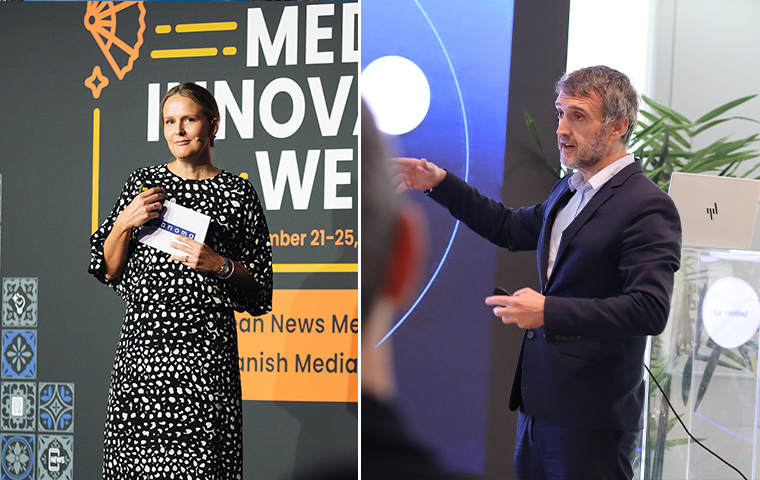
The rollout then gave every journalist three hours of one-on-one coaching from trusted newsroom colleagues, about 460 people and nearly 1,400 hours so far. Around 90% now use ChatGPT, and journalists have built more than 150 tools.
“We started by scaling AI tools. We ended up scaling the support,” she said.
Vocento took a similar route. Editorial Managing Director Fernando Belzunce said around 900 journalists, about 80% of the newsroom, have been trained under three principles:
-
AI must improve the journalism.
-
Its output must be rigorous and verified by journalists.
-
It must build credibility rather than erode it.
Investigating a corruption case once meant 10 journalists spending days combing through 3,000 pages of court documents. Now reporters can surface names and patterns in a day.
The strongest uses were about capacity. During this summer’s border crisis between Spain and Morocco, fact-checker Maldita.es, a nonprofit with a for-profit tech arm, ran open-source models on rented GPUs to translate Moroccan Darija and monitored 30,000 WhatsApp and 40,000 Facebook messages in the first week, COO Ximena Villagrán said.
During the World Cup, AS used AI to produce one-minute audio bulletins for each national team, reviewed by a journalist. It is now planning personalised daily bulletins for club supporters.
INMA Newsroom Innovation Initiative Lead Sonali Verma highlighted Mediacorp’s “snack bot.” Trained on the broadcaster’s 500 best-performing short videos, it coaches reporters on their pitches.
What hasn’t worked yet
Speakers were candid about failures.
Marc Isler, managing director for premium digital at Tamedia, described an early attempt to crawl hyperlocal information and turn it into semi-automated articles. The pieces drew an average of five readers each.
The lesson, he said, was to ask what users need before building something just because you can.

Øystein Reistadbakk, editorial lead for subscription at VG, showed Videofy, an AI tool that turns articles into video. Its best videos drove click-through rates above 25% back to premium stories.
Yet internal use is declining because each video still takes reporters 10 to 15 minutes they would rather spend elsewhere. Even good AI competes for time.
Christophe Israël, founder of OKLab, compared two publishers he has worked with:
-
A local publisher with 50 journalists deployed AI for about €40,000 in four months.
-
A national organisation with 300 journalists spent roughly €2 million and got no pilot into production in almost a year.
The difference, he said, was leadership alignment, not technology.
Governance grows up
That is why governance has moved from a document to a function. Israël said that 18 months ago, nine in 10 respondents to his audience polls had no written AI policy. In Madrid, about eight in 10 did. But a policy also needs owners, enforcement, risk management, and monitoring.
“If everyone is responsible, no one is,” he said.
He cited Prisa Media, which paused new projects for three months to set up an AI oversight committee and a steering committee. It now runs ideas through a use-case card that screens out most weak ones.
Human checkpoints are being written into workflows. El Confidencial’s product process lets AI review work and suggest improvements, but only humans can approve a project to move to the next stage. At Seznam.cz, AI moderation can approve reader comments but never reject them; rejection is left to editors.
Publishers are also drawing lines around their content.
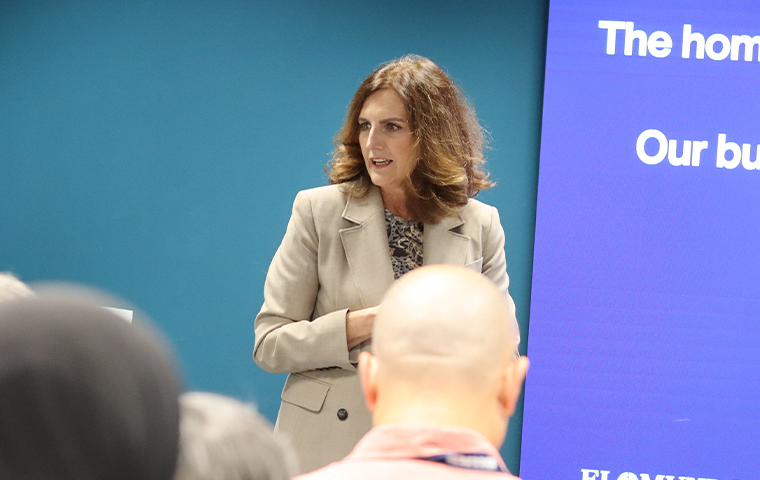
Unidad Editorial CEO Laura Múgica said the company keeps its content closed to technology platforms it has no deal with. Vocento monitors crawlers and blocks those that ignore its rules. Prisa Media CEO Pilar Gil said the group uses AI to support its newsrooms, improve profitability, and grow revenue, but refuses to let platforms extract its content with impunity.
Where this is heading
The shared view of the future was not that AI replaces journalism. It was that AI commoditises much of what journalism used to sell.
Wilkinson’s formula: Automate the commodity, meaning breaking news, basic updates, and the archive, and invest in the person, meaning investigations, star bylines, community, and live events.
Esther Alonso, general director of marketing, product and technology at elDiario.es, put it historically. Media once competed on the scarcity of paper and airwaves, then on the scarcity of attention. Now, with AI, they compete on trust.
Others see opportunity in that shift. De Telegraaf Editor-in-Chief Kamran Ullah said the AI era could bring a new golden age of journalism. Budgets would be smaller and newsrooms leaner, but stronger, built around journalists audiences know by name.
Olaf Seydel, head of engagement and growth at Die Zeit, pointed to a practical hedge. When people search for a publisher’s own tools by name, answer engines struggle to keep them from clicking through.
Speed remains the worry. Members of INMA’s European board said what keeps them up at night is whether legacy organisations can change as fast as audience habits and the technology. Isler put it plainly: Publishers don’t have five years.
The message from Madrid: AI is not a strategy. It is the environment in which publishers must prove, faster than ever, why readers should come to them directly.
Related Articles
-

Marketers should outsource tasks, not thinking
25 October 2026 -

AI’s effect on super user math
15 September 2026 -

At Mediacorp’s CNA, loyalty means giving audiences a reason to ...
20 August 2026 -

Tribun Network turns print “dots” into AI-powered insight
20 August 2026 -

Nation Media Group focuses editorial strategy on stories that m...
4 August 2026 -

Briefly News empowers journalists with AI tool suite Nova
4 August 2026 -

Delhi’s news publishers are trading reach for retention as sear...
23 July 2026 -

AI adoption in newsrooms should move from experiment to strateg...
12 July 2026
Upcoming Events
-

Subscriber Acquisition Master Class
10-17 November 2026
-

Media Advertising Summit
New York, United States
07-10 December 2026
-

AI-Native News Product Master Class
18-25 February 2027
-

Media Subscriptions Summit
Oslo, Norway
08-12 March 2027
-

World Congress of News Media
New York, United States
25-30 April 2027
-

Branded Content & Partnerships Master Class
20-27 May 2027
-

Subscriber Retention Master Class
17-24 June 2027
-

Conferencia Latinoamericana
15-16 July 2027
-

South Asia News Media Festival
New Delhi, India
19-22 July 2027
-

Asia/Pacific News Media Summit
19-20 August 2027
-

CEO Roundtable at Kilkenny
Kilkenny, Ireland
24-26 August 2027
-

Media Innovation Week
Amsterdam, The Netherlands
27 September - 01 October 2027








