

Delhi’s news publishers are trading reach for retention as search traffic falls away
Conference Blog | 23 July 2026

Nobody on the study tour that opened INMA’s South Asia News Media Festival argued that the traffic was coming back.
That candour set the tone. Over two days in Delhi and Noida, 20 executives visited companies including the Foundation for Innovation and Technology Transfer at the Indian Institute of Technology Delhi, HT Digital, The Indian Express, NDTV, and Times Internet.
What emerged was a rough consensus about where growth now comes from — engagement rather than reach, and products built on a publisher’s own content — alongside a sharp split over how far to let automation into the newsroom.
“Our traffic has dropped as the industry’s traffic has dropped. There is no doubt about that,” Rohan Tyagi, chief product officer at NDTV, said. AI has not made up the difference, he added, because new user acquisition remained unsolved.
At HT Digital, executives put a decade of numbers behind that. Publishers’ share of India’s digital advertising spend has fallen from 18% to 7%, they said, with news media publishers accounting for closer to 3% of the total.
Start with the problem, not the technology
The tour’s first stop set a theme the rest kept returning to.
At the Foundation for Innovation and Technology Transfer at IIT Delhi, Neelabh Pathak, who works on partnerships and corporate relations at the institute, said the scarce resource in innovation is not money or engineering talent. It is a well-defined question.
“In academia, it’s very easy to fall into an echo chamber and start working on a research problem that might not have industry relevance,” he said, describing what he wanted from the visiting executives: “We love problem statements. We love to solve. And the one thing that we don’t have are the correct problem statements.”
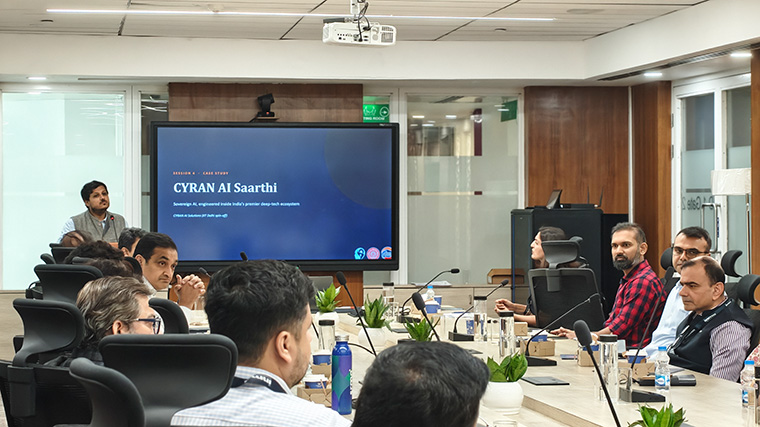
Tyagi made the same argument from inside a newsroom. He divided NDTV’s AI work into thin layers, which are quick wrappers over existing models, and thick layers, which are expensive and proprietary. Both fail in characteristic ways.
“You build an AI application, and within a few weeks or months, no one is using that application anymore,” he said. The risk in thin layers is clutter; the risk in thick ones is that “sometimes you are solving problems which don’t exist.”
At The Indian Express, the same discipline shaped video strategy. The first of four steps was identifying the aim, said Sayoni Aiyar, business head of videos/English.
“When I say identify the aim for Indian Express, our aim was to amplify our core journalists,” she said. For another organisation it might be reaching a younger demographic, or growing revenue — and the platform choice should follow from that, not precede it.
The archive is the defensible asset
The most concrete convergence across the tour was that publishers’ own content, properly indexed, is the thing competitors cannot copy.
NDTV built an answer engine that draws only on its own published journalism. Running a frontier model across decades of articles proved too expensive, so its three-person AI team developed a different approach to information retrieval, which has been accepted for a conference in Melbourne.
The constraint is the point. Asked what separates the tool from a general chatbot, Tyagi said the system is built so that it cannot reach beyond what NDTV has reported.
“The only unique value we’re trying to give is one: it’s grounded,” he said. It is deliberately not an article search — anyone can retrieve a headline through Google. It is meant to answer the more complex questions readers cannot resolve by reading one story after another and to answer them from a newsroom’s own reporting. “Can we answer better than Google or ChatGPT? Better means that it’s editorial-led.”
Times Internet has built something structurally similar for a different purpose. Its Answers feature appends generated questions to the end of an article, each linking to related coverage drawn from The Times of India’s own archive.
The problem it addresses is leakage, said Danish Sahni, product head at Times Internet: “Now users typically read about it and want more context, so they go back to search.” Web search inside the tool is switched off, partly on cost grounds — “if we enable a Web search, the costs will go up,” he said.
Readers who engage with the feature spend three times longer and read three more articles, he said.
The strongest version of that argument came from Vivek Parmar, chief technology officer at Cyran.AI, who put the choice to publishers as one of ownership rather than adoption. As AI shifts from experiment to infrastructure, he said, the question stops being whether to use it and becomes who controls the stack it runs on.
His case rested on what publishers give up when they rent.
“Every API has a liability to it right now,” he said.
Subscriptions to U.S.-based services are priced in dollars and revised unpredictably, and consumption cannot be capped: “You cannot control the input because the amount of tokens it wants to take, it will take.” Enterprise security agreements, he added, do not change where the material ends up. “But still the data goes with them. They have a copy at the end of it.”
Sovereignty, in his account, is about attribution as much as security — value a publisher has added to its own data should not be absorbed by an outside model “without your acknowledgement at least.”
The remedy he proposed was proportionate rather than absolute.
“Especially for media houses, it becomes important to have some level of control over their own AI stack,” he said. “It has to be like on-premise or a cloud dedicated to them.”
Asked whether this applied to a 50-reporter investigative operation, he suggested capable local hardware would be enough; only organisations above about 5,000 employees need consider an indigenous or sovereign cloud. He also floated a collective route: “Maybe everyone can come together and set up a central stack.”
Not everyone in the room was convinced the economics hold. One executive said his organisation already runs its content management system, data collection, Web site, and app on in-house infrastructure rather than a commercial provider, but had been unable to build a financial case for training large language models internally because the models change too quickly to recover the capital outlay.
Reach gave way to return
If the archive is the asset, engagement is the measure.
NDTV has made total time spent on its app the north star metric, with day-30 retention for organic installs running at about 60%. The Indian Express tracks next-day retention across its digital properties — a harder test than daily actives, executives said, because political spikes bring readers who never come back.
Aiyar was blunt about why views were rejected as the primary metric.
“We felt that audience engagement was a more authentic metric,” she said. “Are we doing well? The audience engagement will tell us, not the number of views they’re getting on cat videos or any trending sort of content.”
At HT Digital, the measurement extends to the transaction itself. The company reported acquiring 10 million users in its personal finance business over a year, of whom three million applied for credit, with ₹1,500 crore — about US$155 million — disbursed over 12 months.
“If you are able to acquire users on the basis of trust, they will trust you to take care of your complete end point of the journey,” Neelabh Vikram Mall, business head of the fintech business, said.
Asked how quickly content commerce begins to pay, he didn’t sugarcoat it: “It can be as early as day one or it can be never.”
Trust is what is being monetised
The Indian Express presented research showing where independent creators beat established news brands — being easy to understand, entertaining, relatable, and up to date — and where they do not, on being knowledgeable, trustworthy, and impartial. That gap is the opening.
“It is only your brand identity, what you as a brand or a creator bring differently to that story, that is going to make the viewer keep coming back,” Aiyar said.
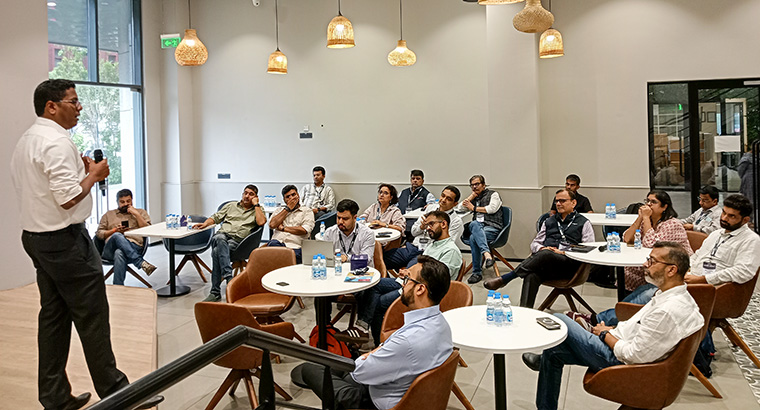
Saurabh Dwivedi, editor of Indian Express Hindi, framed it as a memory test: “Will my viewer remember that they watched my video?” Continuity of content and character is what produces recall, he said, and platform revenue is not a foundation. “A solid brand, do solid programming so that you can attract sponsors, don’t rely on the platforms for the longer term.”
Where the human belongs is unsettled
This is the one question on which the stops did not converge.
At IIT Delhi, Ashwin Saxena, founder/CEO of CybraneX, described an AI-assisted newsroom workflow with “a human verification layer, which is a mandatory thing,” and set out principles of transparency, accuracy, fairness, human oversight, and accountability.
NDTV keeps 100% manual review of AI-generated summaries in sensitive categories but runs its consumer answer engine with no human in the loop, relying on grounding and training to keep errors low.
Times Internet has gone furthest towards automation. Its daily news crossword, built from the roughly 1,500 articles it publishes each day, has run for months without editorial intervention.
Nirmalya Dutta, editorial consultant at Times Internet, was clear about the limits after two and a half years of training models on his own newsletters: “No AI can write in a way that is comprehensible to editors.” What the tools do well, he said, is change tone, crunch data and generate illustration — not write.
Tyagi offered the sharpest formulation of the shift ahead. After “almost a decade of extensively writing for algorithms,” he said, the unlearning question is: “How do we have more empathy for the readers and users and start writing for them?”
Related Articles
-

Marketers should outsource tasks, not thinking
25 October 2026 -

AI’s effect on super user math
15 September 2026 -

At Mediacorp’s CNA, loyalty means giving audiences a reason to ...
20 August 2026 -

Tribun Network turns print “dots” into AI-powered insight
20 August 2026 -

Nation Media Group focuses editorial strategy on stories that m...
4 August 2026 -

Briefly News empowers journalists with AI tool suite Nova
4 August 2026 -

Grupo RBS builds social-first video operation to expand audienc...
20 July 2026 -

Inside Denník N’s successful subscription strategy
15 July 2026
Upcoming Events
-

Subscriber Acquisition Master Class
10-17 November 2026
-

Media Advertising Summit
New York, United States
07-10 December 2026
-

AI-Native News Product Master Class
18-25 February 2027
-

Media Subscriptions Summit
Oslo, Norway
08-12 March 2027
-

World Congress of News Media
New York, United States
25-30 April 2027
-

Branded Content & Partnerships Master Class
20-27 May 2027
-

Subscriber Retention Master Class
17-24 June 2027
-

Conferencia Latinoamericana
15-16 July 2027
-

South Asia News Media Festival
New Delhi, India
19-22 July 2027
-

Asia/Pacific News Media Summit
19-20 August 2027
-

CEO Roundtable at Kilkenny
Kilkenny, Ireland
24-26 August 2027
-

Media Innovation Week
Amsterdam, The Netherlands
27 September - 01 October 2027








