

Dow Jones turns complex B2B data into “prosumer” content with cross-team collaboration
Media Leaders | 13 July 2026


There are moments when the value of expertise becomes immediately visible. For those of us in journalism and information services, the recent Middle East crisis has been one of those moments.
As events unfolded, it became clear the implications extended far beyond the professional customers and audiences who rely on our products every day. The effects were felt across supply chains, financial markets, travel networks, and household budgets.
Questions once confined to trading floors and risk committees suddenly mattered to everyday consumers trying to understand what higher energy prices, shipping disruptions, or geopolitical instability might mean for their daily lives.
This extraordinary crisis compelled an extraordinary response.
At Dow Jones, we identified a consumer need to access information that is traditionally delivered to enterprise audiences. The result was Dow Jones Crisis Monitor: Middle East, a product built in just nine days that combined expertise from our business-to-consumer (B2C) and business-to-business (B2B) businesses across news, risk, and energy to help readers make sense of a fast-moving situation.
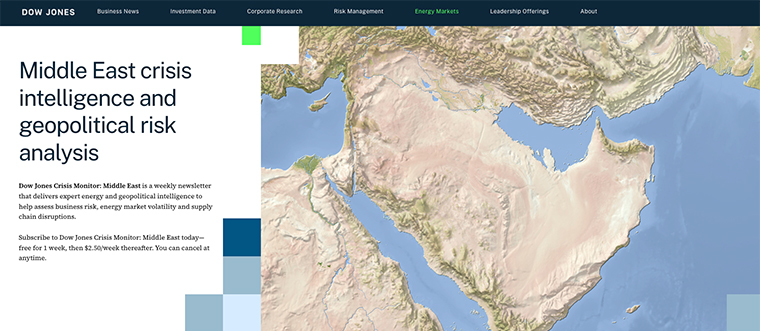
More than 100 colleagues contributed to the effort, and the product has continued to grow in subscriptions. However, the more interesting story is what the experience taught us about expertise, collaboration, and the role publishers can play during moments of uncertainty.
Lesson 1: Map the “layers of intelligence” already in your building
No single newsroom or standard dataset can adequately explain a sweeping global event. To provide true clarity, publishers must look across their entire ecosystem and synthesise different information streams.
While the framework varies for every publisher, at Dow Jones we identified five core layers of intelligence that were relevant to the Middle East crisis:
- Real-time news: verified, boots-on-the-ground reporting as events unfold.
- Physical commodity data: real-time metrics showing how supply chains and energy security are fluctuating.
- Risk intelligence: insights into regulatory exposure, geopolitical fracture points, sanctions, and business vulnerability.
- Financial market intelligence: tracking how global markets are actively pricing in uncertainty.
- Public trust journalism: the crucial translation layer that turns complexity into clear, actionable insight.
The competitive advantage in a crowded media landscape doesn’t just come from breaking news; it comes from synthesis. The capabilities often already exist within separate products or business units in your organisation. The challenge isn’t capability; it’s connection.
Lesson 2: Translate, don’t simplify, for the “prosumer”
One of the biggest operational hurdles in bridging enterprise data and consumer insights is maintaining data integrity while maximising accessibility.
When global volatility spikes, consumers don’t want a watered-down version of the facts. They want sophisticated analysis translated into a format that directly answers how tertiary impacts, like prices at the pump or travel disruptions, affect them.
To achieve this, editorial leaders must work side-by-side with subject-matter analysts. The goal isn’t to dumb down complex datasets; it’s to look at the data, pull out the key macro-economic themes, and contextualise why they matter to a broader audience.
By focusing on this translation layer, publishers can capture an incredibly valuable audience segment: the ambitious “prosumer” navigating both personal and professional financial impacts.
Lesson 3: The ultimate innovation is operational collaboration
Dow Jones Crisis Monitor: Middle East moved from concept to launch in nine days because colleagues were willing to work differently. Teams from Dow Jones Risk, Dow Jones Energy, The Wall Street Journal, Barron’s, product, technology, marketing, and audience development came together around a common objective: rapidly deploying a product to help readers understand a complex and evolving situation.
Moving a subscription product from concept to launch in just over a week isn’t just a technological feat — it’s also an organisational one.
Too often, media organisations allow extraordinary expertise to sit trapped inside isolated brands, paywalls, or business divisions. But a crisis does not arrive neatly packaged as just an energy story, a compliance story, or a financial markets story. It arrives as all three simultaneously.
Audiences do not experience the world in silos, and publishers can no longer afford to operate in them. Breaking down the walls between B2B and B2C teams requires a unified, non-siloed objective. When product, technology, marketing, and editorial teams rally around a singular market need, legacy roadblocks disappear.
A blueprint for future agility
Today, the newsletter remains a response to a specific moment. Whether it evolves into something larger remains to be seen. What it has already demonstrated is the power of bringing expertise together when audiences need it most.
Energy underpins the global economy. Geopolitical events increasingly ripple across industries, markets, and households with remarkable speed. The need for trusted interpretation will only grow.
For publishers, the lesson is straightforward: In an era of limitless information, competitive advantage comes from expertise, synthesis, and the ability to connect dots others cannot.
Many organisations already possess those capabilities. The opportunity is finding new ways to bring them together in service of the audience.
Banner photo: Adobe stock by PhotoJuthamat.
Related Articles
-

Marketers should outsource tasks, not thinking
25 October 2026 -

AI is now media’s operating environment
28 September 2026 -

5 lessons from the INMA Young Audiences Summit
28 September 2026 -

Agents, liquid content, vibe coding raise questions for news me...
9 September 2026 -

What I told 40 CEOs (and won’t gatekeep from you)
30 August 2026 -

With Düsseldorf geht aus, Rheinische Post brings local gastrono...
14 July 2026 -

AI adoption in newsrooms should move from experiment to strateg...
12 July 2026 -

With The B‑Side, Boston Globe scored an A+ with young audiences
10 June 2026
Upcoming Events
-

Subscriber Acquisition Master Class
10-17 November 2026
-

Media Advertising Summit
New York, United States
07-10 December 2026
-

AI-Native News Product Master Class
18-25 February 2027
-

Media Subscriptions Summit
Oslo, Norway
08-12 March 2027
-

World Congress of News Media
New York, United States
25-30 April 2027
-

Branded Content & Partnerships Master Class
20-27 May 2027
-

Subscriber Retention Master Class
17-24 June 2027
-

Conferencia Latinoamericana
15-16 July 2027
-

South Asia News Media Festival
New Delhi, India
19-22 July 2027
-

Asia/Pacific News Media Summit
19-20 August 2027
-

CEO Roundtable at Kilkenny
Kilkenny, Ireland
24-26 August 2027
-

Media Innovation Week
Amsterdam, The Netherlands
27 September - 01 October 2027








