

With The B‑Side, Boston Globe scored an A+ with young audiences
Young Audiences Initiative Blog | 10 June 2026

When The Boston Globe wanted to reach young audiences, it knew it needed more than just a new approach; it needed an entirely new product.
During this week’s Webinar, INMA members heard from Emily Schario, head of content and editorial co‑founder of The B‑Side, Boston Globe’s youth-centric newsletter that has grown beyond being a mere product and has become a community of its own.

The newsletter began as an idea pitched during Boston Globe Media’s internal Innovation Day. At the time, Axios Local and 6AM City were expanding rapidly, and Globe leadership wondered why a national startup should own the “daily local newsletter” space in Boston.
“The pitch was to create a daily newsletter product that does two things: it reaches new audiences — which is code for ‘young people’ — and it also drives new revenue streams,” she explained.
In 2022, The Globe brought Schario on board to build the product from scratch: voice, tone, editorial vision, and audience strategy. She was 26, had never written a newsletter, and was given what she described as “the keys to a kingdom that hadn’t yet been built.” But she had something more important than experience: clarity about the problem The B‑Side needed to solve.
The pain points of young audiences
The B‑Side was built around three core audience pain points Schario identified early on:
- Reliable local news is hard to access. Young people want local information, but much of it sits behind paywalls or is scattered across platforms.
- Being informed feels exhausting. “I have friends who actively tune out of being informed because it’s too depressing,” Schario said.
- Influencers provide information but aren’t always trustworthy. Younger audiences enjoy content delivered by influencers, but “there’s a lack of transparency there. [Influencers] are sometimes paid to advertise things.”
The B‑Side’s solution was to mash-up the accessibility and personality of influencer content with the ethics and editorial guidelines of The Globe newsroom. The newsletter was designed to be free, easy to read in five to seven minutes, and steer clear of national news, crime and politics.
Before the first edition ever went out, Schario created a detailed persona: “Madison Sousa,” a 20‑something living in Brighton, earning US$65,000, working in marketing, and looking for ways to enjoy the city without breaking the bank.
“If you’re trying to talk to everybody, you end up talking to nobody,” Schario said. And so every editorial decision was made with Madison in mind — and the real audience that followed closely matched the persona.
Serving a milkshake with spinach
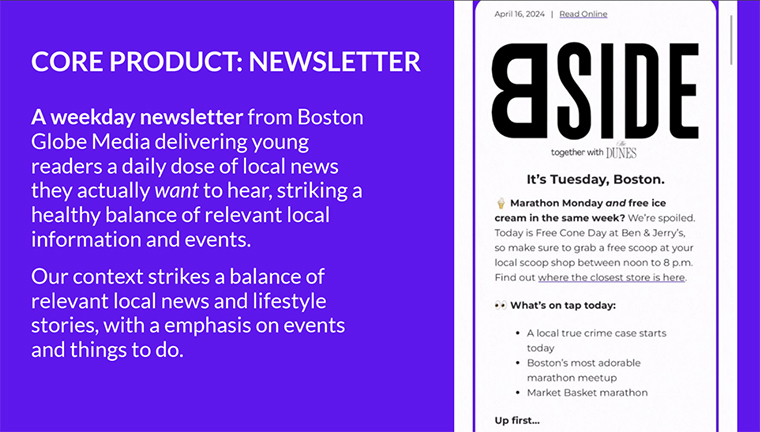
The B‑Side has a distinct style: It’s a little snarky, sometimes irreverent, and is written like a friend talking to the reader. It avoids national politics and crime; in fact, if a story can’t be written in The B‑Side’s voice without sounding flippant, it doesn’t run.
The format offers a 450‑word lead story, four quick‑hit headlines, a daily reader poll, listings of things to do and a “one last thing” surprise‑and‑delight item. This mix, Schario pointed out, is deliberate, and amid the fun, breezy content, they slip in just enough local news to keep readers informed without overwhelming them.
Schario refers to it as “a milkshake with some spinach in it” — it gives readers the editorial equivalent of tasty snacks, but slips in a little nutrition: “Most of the stuff that you’re getting is stuff … you want [and] you end up eating the spinach, too,” she said. “So you’re walking away with a more balanced diet, I’d say.”
Getting social
With nearly 100,000 followers across Instagram and TikTok, social is both a distribution channel and a personality engine for The B-Side.
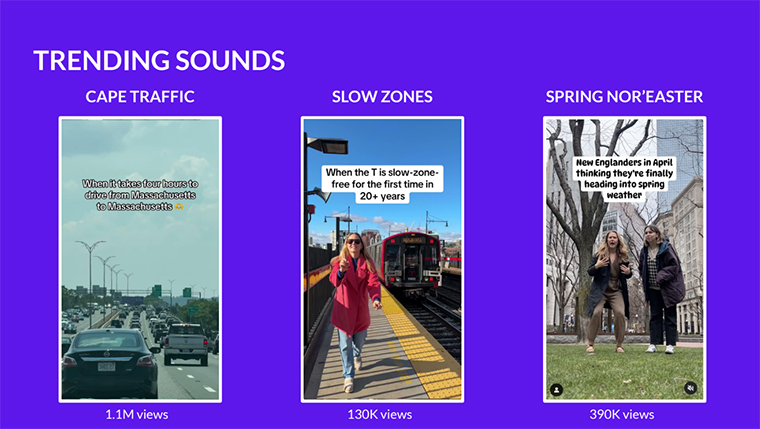
The B-Side uses static memes, trending TikTok sounds, and 60‑second mini‑features showcasing things to do.
As the face of the brand, Schario is often front and centre in the features, as proven by the video she shared of her churning butter while running up Heartbreak Hill to explain the Boston Marathon route a blend of trend, personality, and useful information. “We’re trying to make local news approachable and relatable and human‑centred,” she said.
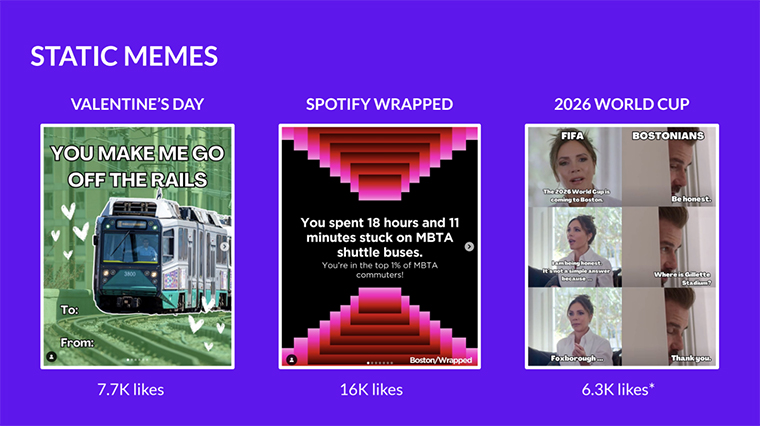
“Again, at the centre of everything, it’s humour, relatability, and authenticity. You hook them with that and then in the caption is where you follow up with that meaningful information.”
Getting down to business
Of course, it’s not all fun, games, and social media; The B‑Side is designed to sustain itself financially. Schario explained the revenue comes from:
- Native advertising: Brands buy placements written in The B‑Side’s voice, making ads feel organic rather than intrusive.
- Social branded content: Instead of having Schario endorse products directly, The B‑Side often partners with local influencers to maintain editorial integrity.
- Membership: For US$7/month or US$70/year, members get access to exclusive events, discounts, a bonus Saturday newsletter, eight paywall‑free Boston Globe links, and access to popular “Supper Club” dinners, where “we take about 12 to 20 B-Side members out to a really hot restaurant around Boston.” The event is a chance for members to meet each other, hang out with The B-Side crew, and strengthen connection with the brand. Membership launched just a year ago and already has 1,000 paying members.
“Part of the decision of creating a membership programme on the business side at least is it’s also about diversifying revenue streams. Advertising can be very fragile, depending on the state of the economy,” she pointed out.
“So if you can have that direct line of subscriber support, it’s only going to add a better foundation.”
In just four years, The B‑Side has amassed more than 60,000 subscribers and boasts about a 60% open rate with a 5% click‑through rate. The audience is primarily 25-34, with about 65% of it skewing female. Not only are the numbers impressive, but they’ve been achieved with a lean team of five.
Schario’s presentation was a reminder for publishers to look for real audience problems to solve and then focus on them without distraction. The B-Side came to life as a solution to provide young audiences with something the Boston Globe didn’t offer and by building a distinct persona and focusing exclusively on it, the newsletter and its voice have remained consistent. Beyond that, she emphasised that new initiatives like this cannot survive and thrive without such focus and attention.
“[Publishers] need to ask themselves: Do I have somebody’s undivided attention on this that can go dive fully into it and that is their responsibility? Things like this cannot succeed if they’re a side project,” she said. “You need to be very intentional about it.”
Related Articles
-

AI’s effect on super user math
15 September 2026 -

What I told 40 CEOs (and won’t gatekeep from you)
30 August 2026 -

At Mediacorp’s CNA, loyalty means giving audiences a reason to ...
20 August 2026 -

Tribun Network turns print “dots” into AI-powered insight
20 August 2026 -

Indian Express builds a video-first future around trusted journ...
20 July 2026 -

Economist launches subscription tier targeting younger audience...
20 July 2026 -

Grupo RBS builds social-first video operation to expand audienc...
20 July 2026 -

Inside Denník N’s successful subscription strategy
15 July 2026
Upcoming Events
-

Subscriber Acquisition Master Class
10-17 November 2026
-

Media Advertising Summit
New York, United States
07-10 December 2026
-

AI-Native News Product Master Class
18-25 February 2027
-

Media Subscriptions Summit
Oslo, Norway
08-12 March 2027
-

World Congress of News Media
New York, United States
25-30 April 2027
-

Branded Content & Partnerships Master Class
20-27 May 2027
-

Subscriber Retention Master Class
17-24 June 2027
-

Conferencia Latinoamericana
15-16 July 2027
-

South Asia News Media Festival
New Delhi, India
19-22 July 2027
-

Asia/Pacific News Media Summit
19-20 August 2027
-

CEO Roundtable at Kilkenny
Kilkenny, Ireland
24-26 August 2027
-

Media Innovation Week
Amsterdam, The Netherlands
27 September - 01 October 2027








