

Hamburger Abendblatt unlocked a 20% subscription uplift with weekly price framing
Ideas Blog | 14 June 2026


Like most news publishers, Hamburger Abendblatt faces a familiar tension: how do we grow digital subscriptions while protecting ARPU — especially when prices are going up?
Our paywall historically communicated follow-up prices as monthly rates, a convention that seems logical from a billing perspective but may feel like a substantial financial commitment to readers. At the same time, we were planning a price increase for our flagship digital offer. We needed a way to make that increase palatable without eroding conversion.
This is the story of how a simple change in price framing — from monthly to weekly communication — delivered a 20% subscription uplift, even while the underlying price rose by 9.4%.
Necessary price increase = real behavioural risk
Paid content providers live between two pressures: reader price sensitivity and the rising cost of journalism and technology. At Hamburger Abendblatt (a Funke brand), our default follow-up price on the paywall was €9.90 per month after the introductory period.
We wanted to move to a new follow-up price of €130 per year, billed every four weeks — effectively a 9.4% increase over the previous annualised price of €118.80. The commercial rationale was strong; the behavioural risk was not. Any price increase can depress response, but an increase that is also framed as a “big monthly number” felt particularly exposed.
So we asked: could we change price perception without discounting?
Smaller units, smaller perceived commitment
Our hypothesis had three parts:
- Presenting follow-up prices as weekly amounts would feel like a lower commitment than monthly prices, even when the annual total increased.
- This improved price perception could offset the negative impact of the higher price.
- The net effect would be a higher conversion rate across subscription plans.
In short: if you tell readers they pay €2.50 per week rather than €9.90 per month, more people might say “yes,” even though the publisher earns more money per year.
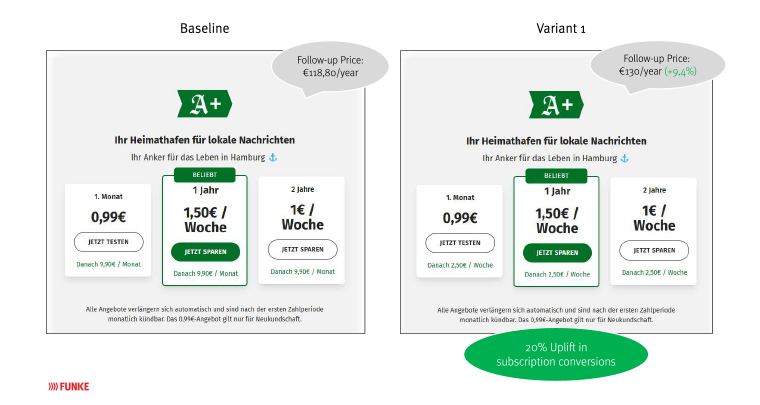
A/B testing weekly vs. monthly framing
We designed a paywall A/B test on abendblatt.de that ran October 6-27, 2025. The introductory offer remained the same in both variants: the first month at €0.99. After that, we diverged only in how we communicated the follow-up price.
- Baseline (control): Follow-up price communicated as €9.90 per month, with monthly billing, equivalent to €118.80 per year.
- Variant (weekly framing): Follow-up price communicated as €2.50 per week, billed every four weeks, equivalent to €130 per year (+9.4%).
Both experiences offered the same three commitment lengths — one month, one year, and two years — and kept the overall UI and promotional copy identical. Only the way we expressed the follow-up price changed.
The results
The test outcome was unambiguous. At a 1% significance level, the weekly-price variant delivered a 20% increase in overall subscription conversions compared with the monthly-price baseline.
- Baseline: 363 total subscriptions.
- Variant: 437 total subscriptions.
Crucially, the uplift was broad-based:
- We saw improvements across monthly, one-year, and two-year options.
- Long-term plans, which are strategically important for retention and revenue, showed particularly strong gains.
In other words, readers opted into more expensive annual value when the price was framed weekly.
Aligning billing logic with consumer psychology
Our test did not change the product, the introductory price, or the user journey. It changed only how we asked for money.
Weekly framing likely worked for several behavioural reasons:
- Narrower numbers: €2.50 is cognitively smaller than €9.90, even though they represent similar time spans.
- Mental budgeting: People often think in weekly patterns (groceries, commuting, streaming services), so a weekly subscription fits naturally into that mental model.
- Anchoring the value: “€1 per week for 2 years” feels like a low price for daily local journalism; the annual number might feel more daunting.
By aligning with how readers intuitively think about recurring expenses, we were able to raise the actual price while increasing both conversion and projected revenue.
What this means for publishers
For INMA members, the lesson is straightforward but powerful: Before you discount, experiment with how you frame the price.
Price points, billing periods, and psychological anchors all interact. Our experience shows that you can sometimes “have it both ways”: improve customer value perception and protect ARPU.
Going forward, we are exploring:
- Testing weekly vs. monthly framing in other markets and verticals.
- Combining price framing tests with offer positioning (e.g., highlighting savings vs. flexibility).
- Measuring the long-term retention impact of readers who joined through weekly-framed offers.
In a world where direct reader revenue is central to the sustainability of journalism, these kinds of pricing experiments are not merely tactical tweaks. They are strategic levers for growth.
This blog post was drafted with the assistance of a language model (LLM) and reviewed by the team for accuracy and completeness.
Related Articles
-

Bundling is a pricing decision, rebundling is an organisational...
18 October 2026 -

Sports brand AS cannot sell subscriptions, so it sells scale
21 September 2026 -

AI’s effect on super user math
15 September 2026 -

Tribun Network turns print “dots” into AI-powered insight
20 August 2026 -

How the Daily Maverick built a reader revenue engine on trust
5 August 2026 -

Milenio builds loyalty infrastructure with gamification, data, ...
23 July 2026 -

Inside Denník N’s successful subscription strategy
15 July 2026 -

Bonnier News Local, Gota Media strike gold with their Core Mode...
21 June 2026
Upcoming Events
-

Subscriber Acquisition Master Class
10-17 November 2026
-

Media Advertising Summit
New York, United States
07-10 December 2026
-

AI-Native News Product Master Class
18-25 February 2027
-

Media Subscriptions Summit
Oslo, Norway
08-12 March 2027
-

World Congress of News Media
New York, United States
25-30 April 2027
-

Branded Content & Partnerships Master Class
20-27 May 2027
-

Subscriber Retention Master Class
17-24 June 2027
-

Conferencia Latinoamericana
15-16 July 2027
-

South Asia News Media Festival
New Delhi, India
19-22 July 2027
-

Asia/Pacific News Media Summit
19-20 August 2027
-

CEO Roundtable at Kilkenny
Kilkenny, Ireland
24-26 August 2027
-

Media Innovation Week
Amsterdam, The Netherlands
27 September - 01 October 2027








