

Sports brand AS cannot sell subscriptions, so it sells scale
Conference Blog | 21 September 2026

On one floor of Prisa Media’s Madrid headquarters, El País has built a digital subscription business of roughly 490,000 subscribers behind a paywall that changes its rules by country. One floor away, Diario AS — the group’s sports title and one of thw two most dominant names in Spanish sports media — has no paywall at all. And the executives who run it aren’t convinced it will ever get one.
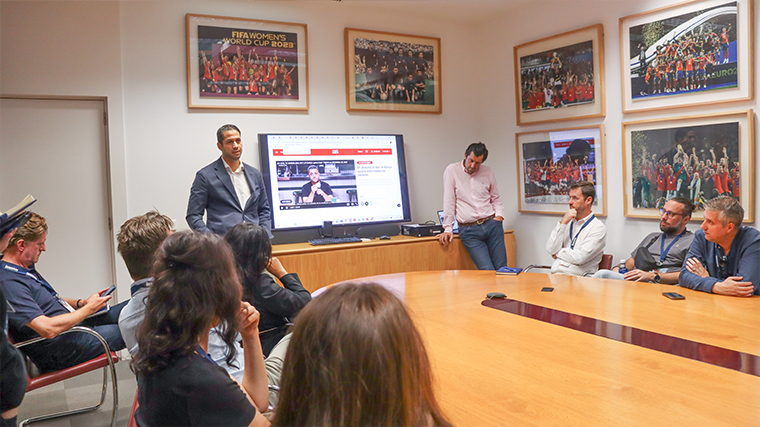
The gap between those two answers was the most instructive thing about the Prisa Media stop on the opening day of INMA’s Madrid study tour, a two-day programme of newsroom visits that opened Media Innovation Week for 25 news media executives.
Ana Ormaechea, digital product manager at Prisa Media, raised the question before anyone in the visiting group could:
“It’s really different from other countries, such as Italy or France, that sports newspapers are under subscription,” she said. “In Spain, no. The two biggest, that are AS and Marca, they are open, both of them.”
Whether they will eventually go behind a paywall, she added, is a perennial discussion.
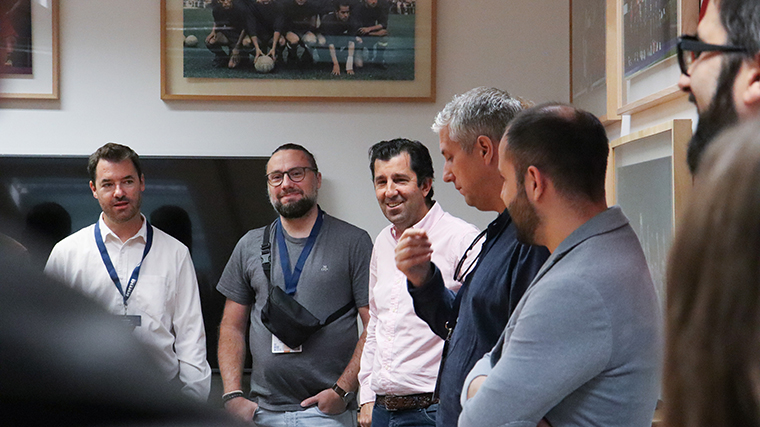
Tomás de Cos, deputy director of strategy at Diario AS, explained why it continues to be a conversation.
“It’s always in the landscape, but it’s not a real thing today because here we have a different sports media ecosystem,” he said. “We have more than four sports media legacy: Marca, Diario AS, Diario Sport, and Mundo Deportivo. And two or three digital players more and probably the most competitive ecosystem in sports media in the world. It’s quite different to Italy or France.”
The structural point matters for any publisher weighing a paywall on a secondary brand. In a market with one dominant sports title, putting the content behind a paywall is a decision about pricing. In a market with four legacy sports dailies and a handful of digital challengers, it is a decision about handing the audience to three rivals who have kept their open.
De Cos still lists a potential subscription model among the brand’s goals. It sits behind everything else.
Ad revenue and audience expansion
What AS built instead began with advertising, not readers.
Its international expansion — a Latin American edition in 2013, then newsrooms in Chile in 2014 and in Colombia, Mexico, and for U.S. Hispanic readers across 2015 — was driven by a revenue problem rather than an audience one.
“We had a huge amount of audience out of Spain but without income,” de Cos said. “We are searching for readers but mostly important advertisers. If you want to have new clients in the advertising industry, you have to be local.”
Local, in practice, means locally made. “Mexican content, written or generated for Mexicans,” de Cos said, “filtered by a Mexican, too. This is the key to success.”
That approach now supports seven digital editions in Spanish and English, 57 million monthly unique browsers, around 800 million monthly page views, and more than 38 million social followers. De Cos said AS ranks first among Spanish-language sports websites worldwide and first in Spanish-language sports media in the United States, where it sits 12th in Comscore's general sports ranking.
Social expansion
The second strategy is social, and it is a response to pressure rather than an opportunity.
“We are suffering a lot with the Google strategies,” said Aloysio Araujo de Albuquerque, chief sports officer at Prisa Media. “All the live matches, we are losing a lot of traffic, direct traffic in the Web, so we are trying to get all the audience by social and combine both audiences.”
The numbers suggest the substitution is holding. AS recorded 3.5 billion social video views in July during the World Cup and climbed 10 positions in the US ranking over the summer. Crucially, the revenue followed.
“We have doubled the revenues this year in social, and idea is to at least increase 50% next year,” Albuquerque said — and not by charging more for the same inventory. Asked whether higher CPMs were closing the gap, he was blunt: “Not increasing CPMs. The idea was to increase branded content, social branded content.” Advertising revenue is rising this year even as Web site traffic falls.
Brand expansion
Print, meanwhile, has become something other than a business. Daily sales have fallen to between 20,000 and 25,000 from a peak around 200,000.
“Print edition today doesn’t help us be a profitable business,” de Cos said. “But at the same time, the print edition is very important in terms of awareness, marketing, and things like that. So it’s not easy to close. But it’s difficult to have this legacy and try to go fast to the future at the same time.”
Where this leads is a reorganisation of the group around the brand rather than the newspaper. Prisa is moving to a matrix structure, with product, technology, and marketing shared across titles, and sports social strategy now managed as one operation spanning AS, the group’s Latin American and Spanish radio stations, and the football social publisher PostUnited.
“According to our strategic plan, AS should be the sport brand of Prisa,” Albuquerque said. “Right now, it’s not like that, but we are moving to this, pushing the brand of AS everywhere.”
For a title that cannot charge for its journalism, the brand is the asset being monetised.
Related Articles
-

WSJ executive councils show how publishers build communities th...
19 October 2026 -

Bundling is a pricing decision, rebundling is an organisational...
18 October 2026 -

AI’s effect on super user math
15 September 2026 -

At Mediacorp’s CNA, loyalty means giving audiences a reason to ...
20 August 2026 -

Tribun Network turns print “dots” into AI-powered insight
20 August 2026 -

Indian Express builds a video-first future around trusted journ...
20 July 2026 -

Economist launches subscription tier targeting younger audience...
20 July 2026 -

Grupo RBS builds social-first video operation to expand audienc...
20 July 2026
Upcoming Events
-

Subscriber Acquisition Master Class
10-17 November 2026
-

Media Advertising Summit
New York, United States
07-10 December 2026
-

AI-Native News Product Master Class
18-25 February 2027
-

Media Subscriptions Summit
Oslo, Norway
08-12 March 2027
-

World Congress of News Media
New York, United States
25-30 April 2027
-

Branded Content & Partnerships Master Class
20-27 May 2027
-

Subscriber Retention Master Class
17-24 June 2027
-

Conferencia Latinoamericana
15-16 July 2027
-

South Asia News Media Festival
New Delhi, India
19-22 July 2027
-

Asia/Pacific News Media Summit
19-20 August 2027
-

CEO Roundtable at Kilkenny
Kilkenny, Ireland
24-26 August 2027
-

Media Innovation Week
Amsterdam, The Netherlands
27 September - 01 October 2027








